

Greetings!
The future may be powered by artificial intelligence, but it still depends on very human intelligence to navigate it well.
In today’s Advice for the Good Life, we look beneath the surface of the AI boom—beyond the chatbots and headline-grabbing technology stocks—to explore the enormous ecosystem of semiconductors, data centers, software, and infrastructure making it all possible. For investors, the opportunity is significant, but so are the expectations already reflected in many valuations. As always, perspective matters.
Then, Christine Despres, our Wellness Navigator, turns from artificial intelligence to the original operating system: your brain. If summer travel has left you feeling like you need a vacation from your vacation, she shares practical ways to reset your body clock, restore your energy, and get your brain back in sync.
Thank you, as always, for spending a few minutes of your week with us. I hope you enjoy today’s edition—and if you find something worthwhile, please subscribe and share it with someone who might benefit as well.
All the best,

To schedule a 15 minute call, click here.
Wealth Advisory: Understanding the AI Value Chain—Semi-Conductors, Data Centers, and What It Means for Investors
In today’s world, computers and smartphones are taken for granted as essential tools of daily life. Yet behind these devices lies extraordinary engineering complexity, supported by intricate global supply chains that enable the production of millions of units.
Artificial intelligence (AI) follows a similar pattern. Using a chatbot may feel effortless, but an elaborate value chain underpins the ability of anyone with a connected device to access capabilities that would have seemed like science fiction just a decade ago. Generative AI and large language models (LLMs) have emerged as among the most consequential themes shaping financial markets and the broader economy. For this reason, developing a wider understanding of AI that extends beyond a handful of technology stocks has become increasingly important.
There is little question that AI represents a transformational shift. Even so, forecasting demand or anticipating how this technology will reshape businesses, workers, and productivity over the coming years remains a significant challenge. For investors, that uncertainty can complicate the task of valuing companies, sectors, and the broader stock market. Gaining a clearer picture of AI’s impact while keeping a long-term perspective in view is therefore a worthwhile pursuit.
The entire AI supply chain is supporting markets
One of the most valuable insights for investors is that “AI” does not refer to a single category of investment. It is natural to focus on the model providers at the center of these capabilities, such as OpenAI, Anthropic, Google, and others, but they represent only one piece of a much larger picture. A complete supply chain spans a wide range of activities, industries, and business models, each carrying its own characteristics and risks. This includes hardware manufacturers, data center operators, software providers, and more.
At the base of this chain sits the semiconductor hardware that makes everything possible. Hardware such as GPUs and memory chips is required at two distinct stages. The first is model training, the process of building LLMs by processing vast quantities of data across thousands of interconnected servers over weeks or even months.
The second stage is known as “inference,” which refers to the actual deployment of these models by individuals and organizations. Every prompt submitted requires computational power and memory resources to produce a response. The combined demands of training and inference have driven a sharp rise in demand and prices for this hardware, contributing to elevated market valuations.
As this hardware scales up to meet growing demand, data centers become critical. A data center can be pictured as a vast warehouse filled floor to ceiling with servers operating around the clock, requiring robust security, continuous power, and sophisticated cooling systems. Taken together, these facilities represent the enormous physical and operational resources dedicated to making AI applications accessible.
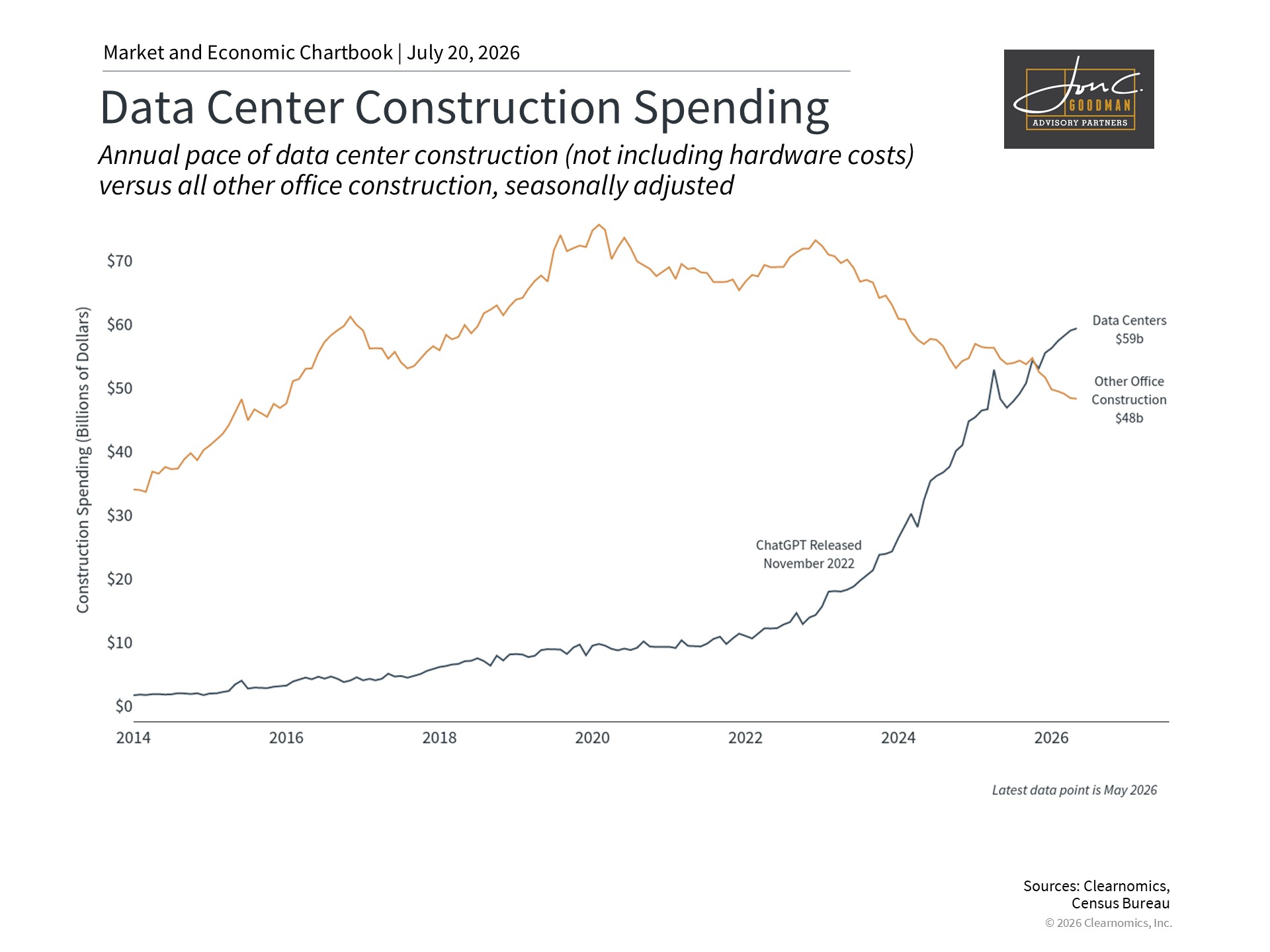
Spending on data centers has grown into a meaningful contributor to overall economic activity. The chart above illustrates construction expenditure on data centers, excluding IT hardware costs. This spending clearly accelerated following the launch of ChatGPT in late 2022 and has since surpassed all other categories of office construction. It is worth noting that not all of this growth stems directly from AI. Broader technology adoption and automation, particularly since 2020, have also fueled greater demand for computational resources.1
Beyond the infrastructure layer, businesses are incorporating AI both for internal purposes and as the foundation for new software applications. Evaluating this segment remains perhaps the most difficult task, as it depends on how effectively companies can translate AI capabilities into genuine productivity improvements and product enhancements. Questions around how AI integrates with existing software platforms, and how those platforms will evolve, have been a notable source of market uncertainty over the past year.
Investors are weighing whether large investments will pay off2
A central question for investors today is whether the hundreds of billions of dollars being directed toward AI infrastructure will ultimately generate adequate returns. The scale of investment, particularly from the largest technology companies, makes this a genuinely difficult question to answer. The demand for computing power required to train and operate AI models has been substantial, benefiting hardware providers and data center operators. At the same time, as models continue to improve, they may also become more efficient, potentially reducing the computing power needed for any given task.
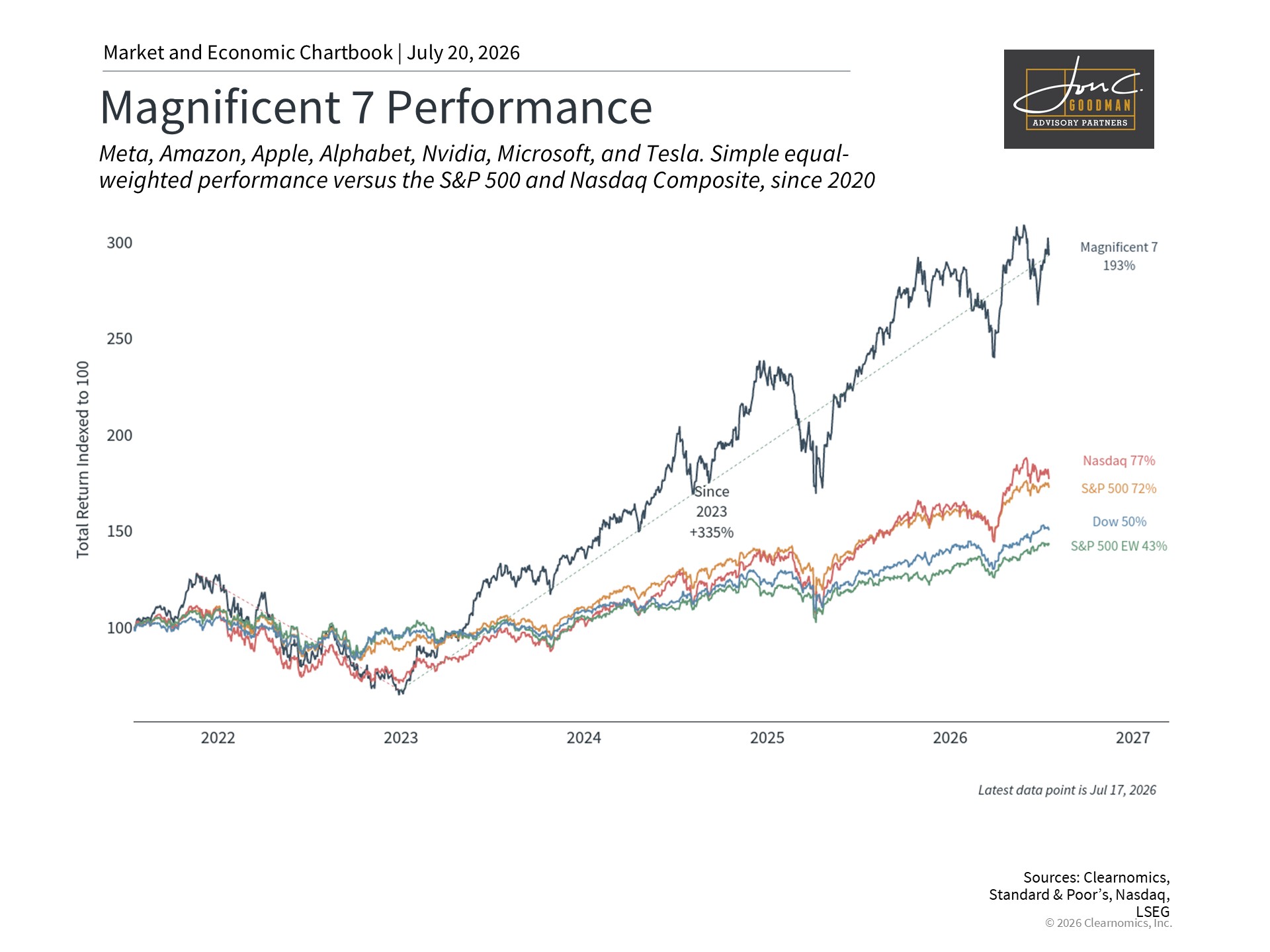
This uncertainty helps account for some of the volatility seen in AI-related stocks. As the accompanying chart illustrates, mega-cap technology stocks have posted strong returns over the past several years, but with considerable swings along the way. Because building new data centers takes time, periods of optimism about infrastructure spending have been followed by periods of concern about whether demand will be sufficient to justify those commitments.
Since early 2025, for instance, investors have grown concerned about more efficient AI models that could reduce the need for computing power. History, however, offers an important counterpoint. Efficiency gains associated with new innovations do not always translate into lower overall demand, a dynamic commonly referred to as the “Jevons paradox.” In many cases, technology that becomes cheaper and more capable leads to broader adoption and entirely new applications. Electricity, after all, is no longer just for light bulbs, and computers are no longer the exclusive domain of large enterprises.
At the same time, markets have a well-established tendency to overestimate how quickly new technologies begin generating profits, even when their long-term potential is genuine. The enthusiasm that surrounded internet stocks in the late 1990s and early 2000s took decades to fully materialize into sustained earnings. This is why maintaining not only a broader view of the companies participating in AI, but also a long-term perspective as the technology and its demand profile continue to evolve, remains so important.
Valuations reflect high expectations
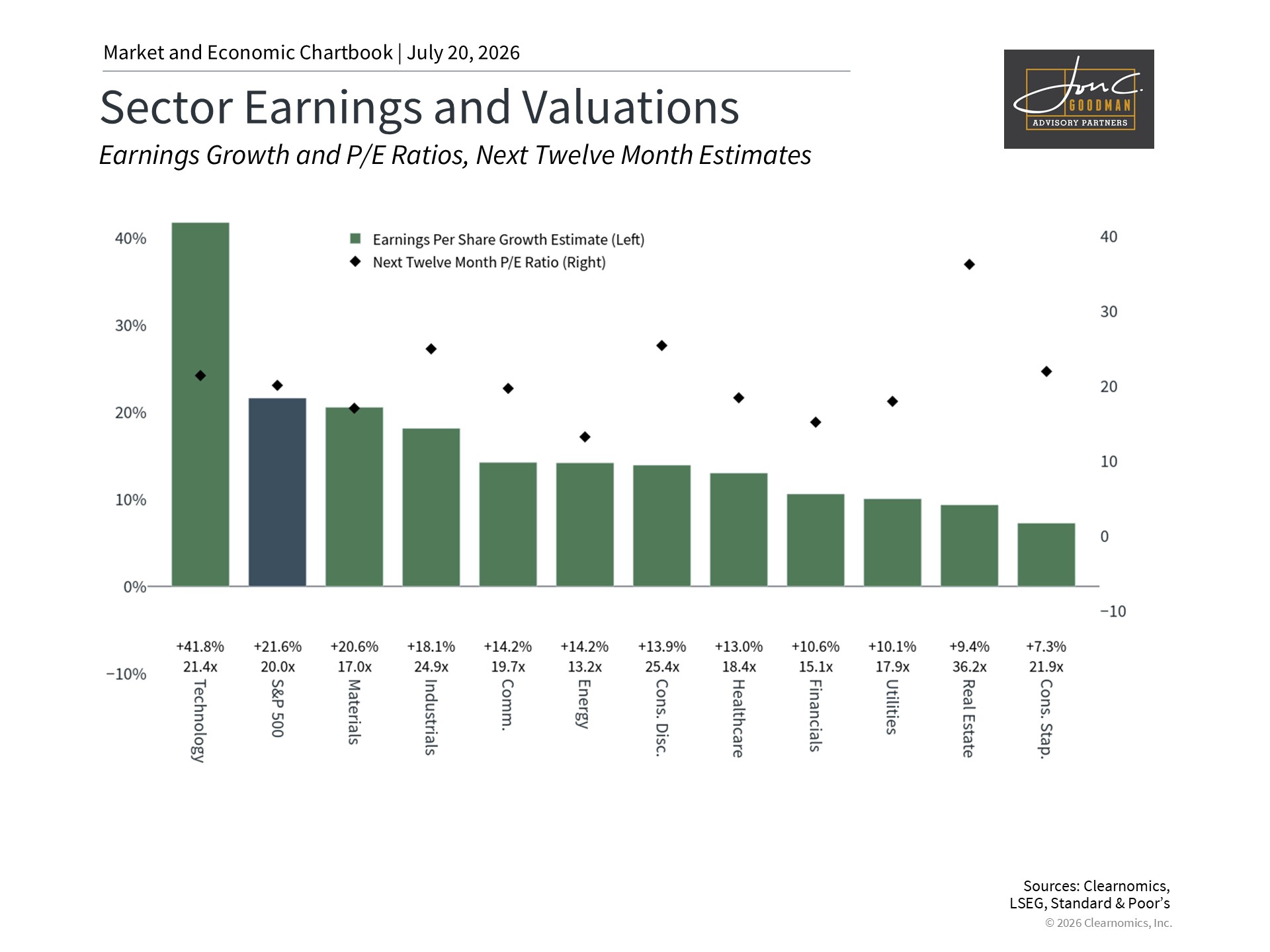
As AI has captured investor attention, valuations across many technology companies have climbed steadily. As the chart above shows, Information Technology sector valuations, at 21.4x, are elevated relative to both their own historical range and the broader market. The same pattern holds for sectors such as Communication Services and Consumer Discretionary, which also include large technology companies. It is worth noting that these valuations reflect strong earnings growth driven by rising demand for AI capabilities.3
It is important to keep in mind that valuations are not a reliable tool for predicting near-term market direction. Rather, they can inform decisions about the appropriate mix of assets within a portfolio, particularly when aligning investments to specific financial goals. While AI trends offer meaningful opportunities for growth, many other sectors carry attractive valuations and similarly strong earnings growth expectations. As always, the key is to maintain perspective, balancing exposure to the AI theme with other areas of the market in pursuit of long-term financial objectives.
The bottom line? The trends driving AI extend well beyond a handful of technology companies. While these themes are shaping markets, maintaining a broader perspective and a longer time horizon, with a focus on long-term financial goals, remains essential.
References
- https://www.census.gov/construction/c30/c30index.html
- The Magnificent 7 companies include Meta, Amazon, Apple, Alphabet, Nvidia, Microsoft, and Tesla. Data as of July 17, 2026
- Clearnomics research and LSEG data as of July 17, 2026

Wellness Navigator and Holistic Brain Health Coach, Christine Despres, RN, NBC-HWC, CDP
Home From Your Trip? Your Brain Isn’t Yet
No amount of melatonin fixes that first night home. Your brain’s master clock, the one that controls your sleep, energy, and body temperature rhythms, is still set to a different time zone. That mismatch throws off cortisol, melatonin, and body temperature rhythms, the same systems that control how clearly you think. Here is the recovery plan that helps you bounce back as efficiently as possible.
Hydrate hard
You did not get enough water on planes, trains or in the heat. Push coconut water, water and electrolytes. An IV with a Myers cocktail and glutathione is never a bad idea if you want to support your liver and bounce back quickly.
Move gently
You’re exhausted, but you still need blood flow. Legs up the wall, gentle yoga, stretching and a weighted walk help your body regroup after strange beds and days of travel.
Support your gut and liver
Lemon water on waking. Dandelion, peppermint, chamomile and green tea. Fermented foods like kombucha and miso. Limit dairy and gluten for a few days. Green juice, celery juice and bone broth all help. A mini cleanse, even just in the mornings, gets things back on track faster.
Get morning sunlight
This is essential!! Skip the sunglasses. Bright light in your eyes tells your internal clock what time zone you’re really in now, so it can start syncing your hormones and sleep cycle back to normal.
Sweat it out
A sauna or steam session supports circulation and detox while your body recalibrates. Even fifteen minutes helps you feel human again.
Brain Benefit
Jet lag disrupts more than sleep. It temporarily interferes with the glymphatic system, the process that clears metabolic waste from your brain overnight. That is part of why jet lag brain fog feels so real. Supporting your body through hydration, light, a good night’s sleep in your own bed and gentle movement helps your brain recover its clarity faster, not just your energy.
Give your body a few days. It knows how to recalibrate. Your job is just to support it.
This isn’t just a jet lag protocol. It can be for any trip, vacation, music festival or whenever you just need to support your body a little extra. It’s a recovery program you can repurpose for life.
Rest up,
Christine
The Wellness Navigator | Brain & Metabolic Wellness Coach | RN, NBC-HWC, CDP
P.S. And if you’re ready to start investing in your greatest asset, I’d love to be your guide.
👉 Book a free Brain Health Strategy Session here: Click Here to Schedule Your 30 minute Strategy Call