
Greetings!
This week’s Advice for the Good Life brings perspective across markets, mind, and meaning—three areas that, together, shape how we build and experience wealth.
In this week’s Wealth Advisory, we break down the often-overlooked role of the U.S. dollar—and how its movements ripple through international stocks, gold, and your global portfolio. With shifting leadership across markets and currencies quietly doing their work, understanding these relationships can help keep your plan grounded and properly diversified.
Next, our Wellness Navigator, Christine Despres offers a refreshingly honest take on stress during Stress Awareness Month. This isn’t about adding more to your plate—it’s about understanding how your brain actually works, interrupting unhelpful patterns, and building resilience from the inside out.
And in Etcetera, we zoom out—way out—with 10 things you may not know about NASA’s Artemis mission. Because sometimes the best way to gain clarity on what matters most…is to look beyond what’s right in front of us.
As always, enjoy, share with someone who could benefit, and subscribe if you haven’t already.
Wealth Advisory: How the US Dollar, Gold, and International Stocks Impact Your Global Portfolio
Global financial markets have been shaped by a confluence of forces, including elevated oil prices, geopolitical developments, and evolving tariff policies. Yet underlying many of these dynamics is the value of the U.S. dollar. Although currency movements have attracted less headlines recently, they continue to exert significant influence on portfolios — affecting international investments, commodities such as gold, and the broader economic landscape.
A notable development over recent years has been the dollar’s retreat from its 2022 peak. More recently, it has staged a partial recovery, reflecting its traditional role as a safe-haven currency during periods of global uncertainty. What does this mean for investors, and how does it connect to international equities and precious metals? Gaining clarity on these relationships can help investors stay grounded and keep portfolios aligned with their long-term financial goals.
Three key facts investors should understand about the dollar
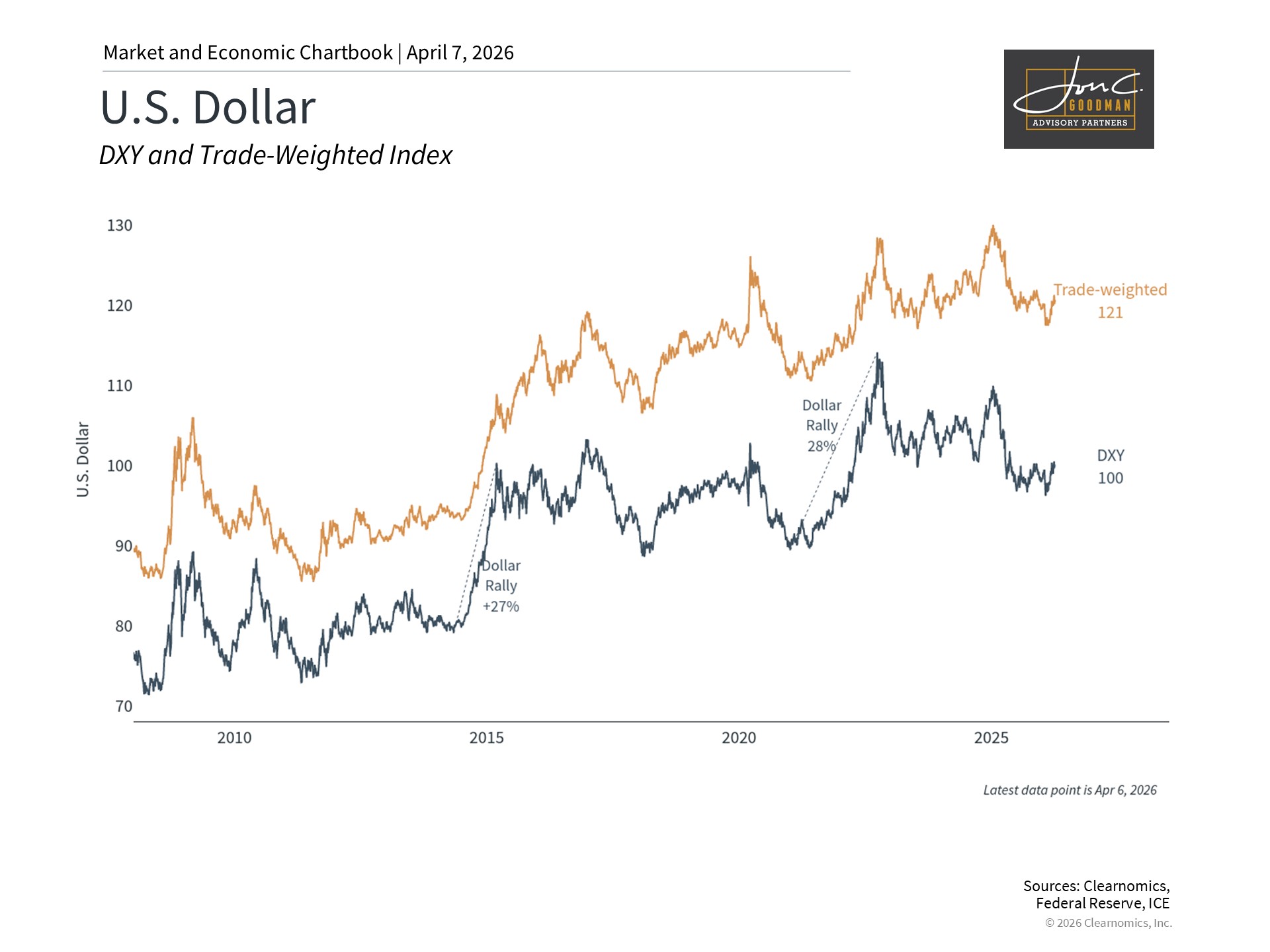
After peaking near 114 on the dollar index (DXY) in 2022, the dollar began to weaken as global growth stabilized and investors sought opportunities beyond U.S. assets. That trend accelerated last year when tariffs pushed the dollar below 100 for the first time in three years. The currency has since partially recovered in 2026, driven by investor demand for safe-haven assets amid heightened geopolitical concerns. Viewed over a longer horizon, the dollar remains stronger than its historical average, even if it sits below its all-time high.
There are three important considerations for investors when evaluating the dollar’s role in today’s market environment. First, a stronger dollar is not always advantageous. For everyday consumers, a favorable exchange rate is appealing as it lowers the cost of imported goods and international travel. However, this is only part of the picture.
A strong dollar can pose challenges for globally competitive businesses, as it makes their products more expensive for foreign buyers. This is why many countries have historically been accused of deliberately suppressing their currencies — a weaker currency can confer a competitive advantage for exports. The optimal currency level, therefore, reflects a careful balance among consumer needs, business competitiveness, and overall economic health.
Second, from a macroeconomic standpoint, the dollar’s value is shaped by a wide range of global factors, including interest rate differentials, trade flows, and fiscal policy. These factors have shifted meaningfully in recent years as the Federal Reserve moved from aggressive rate hikes to cuts and then to a pause, while new tariff policies were simultaneously introduced.
Notably, last year’s tariffs did not strengthen the dollar as conventional economic theory might suggest — in fact, the opposite occurred. This is partly attributable to the so-called “debasement trade,” or the concern that government policies could erode the dollar’s economic standing over time. Persistent fiscal deficits are likely to return to the forefront later this year as budget discussions in Washington and the November midterm elections approach.
Third, since late January, the dollar has rebounded from its lows as geopolitical tensions prompted investors to seek refuge in dollar-denominated assets. This recovery serves as a reminder that during periods of global stress, both the dollar and U.S. Treasurys tend to attract capital inflows — a reflection of the dollar’s continued status as the world’s preeminent currency.
The dollar still accounts for the majority of global currency reserves and is used in a significant share of international transactions. Concerns about the dollar eventually losing its reserve currency status are not new — similar debates arose during Japan’s ascent in the 1980s, the introduction of the euro in the early 2000s, China’s rapid economic rise, and more recently with the growth of digital currencies. While this dynamic may gradually evolve, investors continue to gravitate toward the dollar during times of uncertainty.
Dollar weakness has bolstered returns on international stocks
One meaningful consequence of the dollar’s decline over the past year has been its positive impact on international equity returns. In 2025, both developed and emerging market stocks delivered impressive results, with the MSCI EAFE index returning 31.9% and the MSCI EM index returning 34.4% in U.S. dollar terms — both comfortably ahead of the S&P 500. This performance underscores the value of maintaining international diversification in a portfolio.
Understanding why currencies matter requires a closer look at how international investing works for a U.S.-based investor. When investing in foreign stocks, those assets are priced in local currencies, meaning the investor effectively holds an exposure to those currencies as well. When the dollar weakens, the same amount of foreign currency converts into more dollars upon repatriation. As a result, currency movements represent an important component of international returns, alongside the performance of the underlying assets.
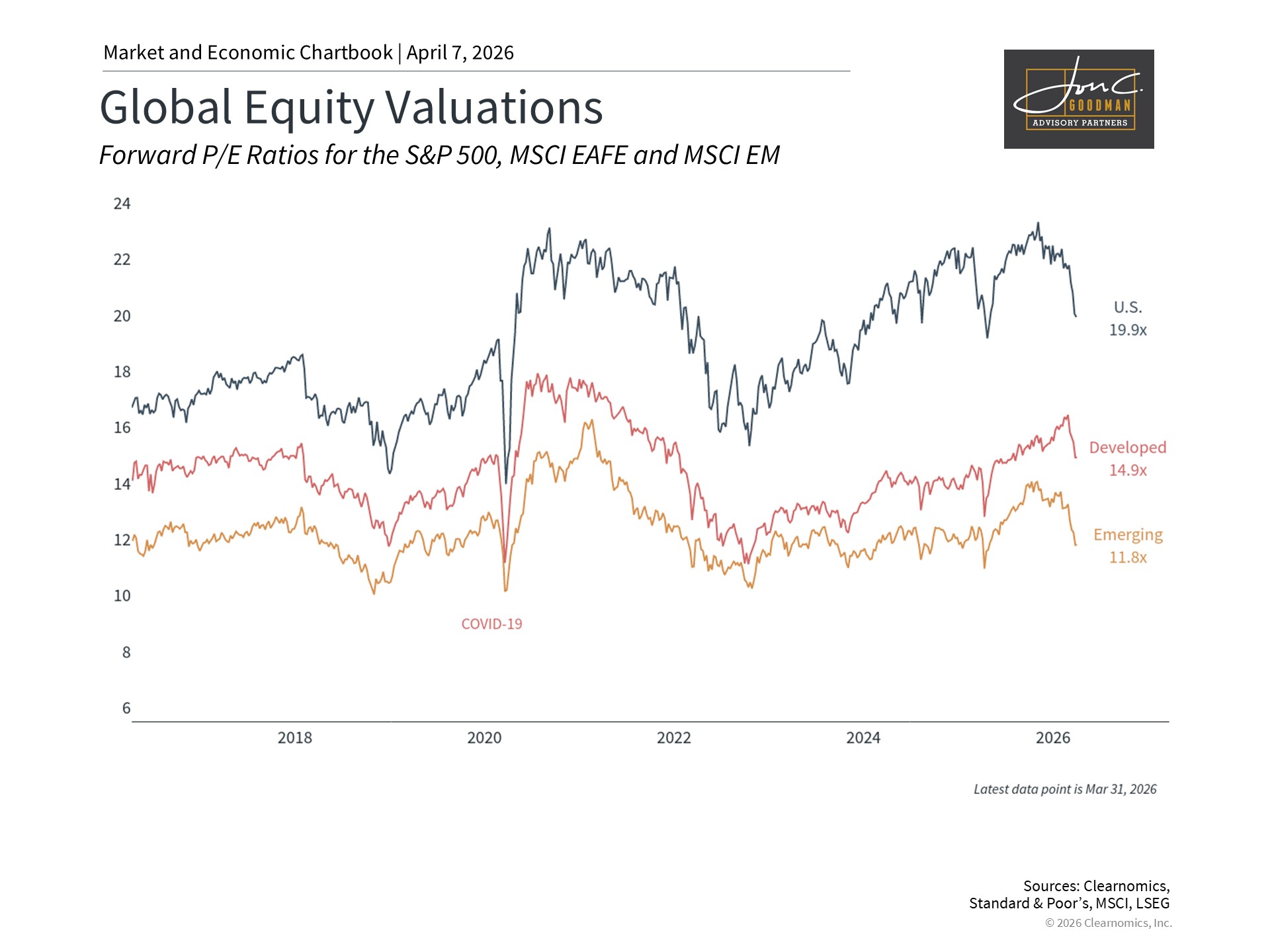
Valuations also play a significant role. International markets have traded at a notable discount to U.S. equities for some time, with developed markets carrying a price-to-earnings ratio of 14.9x and emerging markets at 11.8x, compared to 19.9x for the S&P 500. While this gap does not serve as a short-term timing signal, it is an important factor when constructing diversified portfolios and determining how to allocate across asset classes.
Through 2026, international markets have continued to modestly outpace the S&P 500, even as the dollar has partially recovered. Both developed and emerging markets are up slightly on the year, while U.S. indices have been modestly negative. This represents a meaningful shift after years of consistent U.S. equity leadership that had led some investors to question the merits of international diversification. For long-term investors, this reinforces the principle that asset class leadership rotates over time and that global exposure can contribute to more consistent portfolio outcomes.
Gold has pulled back in tandem with other asset classes
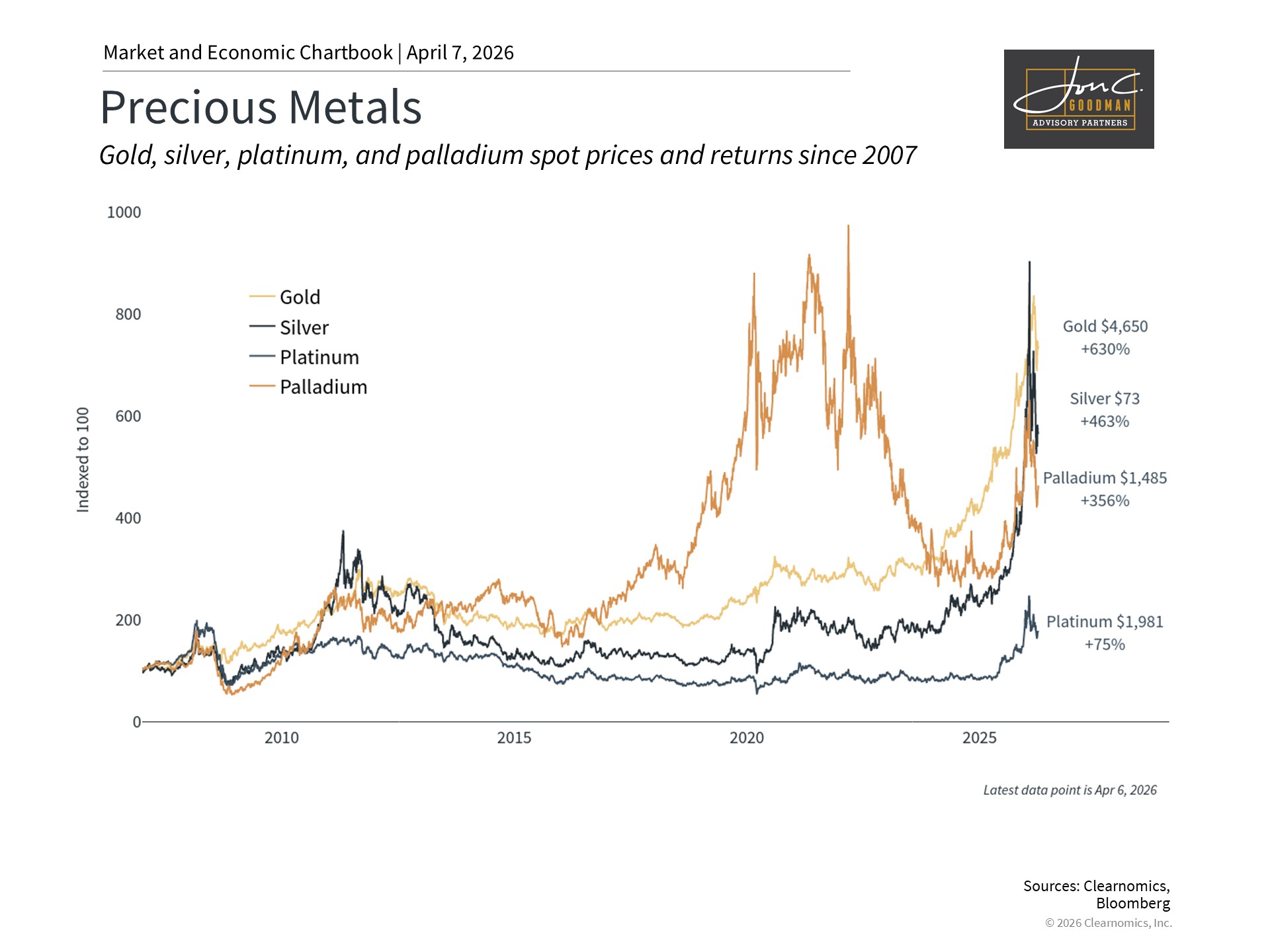
Gold has been one of the most closely watched assets over recent years and is influenced by many of the same factors as the dollar. Rising fiscal deficits, accommodative monetary policy, geopolitical tensions, and concerns about currency debasement all supported the narrative for gold, contributing to a multi-year rally that drove prices to all-time highs as recently as late January, when gold reached $5,417 per ounce.
Since then, gold has retreated roughly 14% from that peak, even as geopolitical uncertainty has remained elevated and many of the underlying drivers remain in place. This may seem counterintuitive to investors who hold gold primarily as a safe-haven asset.
Part of the explanation lies in the significant investor interest that had already built up during gold’s latest rally. As more investors accumulate gold in anticipation of further gains, its price movements can begin to correlate more closely with other assets. During periods of market stress, gold may be sold alongside equities rather than acting as a true offset — particularly as investors have rotated back toward the dollar. This dynamic helps explain why gold’s recent decline has coincided with the dollar’s rebound.
This pattern is not without precedent. Between 2011 and 2020, gold was essentially flat, even as the Federal Reserve maintained accommodative monetary policy for much of that stretch and financial markets weathered several bouts of significant volatility. Gold was also relatively range-bound during the inflationary period from 2022 to early 2024 — a period that would typically be viewed as supportive for the metal. The Fed’s rapid rate hikes during that period, however, enhanced the appeal of cash and short-term fixed income alternatives.
As always, the most constructive way to evaluate the dollar, international investments, and gold is as components of an overall portfolio rather than as standalone positions. The value of these assets stems from the fact that they behave differently from stocks and bonds, thereby helping to stabilize portfolios across market cycles.
The bottom line? The dollar, international stocks, and assets such as gold can all serve different roles in balanced portfolios. During periods of uncertainty, it’s important to maintain a broader perspective on the driving factors behind these assets. Ultimately, a well-constructed portfolio remains the most reliable way to achieve long-term financial goals.

Wellness Navigator and Holistic Brain Health Coach, Christine Despres, RN,NBC-HWC,CDP
Stress Awareness Month Starts Now. And I’m Not Going to Tell You to Take a Bath.
April is National Stress Awareness Month. And if your inbox looks anything like most people’s right now, you are already seeing the articles. Breathe more. Sleep better. Try yoga. Limit your screen time. Cut back on caffeine.
None of that is wrong. But if you are genuinely struggling, if the anxiety is real, the thoughts won’t slow down and the exhaustion goes deeper than a bad night’s sleep, a bubble bath is not going to get you there. Being told to do more things when you are already overwhelmed is its own kind of stress.
So this month I want to have a different conversation. A more honest one.
Stress is not a character flaw. Anxiety is not a weakness. And the thoughts that loop in your head at 3am are not evidence that something is wrong with you. They are evidence that your brain is doing exactly what it was designed to do. The problem is that nobody ever taught you how to work with it or cut it off at the source.
Mental health is brain health. Research suggests we have somewhere between 60,000 and 80,000 thoughts a day, the vast majority repetitive. And when a negative thought goes unchallenged, the brain doesn’t just notice it and move on. It attaches. It grabs the thought, builds a story around it and your body responds as if that story is real. The conversation you replayed at 3am. The decision you second-guessed all week. The worry about your memory that keeps showing up uninvited. That is the loop. And for a lot of women, it has been running so long it just feels like who they are.
It is not who you are. It is a pattern. And patterns can change.
Chronic stress is one of the most well-documented modifiable risk factors for Alzheimer’s disease. That word, modifiable, matters. It means this is not your fate. The choices you make right now, including how you learn to respond to stress, have a direct impact on how your brain ages.
We all have stress. The question was never whether you have it, it is how you are handling it. And that looks different for every person, which is exactly why generic advice so often falls flat.
This is where my work comes in. My coaching program is built around helping midlife women reduce the internal load that chronic stress creates, not by adding more to your plate, but by getting to the root of what is driving it. We work on the thought patterns keeping your nervous system in a state of low-grade threat response and build the kind of mental resilience that changes how your brain processes stress over time. A mind that can pause before it ruminates. That can catch a thought before it becomes a story. That can return to baseline faster after something hard.
My goal is to help you cut this process off before it affects your wellbeing, your memory, your relationships and your long-term brain health. You deserve more than management. You deserve to feel sharp, steady, and in control of your own mind from the inside out.
Your micro habit for this week is simple…What is the thought running in your head right now? You don’t need to fix it yet. Just notice it. Write it down.
Your brain cannot examine what it cannot see and you cannot change a pattern you have never stopped to name. One thought. Written down. That is your assignment this week.
And if what you are carrying already feels heavier than it should, if stress, anxiety, or difficulty focusing has quietly become your new normal, you do not have to figure this out alone. I am sorry you are going through this and you have options. A Brain Health Strategy Session is a great place to start. It’s a complimentary 30-minute conversation, just the two of us, where we look at what is actually going on. No pressure, no agenda. Just an honest look at where you are and what might help…
If you are ready, I would love to talk.
👉 Book a free Brain Health Strategy Session here:
Click Here to Schedule Your 30 minute Strategy Call
With care,
Christine
RN | Board-Certified Health & Wellness Coach | Certified Dementia Practitioner | Holistic Brain Health Coach | Nutrition Coach
If you’re ready to start investing in your greatest asset, I’d love to be your guide.
https://www.thewellnessnavigator.com/

10 Things You May Not Know About Artemis (And Why It Matters)
There’s something fitting about looking up—especially in a world that can feel increasingly crowded, noisy, and near-term.
While we’re managing budgets, markets, and the day-to-day, NASA is quietly working on something far bigger: a return to the Moon through the Artemis program.
Here are 10 things you may not know:
1. Artemis isn’t Apollo 2.0.
This isn’t a repeat of the Apollo program—it’s a foundation. The goal is sustained presence, not a one-time flag.
2. Artemis I already flew.
In 2022, Artemis I sent the Orion spacecraft around the Moon and back, proving the system works.
3. Artemis II is carrying humans, flew to the far side of the moon, traveled farther from Earth than humans have ever gone before, and is expected to splash down on Friday, April 10th, 2026–around 8:07 pm ET.
4. Artemis III aims to land astronauts on the moon again.
This mission is expected to include the first woman and first person of color on the Moon.
5. The rocket is the most powerful ever built.
The Space Launch System (SLS) produces more thrust than the Saturn V rockets of the Apollo era.
6. The mission is international.
Through the Artemis Accords, dozens of countries are participating in this effort.
7. There will be a lunar “base camp.”
Think longer stays, research stations, and repeat missions—not touch-and-go visits.
8. A space station will orbit the Moon.
The planned Lunar Gateway will serve as a hub for deeper exploration.
9. This is really about Mars.
The Moon is the proving ground. Mars is the horizon.
10. It’s happening now.
Delays aside, this isn’t theoretical. Hardware is built, missions are scheduled, and momentum is real.
Why this belongs here:
Because Artemis is a reminder of something we all need: the discipline to think beyond the immediate.
Space exploration requires long timelines, coordinated systems, and sustained commitment—the same ingredients required to build anything meaningful here on Earth.
Whether in markets, money, or life, the people who win aren’t just reacting to today. They’re building toward something that isn’t fully visible yet.
And sometimes, the best way to regain perspective is simply to look up.
That’s all for now.
Until next week,
Take care,