

Greetings!
Welcome back to Advice for the Good Life, where we explore the intersection of wealth, wellness, and wisdom.
This week’s edition begins with a Wealth Advisory update on the escalating conflict in the Middle East and oil’s rapid rise toward $100 per barrel. While headlines warn of recession, stagflation, and market turmoil, history offers valuable perspective. In the article that follows, we examine how energy shocks affect markets and why maintaining a long-term investment mindset and diversified portfolio remains the most reliable strategy during periods of geopolitical uncertainty.
Next, our favorite Wellness Navigator, Christine Despres, RN shares news of completing the Amen University Elite Brain Coaching Program and reminds us that our brain is our most valuable asset. When properly nourished, rested, and protected from chronic stress, it improves how we think, decide, and show up in the areas of life that matter most.
Finally, in Etcetera, I introduce the guides behind the guide, aka, the specialized partners who help support our work at JCG Advisory Partners—including CacheTech’s macro and portfolio infrastructure expertise, John Beldy’s options strategies at Sentry Capital, and Global Value Investment Corporation’s work in individual securities and municipal bond portfolios.
If you enjoy this week’s edition, please share it with a friend and subscribe so you never miss an issue.
Wealth Advisory: How $100 Oil and the Middle East Conflict Affect Investors
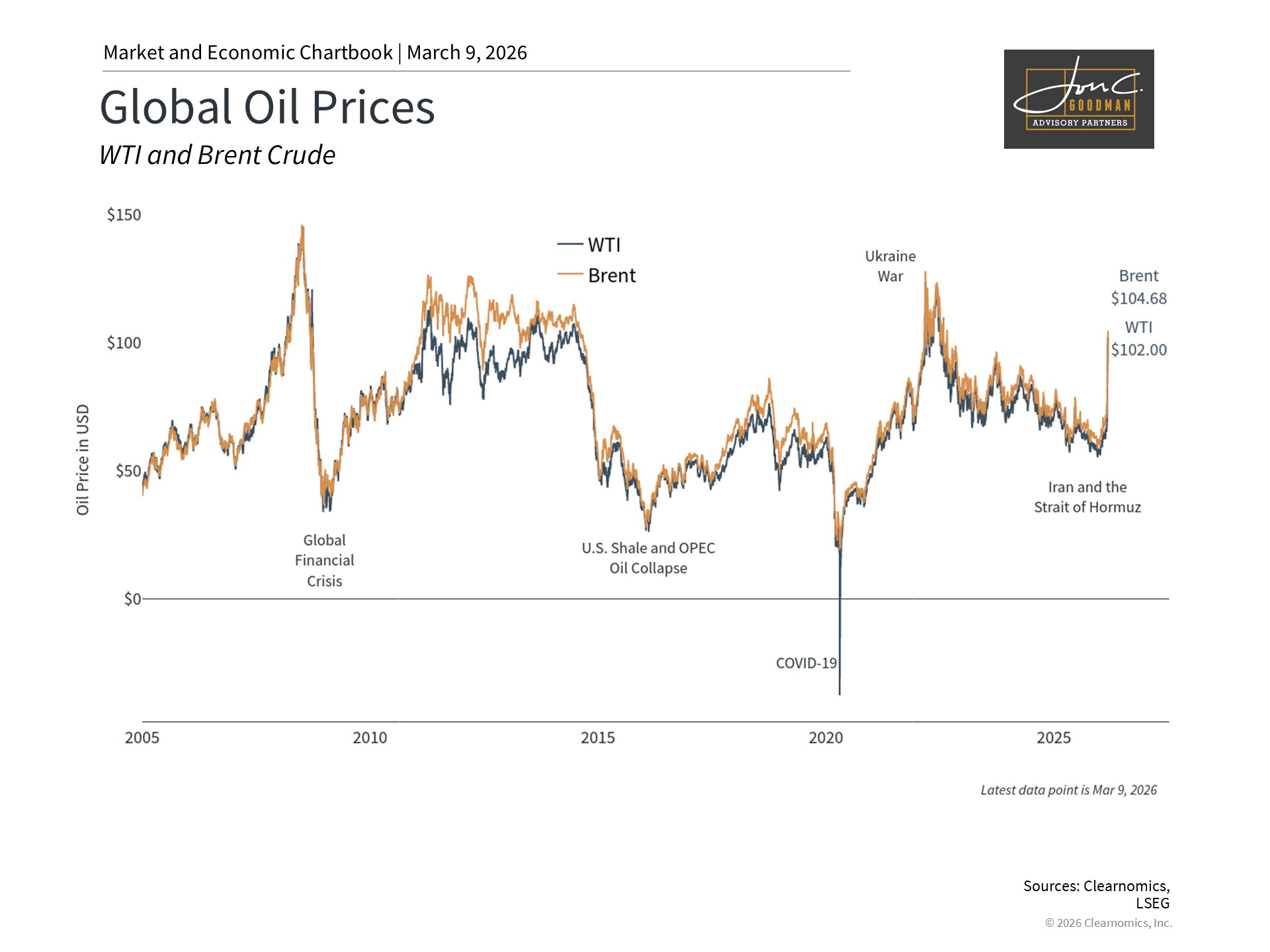
The escalating conflict in Iran and the effective shutdown of the Strait of Hormuz have sent oil prices surging dramatically. Both Brent crude and WTI have climbed from roughly $70 per barrel to approximately $100 in just a matter of days, nearing levels last observed in 2022 when Russia launched its invasion of Ukraine. This rapid rise has introduced considerable uncertainty across global markets, with commentators raising concerns about a “global economic downturn,” “stagflation,” and related risks.
The safety of civilians and military personnel remains the foremost priority in any conflict. Nevertheless, from an investment standpoint, history consistently demonstrates that maintaining a long-term perspective is the most effective approach when navigating periods of heightened uncertainty. A quote often attributed to Winston Churchill is “the farther back you can look, the farther forward you are likely to see.” This wisdom applies directly to energy price shocks, which have recurred roughly every decade. While each episode carries its own unique characteristics, a recognizable pattern emerges: oil prices spike in response to geopolitical tensions, markets experience volatility, and conditions eventually stabilize and recover.
The situation continues to evolve in real time, and there is no certainty about when stability will return to the region or to financial markets. Recent episodes—including other Middle East conflicts, inflationary pressures, trade disputes, and developments in Venezuela earlier this year—all offer valuable context. With that in mind, what key considerations should investors keep in focus over the coming weeks?
The drivers behind oil’s rise to $100
For investors, energy prices represent the primary channel through which geopolitical events influence the broader economy and financial markets. The magnitude of each conflict’s impact depends on how it alters the balance of supply and demand. Currently, elevated oil prices reflect disruptions to transportation, constrained storage capacity, and production cutbacks by major Middle Eastern oil producers. The potential length of the conflict is also a consideration as Iran navigates the appointment of a new supreme leader.
At the heart of the current oil price surge is the Strait of Hormuz—a narrow but critically important waterway linking the Persian Gulf to global markets. Approximately 20% of the world’s oil shipments and a substantial portion of natural gas transit this chokepoint annually. While Iran cannot formally close the strait, attacks on tankers and heightened safety concerns have effectively halted traffic. Major shipping and logistics firms have curtailed or suspended bookings through the area, leaving hundreds of oil tankers stranded within the strait.
This disruption has produced a cascading effect throughout energy markets. With tanker transit through the Strait of Hormuz effectively blocked, large Middle Eastern producers have been forced to divert oil into storage. As storage capacity reaches its limits, countries such as Saudi Arabia, Iraq, Kuwait, Qatar, and the UAE have had to reduce output. Unlike conventional OPEC production cuts designed to support prices, these reductions are involuntary emergency measures. This sequence of events explains why oil prices have risen so sharply in such a compressed timeframe.
It is widely understood that oil prices above $100 per barrel can weigh on economic activity, straining household budgets and fueling inflation. Even so, it is important to view these moves in historical context. Although oil prices have remained relatively subdued in recent years, they have experienced significant swings throughout history. When Russia invaded Ukraine in early 2022, Brent crude surged to nearly $128 per barrel, driving average U.S. gasoline prices above $5 per gallon. Prior to that, the mid-2000s saw oil reach record levels amid rapid global growth in the lead-up to the 2008 financial crisis. In each instance, prices ultimately normalized as supply and demand conditions adjusted.
The impact of elevated oil prices on consumers and businesses
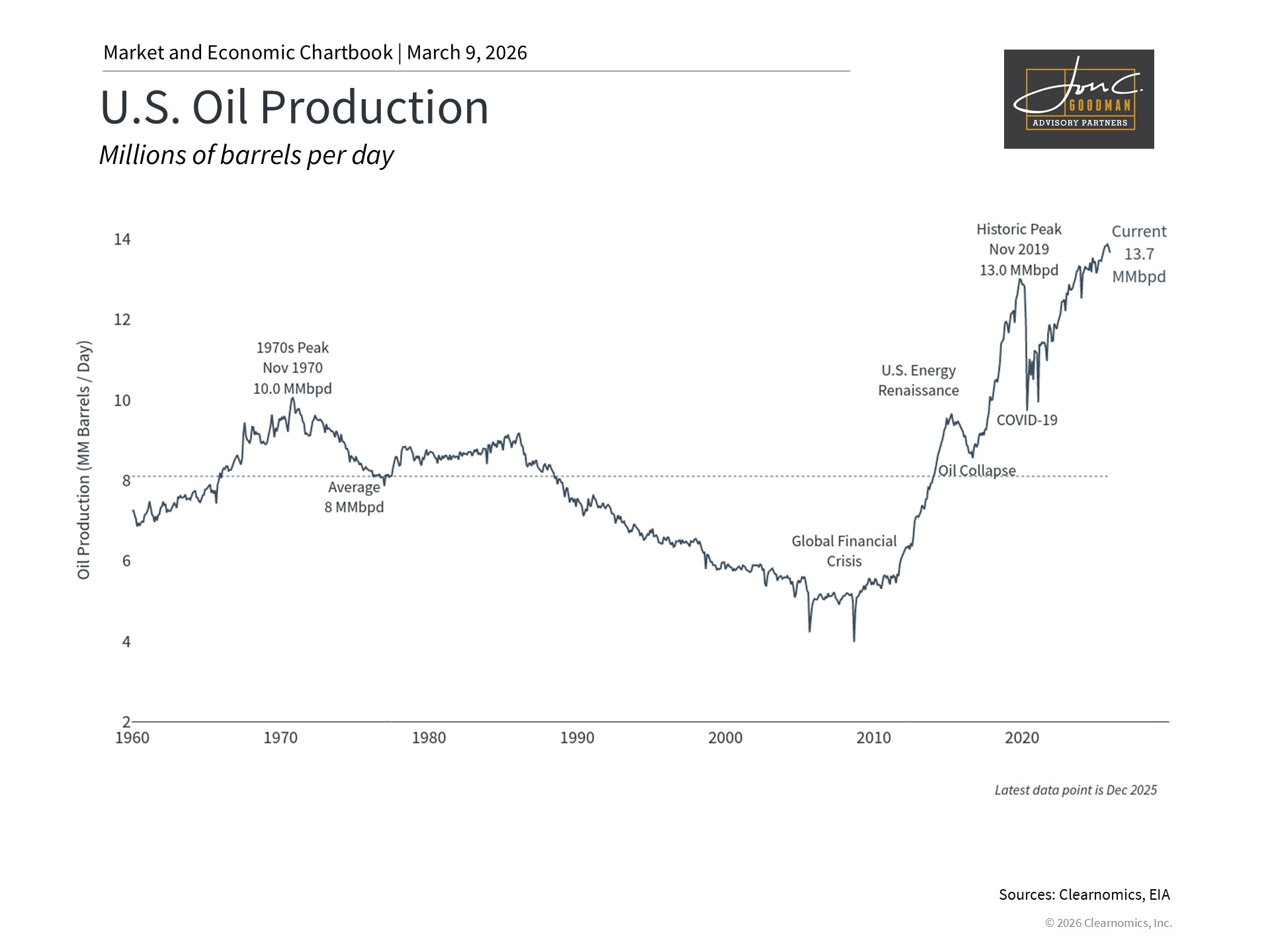
The shale revolution has placed the U.S. in a comparatively stronger position today than during previous oil crises. As the world’s largest producer of both oil and natural gas, the U.S. enjoys a degree of energy independence that was absent during earlier historical oil shocks. Although oil remains a globally priced commodity and the U.S. continues to import certain grades of crude, this dynamic provides the domestic economy with greater insulation than many counterparts in Asia and Europe. The U.S. is widely regarded as a “swing producer,” capable of expanding output in response to elevated prices.
That said, higher oil prices do permeate every facet of economic activity. For consumers, the most immediate and visible effect is felt at the gasoline pump, where rising prices directly reduce household purchasing power. At present, gasoline prices have climbed back toward $3.50 per gallon nationally and may rise further. While this represents a notable increase, it remains well below the $5 per gallon experienced four years ago.
Beyond gasoline, the indirect effects on consumer prices are widespread. Rising energy costs increase the expense of transporting goods, manufacturing products, and operating businesses. In this manner, higher oil prices function as an effective burden on the broader economy by increasing the cost of all goods and services and reducing disposable income.
Economists often describe this dynamic as “cost-push inflation.” When oil prices rise sharply, businesses confront higher production costs that are ultimately passed along to consumers. This stands in contrast to demand-driven inflation, where price increases stem from stronger consumer spending—such as during periods when government stimulus payments are distributed.
This distinction carries meaningful implications because supply shocks are generally viewed by economists and investors as “transitory”—meaning their effects are expected to diminish over time. This may occur either because conditions stabilize and oil prices retreat, or because the broader economy adapts to the new price environment. While sudden energy price increases are undeniably challenging, history suggests they do not permanently derail economic growth.
Financial markets have historically navigated oil price shocks
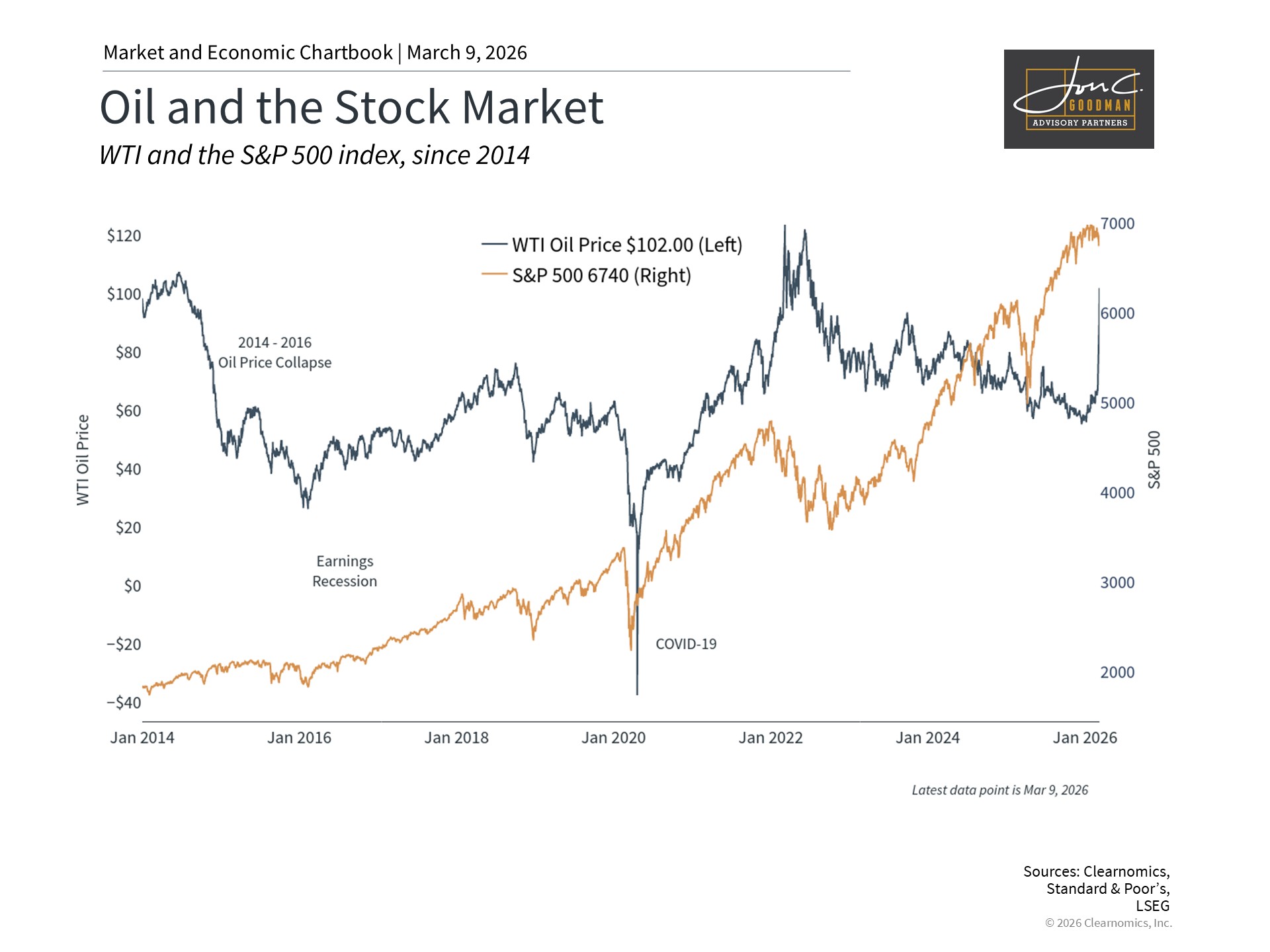
Despite the lessons of history, financial markets can and do react to oil price shocks in the near term. The S&P 500 is down only a couple of percentage points year-to-date, yet many headlines are highlighting the South Korean KOSPI index’s decline of 17%, Japan’s Nikkei index’s 10% fall, and others since the end of February. What these headlines often omit is that the KOSPI and Nikkei remain up over 104% and 40%, respectively, over the past year, even accounting for these recent pullbacks. Markets rarely advance in a straight line, making it essential to preserve this broader perspective.
At the same time, energy companies stand to benefit from elevated prices. The energy sector has gained approximately 25% year-to-date and leads the broader market, consistent with its outperformance in 2021 and 2022. Similarly, the commodities asset class has risen more than 20% this year, supported by both energy and precious metals. This is not an argument for concentrating portfolios in energy, but rather a reminder of the value that diversification across asset classes and sectors can provide.
Recent developments also introduce uncertainty regarding the Federal Reserve’s next steps. Should inflation accelerate due to higher oil prices, the Fed may need to maintain rates at higher levels than currently anticipated. At present, market-based expectations point to at least one rate cut later this year in September, and potentially two before year-end. However, if the supply disruption proves temporary—even if it persists for several months—its influence on monetary policy may ultimately be modest, consistent with historical precedent.
This does not mean markets will be immune to continued day-to-day fluctuations. Rather, it underscores the importance of well-constructed asset allocations and financial plans, which are specifically designed to navigate these types of risks. Making sweeping portfolio changes in reaction to short-term headlines frequently proves counterproductive. Long-term investment success is more reliably achieved by maintaining balanced, diversified portfolios and staying committed to one’s financial objectives.
The bottom line? While the conflict in Iran has pushed oil prices above $100 and created volatility, financial markets and the economy have historically adapted to supply shocks. Investors should maintain perspective, stay diversified, and continue to focus on their long-term financial goals rather than reacting to daily geopolitical headlines.

Wellness Navigator and Holistic Brain Health Coach, Christine Despres, RN,NBC-HWC,CDP
I have some news I’ve been looking forward to sharing — and a question I want to leave you with by the end of this email.
I’ve officially completed the Amen University Elite Brain Coaching Program. And walking away from it, one thing is clearer to me than ever: your brain is your greatest asset. Not your portfolio. Not your career. Not your network. Your brain runs all of it. And honestly, without it you have nothing. Think about that.
Your brain has been working on your behalf for decades — mostly on autopilot, quietly managing everything behind the scenes so you could just live your life. And for a long time, that works beautifully. But at some point, (usually midlife) something shifts. A little more fatigue than usual. Words that used to come easily now don’t. Forgetting why you walked into a room. A feeling that you’re working harder to get the same results.
That’s not decline. That’s your greatest asset asking for a little attention.
The question isn’t whether that moment will come. It’s whether you’ll be ahead of it when it does. That’s the investment I’m talking about.
And here’s the return.
When your brain is well-nourished, well-rested, and protected from chronic stress and inflammation — you don’t just feel better. You think more clearly. You make better decisions. You show up more fully for the people and the work that matters most to you. The ROI on brain health isn’t abstract. You feel it every single day.
This training made me better equipped to help you get there. Here’s what’s now part of my toolkit: A more personalized approach. Every brain is different. The brain type assessment work I trained on means the protocols I build with clients are even more tailored to how your specific brain works and what it needs.
Deeper nutritional guidance. Nutraceuticals and targeted supplement recommendations are now a more formal part of how I work. Food is medicine — and now I have an even stronger evidence base behind every recommendation I make.
Lifestyle prescriptions that actually stick. Sleep, movement, stress management, detox — these are the compounding investments that pay the biggest dividends. We build them in a way that works for your real life.
A closer look at your thoughts. The ANTs framework — Automatic Negative Thoughts — is one of Dr. Amen’s most powerful tools, and for good reason. The way we think directly affects how our brain functions. Identifying and interrupting those patterns is one of the highest-return habits you can build.
My mission is to help people fall in love with caring for their brain. Not out of fear. Not because something is wrong. But because you deserve to run your life from a place of clarity, energy, and confidence — for decades to come.
If you’re ready to start investing in your greatest asset, I’d love to be your guide.
👉 Book a free Brain Health Strategy Session here: Click Here to Schedule Your 30 minute Strategy Call
With gratitude,
Christine
RN | Board-Certified Health & Wellness Coach | Certified Dementia Practitioner | Holistic Brain Health Coach | Certified Nutrition Coach
https://www.thewellnessnavigator.com/

The Guides Behind the Guide
Every great expedition has a lead guide…
but the best expeditions also rely on a trusted team.
Think of a mountaineering expedition in the Absarokas or Beartooths. One guide may know the terrain, but another understands the weather, another the climbing lines, and another how to navigate the unexpected. Together, they dramatically improve the odds of reaching the summit safely.
The same is true in wealth management.
While my role at JCG Advisory Partners is to serve as your primary guide—helping translate income into assets, assets into optionality, and optionality into freedom—I also work alongside a curated group of specialist subadvisors whose expertise strengthens the journey.
Over time, I’ll introduce you to the professionals who comprise the Advisory Partners portion of our practice.
Here’s a brief introduction to three of them.
CacheTech Advisors serves as our go-to macro investment partner. Their capabilities span advanced financial and estate planning, tactical asset management, and institutional-grade technology infrastructure. Many advisors know them for their sophisticated portfolio construction work, but their Turnkey Asset Management Platform (TAMP)—which we’ll explore next week—also brings powerful operational and reporting tools that allow portfolios to be managed efficiently and at scale.
John Beldy and the Sentry Hedged Growth Strategy bring a deep specialization in options and risk management. Sentry’s approach seeks to refine, hedge, optimize, and diversify equity exposure using options strategies designed to reduce downside risk, enhance yield, and participate in equity-like returns across market cycles. For clients with concentrated equity positions—often the result of performance-based compensation or long-held stock—Sentry also provides tailored option strategies designed to help manage risk while preserving opportunity.
Global Value Investment Corporation (GVIC) rounds out the team with traditional security selection expertise. GVIC focuses on individual stock and bond portfolio management, and more recently has expanded its capabilities for high-net-worth and ultra-high-net-worth clients seeking to mitigate tax exposure through professionally managed municipal bond portfolios.
Each of these partners brings a distinct value proposition.
Together, they allow us to combine strategic guidance with specialized execution—a structure designed to serve complex portfolios thoughtfully and efficiently.
If you’d like to learn more about the professionals behind these capabilities, click here.
In closing, I would be remiss if I did not state the obvious. As wonderful as our Advisory Partners are, the partnership that matters most is the one we share with our clients.
Yes, we are grateful for the collaboration we enjoy with our advisory partners and colleagues, whose expertise strengthens the work we do together. But it is the trust you place in us that gives our work its deepest meaning.
You invite us into conversations about your goals, your families, and your hopes for the future—privileges we never take for granted. So, thank you for that trust and for the opportunity to walk this road alongside you. Without you, this work would not only cease to exist, it would lose the purpose and fulfillment that make it so deeply worthwhile.
So, thank you!
On that happy note, may the trails we travel rise to meet us all!
See you next week,
