

Greetings,
This week’s headlines are heavy. U.S. and Israeli strikes in Iran, rising oil prices, market volatility, and the very human cost of conflict all demand attention. In this edition of Advice for the Good Life, we step back from the noise and focus on what actually drives long-term outcomes.
In today’s Wealth Advisory, we examine what’s changed—and what hasn’t. We put the latest escalation in historical context, explore why oil and the Strait of Hormuz matter for global markets, and highlight the sectors most likely to feel second-order effects. Most importantly, we revisit the discipline that has carried investors through wars, crises, and shocks before: diversified planning over reactive prediction. Volatility creates headlines, but structure and rebalancing create results.
Next, our Wellness Navigator, Christine Despres reminds us that food is information. With March marking National Nutrition Month and spring around the corner, she shares practical shifts that move the needle—prioritizing protein, balancing blood sugar, hydrating consistently, and abandoning all-or-nothing thinking. Health, like wealth, compounds when daily habits align with long-term goals.
Last, in our Etcetera section, we’ve also curated a short list of reliable sources if you want deeper context without doomscrolling.
If this edition brings clarity, forward it to someone who needs it. And if you haven’t subscribed yet, join us. Each week we focus on building wealth, strengthening health, and staying steady when the world feels anything but.
Wealth Advisory: Iran and Long-term Investing
As widely reported in the news, the U.S. and Israel have launched military strikes against Iran, targeting its leadership, military assets, and nuclear infrastructure. Iran’s Supreme Leader is confirmed to have been killed, and Iran has retaliated with missile and drone attacks across the Middle East. President Trump has stated that the goal of the operation, dubbed “Operation Epic Fury,” is regime change in Tehran, with strikes expected to continue for weeks and a number of U.S. troop casualties already reported.
The situation is evolving rapidly, and the safety of civilians in the region and our troops remain the most important consideration. Without diminishing the gravity of these events, investors will naturally have questions about what this means for markets, oil prices, and their portfolios.
President Dwight D. Eisenhower once said that “plans are worthless, but planning is everything.” Applied to the present moment, this suggests that while specific geopolitical events are unpredictable, the fact that they occur regularly is not. Portfolio construction and financial planning are designed precisely to manage this kind of uncertainty. Though each event is unique, financial markets have successfully navigated countless wars, crises, and regional conflicts, including the U.S. operation in Venezuela earlier this year.
For long-term investors, the critical task is to separate geopolitical headlines from portfolio decisions. So, what should investors keep in mind as events continue to develop over the coming weeks?
The latest strikes are part of a long-running story
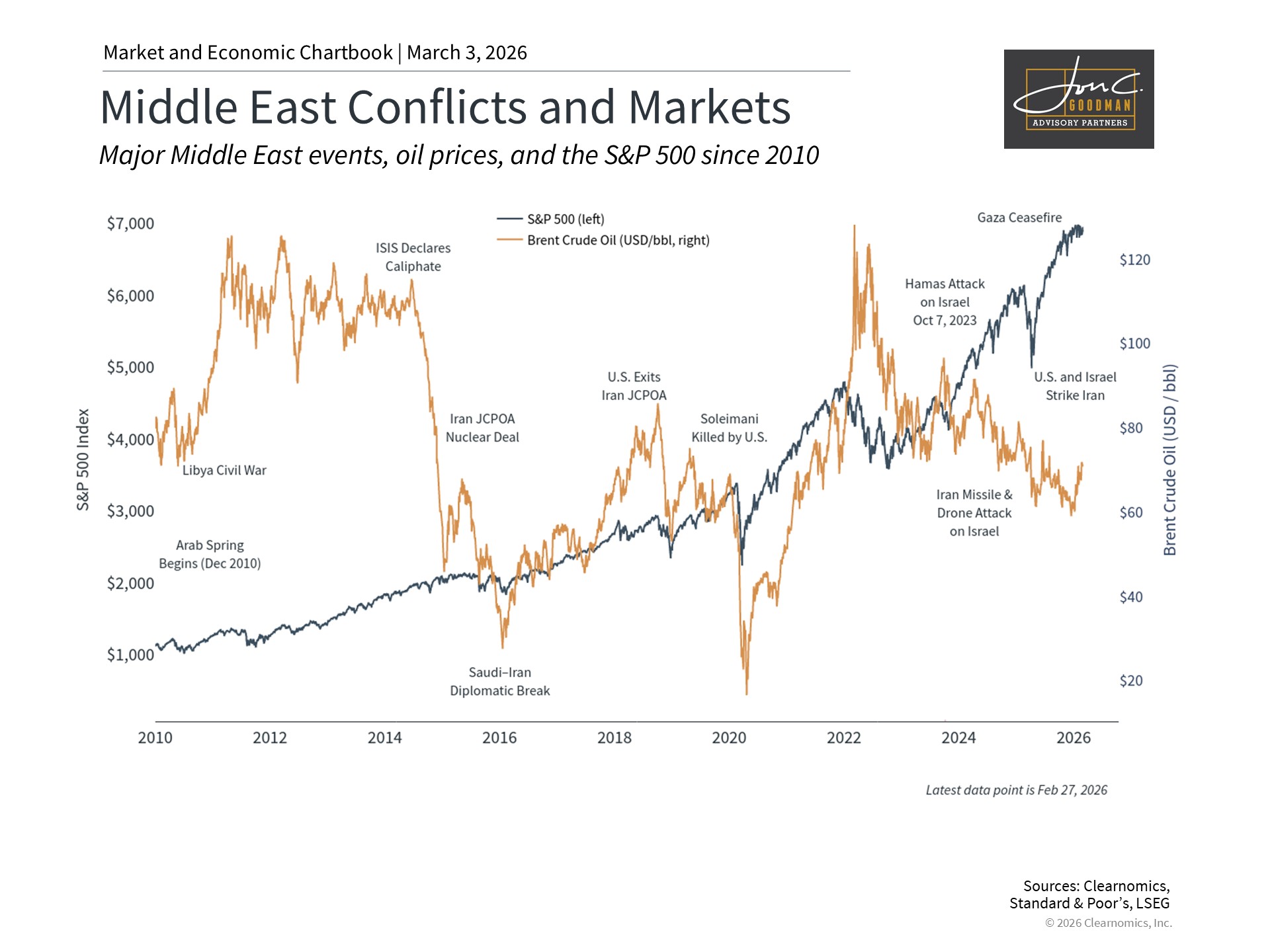
Although the scale of the current strikes is significant, tensions among the U.S., Israel, and Iran have been building for a considerable period. This latest escalation follows a monthlong U.S. military buildup in the region, failed negotiations over Iran’s nuclear program, and President Trump’s earlier pledge to support Iranian protesters who challenged the regime this year.
To understand how this moment came about, it is helpful to review the broader sequence of events:
- Tensions between Iran and the West extend back decades, rooted in part in the Iranian regime’s longstanding support for Hezbollah and Hamas, both of which have been central to conflicts throughout the Middle East.
- In 2019, Iran launched drone strikes against Saudi Arabia’s oil infrastructure, temporarily disrupting global oil production and stoking fears of a wider regional conflict.
- Hamas’s October 2023 attack on Israel reignited hostilities in the region, eventually drawing in Hezbollah and intensifying tensions with Iran.
- Last summer, Israel conducted a 12-day military campaign against Iran, targeting nuclear and ballistic missile programs in the most direct confrontation between the two nations in decades.
- Earlier this year, Iranian protesters challenged the regime, prompting President Trump to pledge U.S. support.
- Negotiations over Iran’s nuclear program ultimately failed. A significant U.S. military buildup in the region over recent weeks signaled that a broader operation was being planned, culminating in the current strikes.
The scope of the latest campaign — including the targeting of Iran’s senior leadership — is broader than previous engagements. Nevertheless, history demonstrates that such conflicts are not always a direct catalyst for sustained market movements.
Oil prices and the Strait of Hormuz
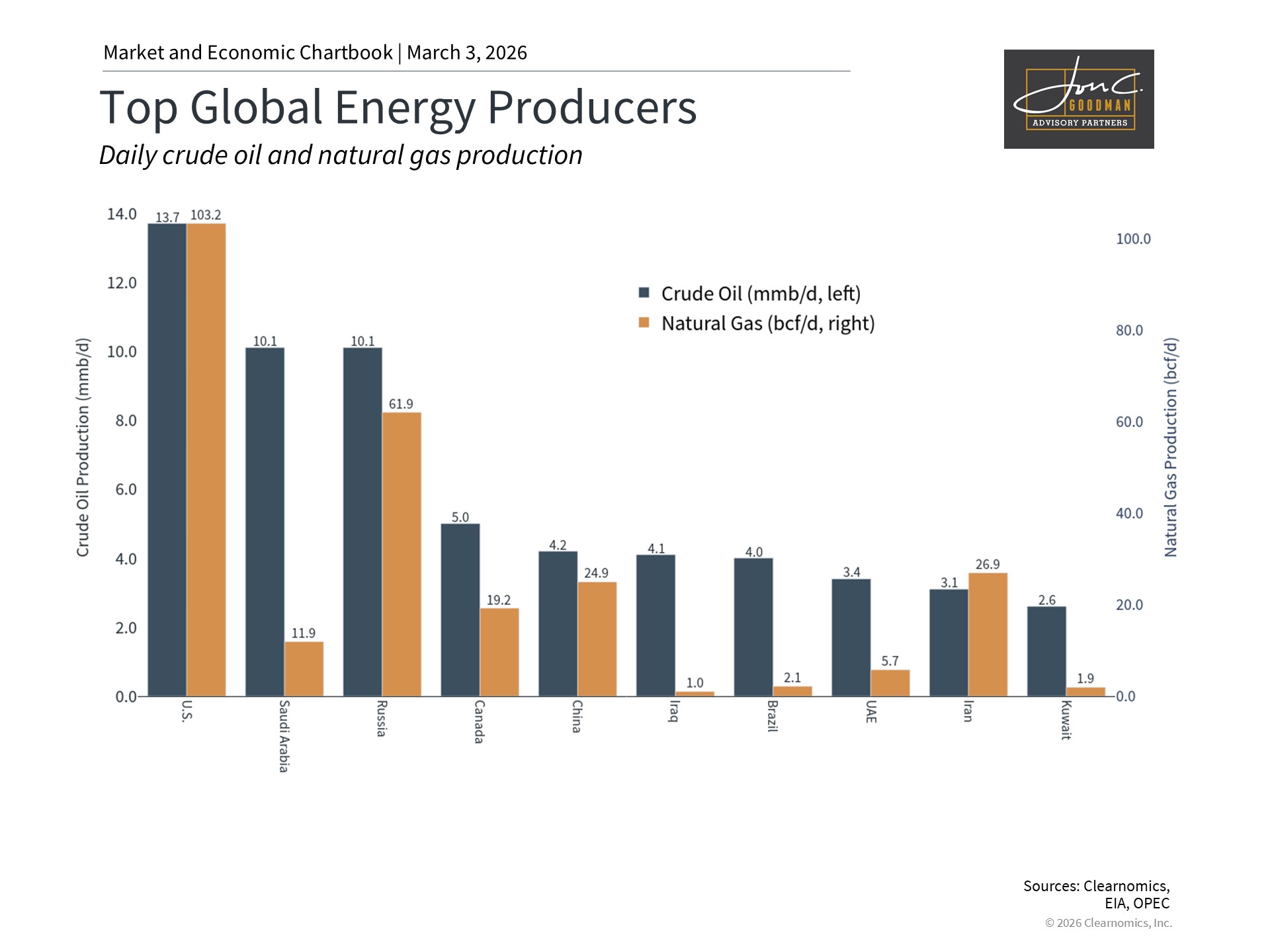
For investors, the most direct channel through which Middle East conflicts influence financial markets is global energy prices. Iran is a member of OPEC and produces around 3 million barrels per day of oil and 27 billion cubic feet per day of natural gas. The country also borders the Strait of Hormuz, the world’s most critical energy waterway. According to the U.S. Energy Information Administration, approximately one-third of all seaborne oil exports and one-fifth of natural gas passes through this region. Even the threat of disruption to this vital corridor could carry meaningful implications for global energy markets.
Oil prices had already been rising in anticipation of the strikes. The immediate reaction has been a further increase, with WTI moving into the low $70s and Brent crude rising to just under $80 per barrel. While western countries do not directly import Iranian oil, the global and fungible nature of oil markets means that any supply disruption can push prices higher.
Some perspective is warranted, however. Current oil prices remain well below the 2022 peak of nearly $128 per barrel reached when Russia invaded Ukraine. The current environment is also quite different from prior episodes. In 2018, the U.S. became the world’s largest producer of oil and natural gas, with domestic production now exceeding that of other major producers such as Saudi Arabia and Russia. While the U.S. still participates in global energy markets, this level of domestic production helps shield the economy from supply-side disruptions.
It is also worth noting that oil prices are notoriously difficult to predict. When Russia invaded Ukraine, many anticipated that prices would remain elevated for an extended period. Instead, they stabilized and declined far sooner than expected. Likewise, the U.S. operation in Venezuela in January of this year caused a brief move in oil prices but had little lasting effect.
Maintaining a long-term perspective amid geopolitical uncertainty
For long-term investors, the most important lesson drawn from past geopolitical conflicts is the value of remaining invested. It is entirely natural to feel unsettled when headlines describe military strikes, retaliatory attacks, and the potential for a broader regional war. These events carry real human consequences and stand apart from the typical flow of market-related news about earnings, valuations, and economic data.
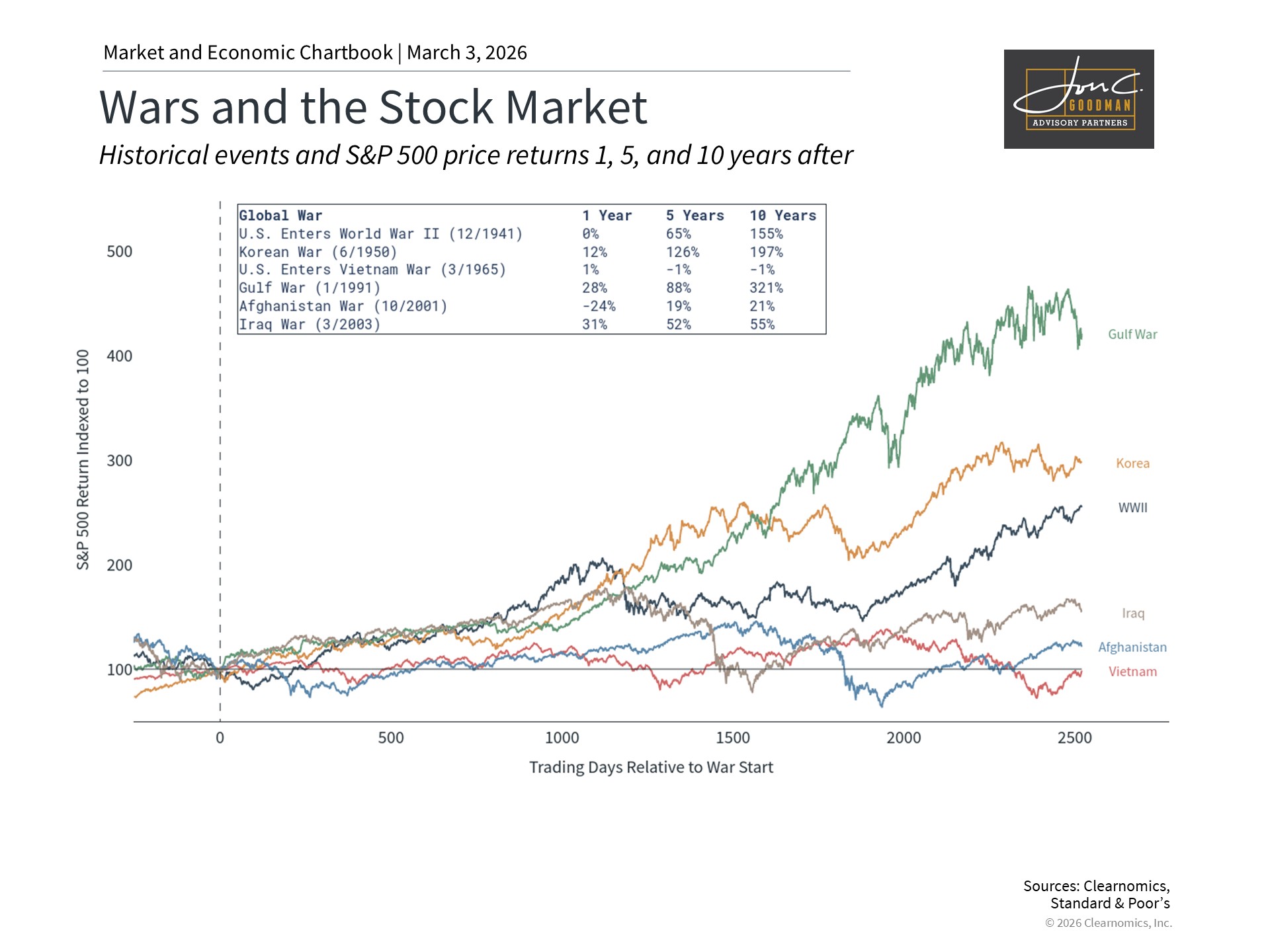
As the accompanying chart illustrates, markets have successfully navigated even the most serious global events. From World War II to the Gulf War to the wars in Iraq and Afghanistan, markets experienced short-term volatility but were ultimately driven by economic fundamentals over the long run. More recently, the conflicts involving Russia and Ukraine, and between Israel and Hamas, introduced uncertainty but did not derail the broader market trajectory.
It is also important to recognize that Iran plays a minimal direct role in most investment portfolios. The country has been subject to heavy sanctions for years, and its economy has endured hyperinflation, with its currency, the Rial, experiencing a dramatic collapse in value. As a result, very few investors have meaningful direct exposure to Iran within their asset allocations.
Markets may experience heightened volatility in the days and weeks ahead as the situation continues to evolve. Oil prices could climb further, and uncertainty may weigh on investor sentiment. However, attempting to time these moves has historically proven counterproductive. Markets have demonstrated a capacity to rebound in unexpected ways, and missing even a small number of the best trading days can substantially reduce long-term returns.
The bottom line? The U.S. and Israeli strikes on Iran represent an important geopolitical development. However, history shows that investors who maintain diversified portfolios aligned with their long-term financial goals are best positioned to navigate periods of uncertainty.

Wellness Navigator and Holistic Brain Health Coach, Christine Despres,
March is National Nutrition Month, and there is no better time to take a step back and think about what you are actually putting on your plate — and why it matters so much more than the latest diet trend. The Academy of Nutrition and Dietetics created this month as a reminder that food is information. Every bite you take either feeds disease or fights it, fuels your brain or fogs it, supports your metabolism or works against it. Nutrition is not about perfection or restriction — it is about making informed, empowered choices that add up over time and move the needle on your health and your goals.
Q1 is almost over. Sundresses and swimsuits are closer than you think. March is the moment to build momentum — here’s how.
5 Nutrition Tips That Actually Move the Needle and the Scale
- Prioritize Protein at Every Meal. Keeps you full, preserves muscle, and boosts metabolism. Build your plate around protein first.
- Crowd Out with Plants and Fiber. More fiber means better gut health, steadier blood sugar, and less room for the ultra-processed foods that drive inflammation and cravings.
- Ditch All-or-Nothing Thinking. One imperfect meal doesn’t derail your progress — the pattern over weeks matters far more than any single choice.
- Balance Your Blood Sugar. Eat veggies and protein before starch, pair carbs with fat or fiber, and never skip meals. Spikes and crashes drive fat storage and cravings.
- Hydrate Like It’s Your Job. Mild dehydration masquerades as hunger. Aim for half your body weight in ounces daily — it supports metabolism, lymphatic drainage, and cognitive clarity.
The Real Secret? Cut Through the Noise.
Do this, not that. Lift heavy. Go plant-based. Fast. Don’t fast. The conflicting advice is exhausting — and it’s not your fault you’re confused.
The truth is, health is bioindividual.
What works for your best friend may not work for you — and that’s why a personalized approach is everything. The right nutrition plan, movement strategy, and stress reduction protocol depends on your genetics, hormones, history, and goals.
An accountability partner and personal coach doesn’t just hand you a plan — they help you find the right plan for you, optimize your health, and protect against disease. With 30+ years of nursing and coaching experience, that’s exactly what I do.
Ready to Reignite Your Mind and Metabolism? Book your complimentary Brain Strategy call — let’s build your personalized plan for spring and beyond.
Click Here to Schedule Your 30 minute Strategy Call
To your brain, your body, and your best season yet,
Christine
RN | Board-Certified Health & Wellness Coach | Certified Dementia Practitioner | Holistic Brain Health Coach | Certified Nutrition Coach
https://www.thewellnessnavigator.com/

We asked ChatGPT for the best apolitical or bipartisan resources for tracking things in the Middle East, and here were the results.
- Best “what we know + what’s changed + competing justifications”:
- The Guardian’s day-by-day explainer is very thorough on the shifting rationale and early battlefield picture.
2. Best “nuts-and-bolts military + what’s left of the nuclear program”:
- CSIS has a deep dive on the strikes and what they do/don’t imply about Iran’s remaining capabilities.
3. Best “ongoing tracker you can keep checking without doomscrolling”:
- CFR’s conflict tracker format is built for this kind of evolving situation:
4. Best “timeline / confirmed details”
- Reuters’ timeline-style reporting is typically the gold standard for separating signal from noise.
Bonus Round: Sectors to Watch and Why…Think: second-order effects (prices, supply chains, risk premia), not just headlines
- Energy (oil, refined products, LNG): higher geopolitical risk premiums can lift prices fast; refiners/tankers can move differently than producers.
- Defense & aerospace: replenishment cycles, munitions, ISR, drones—spending discussions are already bubbling.
- Cybersecurity: conflicts tend to spike cyber activity against governments, contractors, logistics, and financial rails.
- Shipping/logistics & insurance: war-risk premiums and rerouting can hit freight rates and margins.
- Airlines/travel: usually negative beta to oil spikes and uncertainty.
- Banks/credit: watch regional exposures + market volatility impacts.
That’s all for today.
Until next week,
Be safe and take care,
