

Greetings!
It’s been a year defined by uncertainty—policy shifts, market volatility, and a world that, at times, doesn’t quite make sense.
Yet as investors, as stewards of our health, and as participants in an ever-changing environment, the question is not whether uncertainty exists. It always has. The question is how we respond.
This week’s Advice for the Good Life explores that idea from three perspectives:
In today’s Wealth Advisory, we examine how the Supreme Court decision is reshaping the trade policy landscape, while acknowledging that the bigger lesson isn’t legal—it’s behavioral. Over the past year, markets have reminded us that reacting to headlines often leads to the wrong decisions. We walk through what happened, what may come next, and why staying invested remains one of the most powerful strategies in uncertain times.
Next, our Wellness Navigator, Christine Despres, concedes that February may be about love, but holds that it’s also about the critical connection between your heart and your brain. What’s more, she explores how cardiovascular health directly impacts cognitive function, why the vagus nerve plays a central role in stress and recovery, and offers five practical steps you can take today to protect both your physical and mental well-being for the long term.
Last, in Etcetera, we note the record-low snowpack in parts of the West to extreme cold in the East, and consider what it might be telling us. What we’re witnessing is a reminder that systems—whether financial or physical—are dynamic. The takeaway isn’t alarm, but preparation. Building resilience, not relying on stability, may be one of the most important shifts we can make.
Because whether we’re talking about markets, health, or the world around us…
The goal isn’t to predict the future. It’s to be prepared for it.
Enjoy, share, and as always, let’s keep moving forward—together.
Wealth Advisory: What the Supreme Court’s Tariff Decision Means for Your Portfolio
After nearly a year of uncertainty surrounding trade policy, the Supreme Court’s determination that recent tariffs are unconstitutional has fundamentally altered the policy environment. Yet, as so often happens in Washington, the closing of one chapter marks the beginning of another. President Trump has already indicated a move toward an alternative legal basis for tariffs, and markets continue to assess what this means for trade policy, corporate earnings, consumer spending, and investment portfolios.
For investors, the critical takeaway is not the legal decision itself, but what the past year demonstrates about the value of staying invested. While markets may undergo significant swings during periods of policy uncertainty, they are also capable of stabilizing and recovering when investors least anticipate it. Tariffs will likely remain a dominant news topic, so a solid understanding of the events of the past year can help long-term investors keep perspective as this new chapter begins.
A year marked by tariff-driven volatility
To appreciate the implications for investors, it is helpful to understand what this ruling actually means. Presidents have access to several legal mechanisms for imposing tariffs, each with distinct rules regarding rates, duration, and scope.
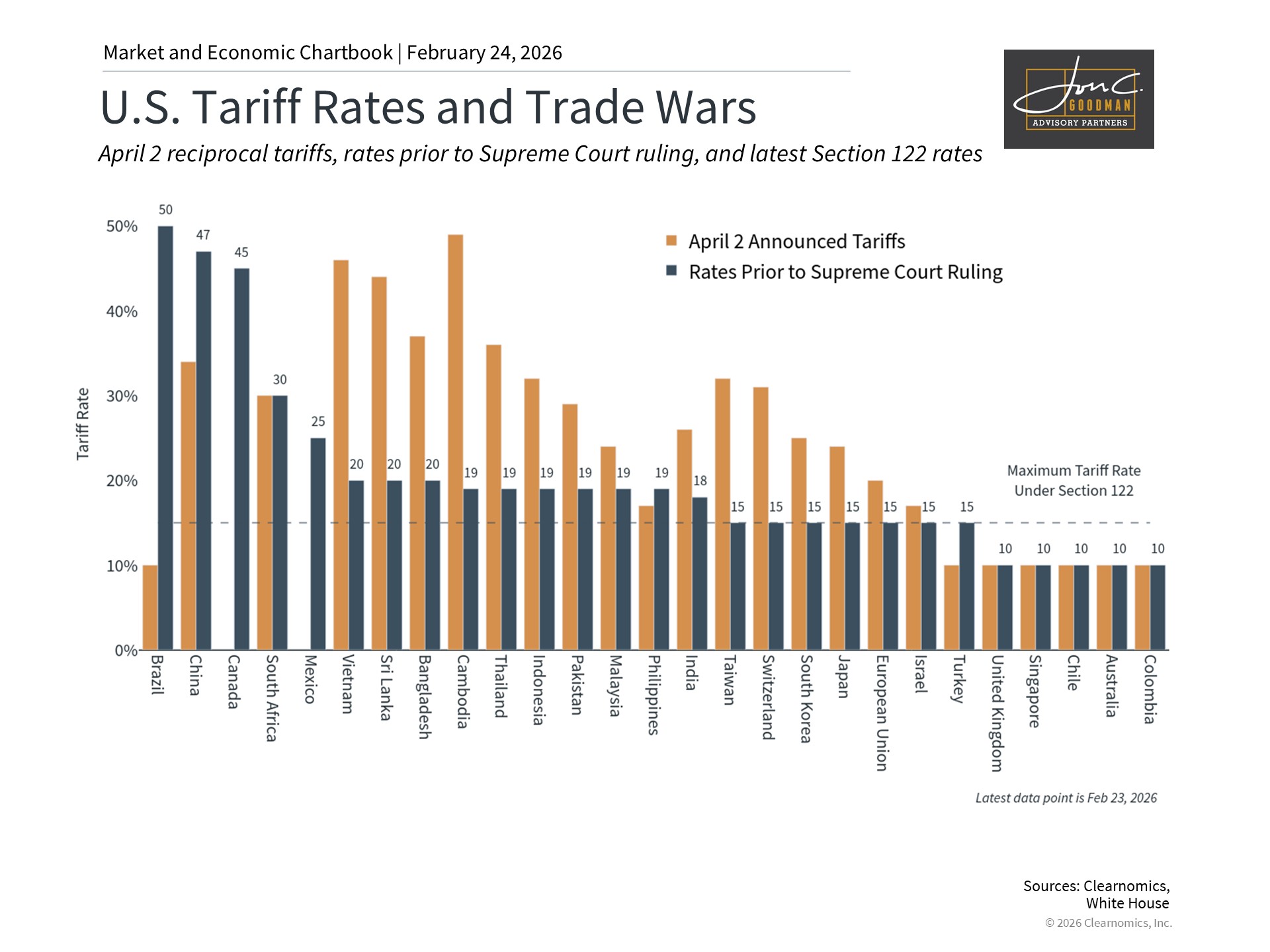
The reciprocal tariffs announced on “Liberation Day” last April were implemented under the International Emergency Economic Powers Act, commonly known as IEEPA. This 1977 law grants the president broad authority to regulate commerce in response to a declared national emergency. In this instance, the stated emergency encompassed the country’s persistent trade deficits with numerous nations, illegal drug trafficking, and immigration concerns.
Below is a summary of the key events:
- On April 2, 2025, the initial announcement established a baseline 10% tariff on nearly all trading partners, with higher country-specific rates added on top. The immediate market reaction was sharp, producing a correction across major indices. Perhaps more significantly, investors worried that tariffs would trigger “stagflation,” as tariffs could push inflation higher while dragging economic growth lower—a scenario that has historically been damaging to both stocks and bonds.
- On April 9, 2025, the administration announced a 90-day pause on the country-specific increases, retaining only the baseline rate. Markets began rebounding almost immediately and climbed to new all-time highs within just a few months. Trade agreements were subsequently reached with individual countries and regions.
- On February 20, 2026, the Supreme Court ruled that the administration lacked the authority to impose broad global tariffs under IEEPA, reaffirming Congress’s central role in shaping trade policy.
Tariffs are not going away
The administration had been aware of the possibility of this ruling, and alternative legal pathways for imposing tariffs had been widely explored in advance. Following the Supreme Court’s decision, the administration moved quickly to implement tariffs under a different statute, Section 122 of the Trade Act of 1974. This law was selected over other options because it can be applied to multiple countries simultaneously and does not require lengthy investigations or reports that could take many months to complete.
Specifically, Section 122 allows the president to impose tariffs of up to 15% for a period of 150 days without requiring Congressional approval. The intent behind this law was to give presidents the ability to respond to trade imbalances and threats without completely circumventing Congress. Historically, during the period when the dollar was still backed by the gold standard, this authority was at times necessary to protect the currency.
This means that while some of the higher tariff rates introduced in 2025 may be scaled back, and the new tariffs may not persist beyond several months, tariffs are likely to remain an active instrument of policy. Businesses and investors should anticipate continued uncertainty around tariff levels and ongoing negotiations with individual trading partners.
Additional areas of uncertainty remain, including whether and how refunds will be administered. Courts must still determine whether businesses that paid tariffs under the IEEPA framework are entitled to refunds, and whether individual Americans would be eligible for any reimbursements. In the most challenging scenario, clarity could be years away. Nevertheless, for businesses and consumers, the prospect of refunds represents a potential uplift to corporate earnings, capital investment, and disposable income.
Economic outcomes don’t always follow the textbook
Economics is sometimes referred to as the “dismal science,” in part because of its limited track record when it comes to forecasting responses to major policy shifts. When tariffs were raised to their highest levels since the Great Depression, many anticipated demand destruction, rising inflation, a strengthening dollar, and struggling markets.
Why did these fears not fully materialize? First, tariff levels changed quickly and repeatedly. The 90-day pause announced just one week after Liberation Day dramatically reduced the effective tariff burden on most trading partners, meaning the highest announced rates never truly took effect except with a small number of trading partners.
Second, companies responded by stockpiling imported goods well ahead of the April deadlines. This behavior was clearly visible in trade data, which showed a notable spike in imports during the first quarter of 2025 as businesses front-loaded their purchases. As a result, the immediate inflationary impact was cushioned, at least in the near term.
Third, and perhaps most consequential for markets, the underlying fundamentals of the economy remained solid. Inflation continued to moderate, with the Consumer Price Index rising just 2.4% year-over-year in January 2026. Real GDP grew at a modest but healthy 2.2% pace for all of 2025, according to the latest report from the Bureau of Economic Analysis. Corporate earnings also remained strong, supporting valuations and long-run growth prospects.
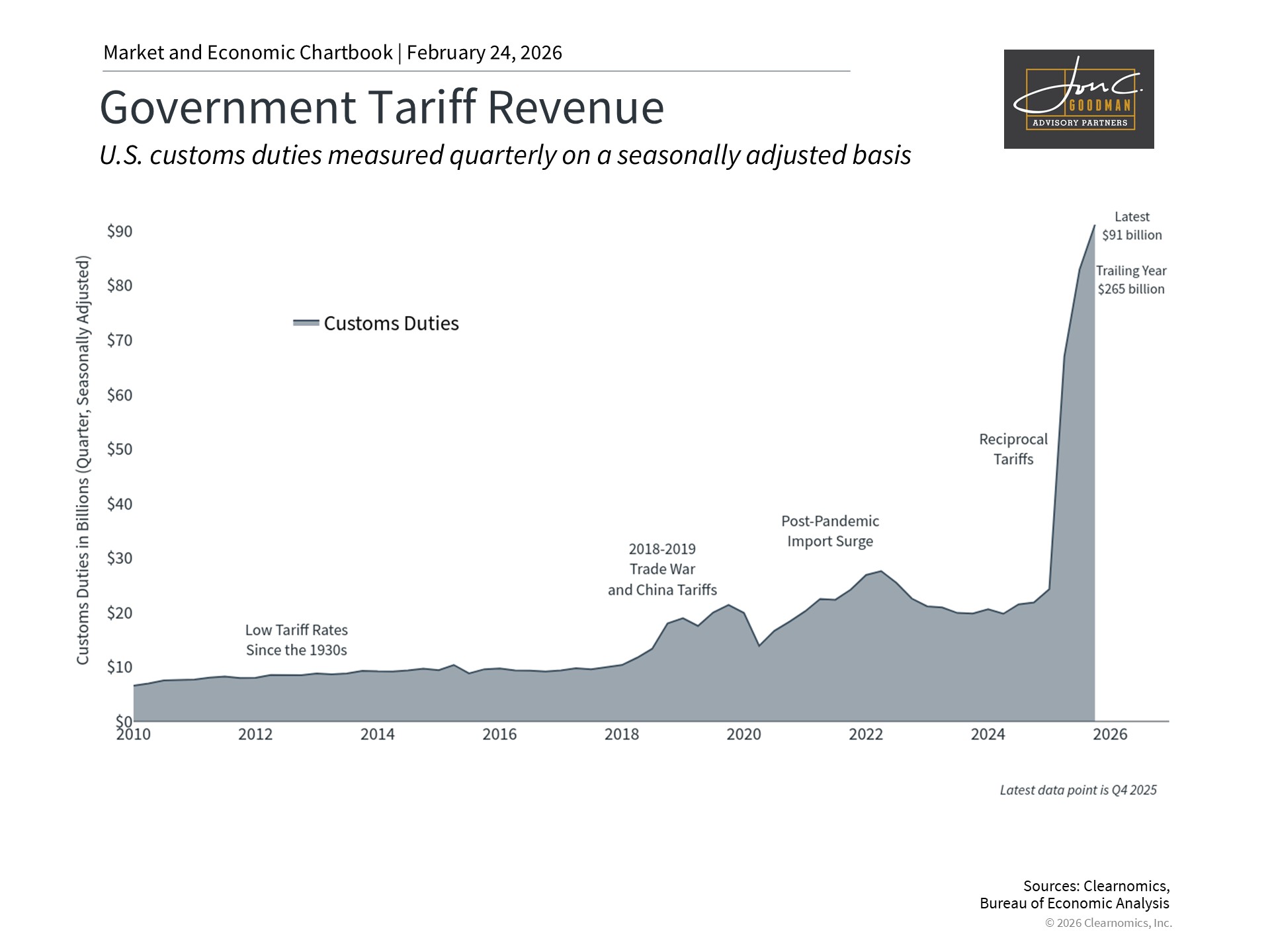
This is not to say that tariffs had no impact. The federal government collected hundreds of billions of dollars in tariffs, costs that were borne by both consumers and businesses. However, the experience of the past year serves as a reminder that economic outcomes are rarely as clear-cut as headlines suggest—and that is precisely why investors should resist reacting to worst-case scenarios.
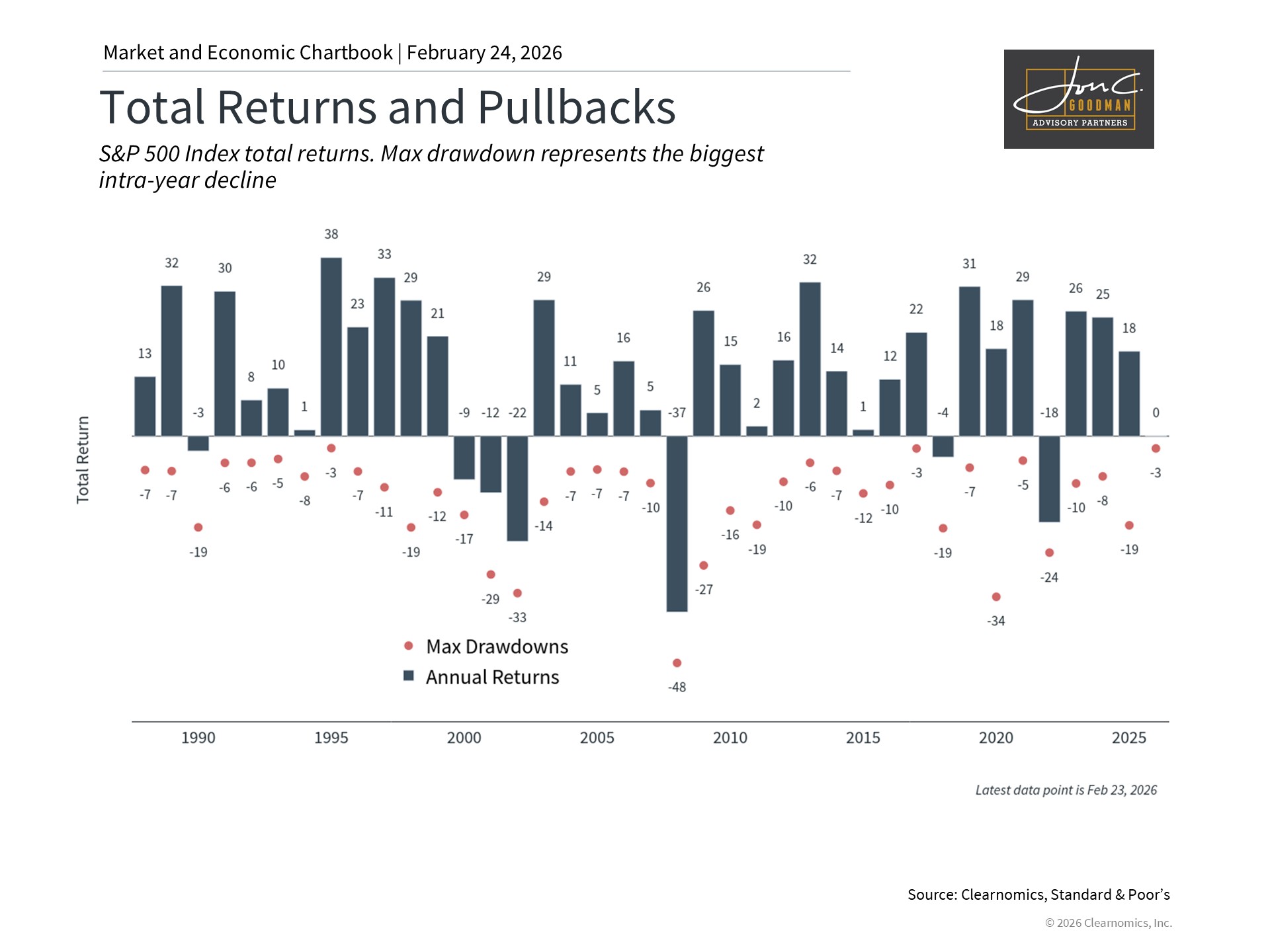
The most evident lesson from the past year of tariff-driven volatility is one that applies to virtually every period of market and policy uncertainty: by far the most effective course of action for investors was to stay invested. Attempting to predict the precise impact of tariffs on the economy and markets is not only difficult but potentially counterproductive. As the accompanying chart illustrates, years that featured significant intra-year pullbacks have very often still concluded with positive returns.
The bottom line? It’s important to separate political views from portfolios and financial plans. Trade policy, legal battles, and political debates are important for taxpayers and voters, but they often lead to the wrong investment decisions. The history of markets shows that economic fundamentals, corporate earnings, and investment principles matter far more to achieving financial goals.

Wellness Navigator and Holistic Brain Health Coach, Christine Despres, RN,NBC-HWC,CDP
Why Your Heart Health Matters More to Your Brain Than You Think
February was a month centered on love – not just romantic love, but love for yourself and your long-term brain health. February was also American Heart Month, which is fitting. Because heart and brain health? They’re inseparable.
Cardiovascular disease is the leading cause of death worldwide, and nearly half of Americans are living with it. While heart attacks and strokes are among its most serious outcomes, they aren’t the only ways an unhealthy cardiovascular system affects the body.
Heart and brain health are deeply connected. The same network of blood vessels that keeps the heart functioning also supplies the brain with oxygen and nutrients. When those vessels become unhealthy, their dysfunction affects memory, cognitive function, and long-term brain health.
Your heart and brain talk to each other constantly
The vagus nerve is something I’m just beginning to learn about myself, and I want to share what I’m discovering with you.Think of the vagus nerve as the main telephone line between your heart and brain. It runs from your brainstem down through your chest, and it’s constantly sending messages both ways.
This is your body’s internal brake system – the pathway that allows you to shift into what’s called “rest and digest” mode. When your vagus nerve is working well, your nervous system can downshift after stress. You can actually calm down, think clearly, and recover.
When you’re stressed and your heart is racing? That signal goes straight to your brain. When you take a deep breath and your heart calms down? You’re activating the vagus nerve, telling your whole system it’s safe to slow down.
This is why a breathing exercise can actually change how you think and feel – you’re literally changing the conversation between your heart and brain.
Strengthening this connection – your vagal tone – is one of the most powerful things you can do for both heart and brain health.
Blood pressure matters more than most women realize. Too high damages vessels. Too low means not enough brain perfusion. There’s a sweet spot – and protecting it protects your cognitive function. Inflammation in your arteries doesn’t stay there. It triggers a cascade that reaches your brain.
This is why inflammation is one of the most important things we can address for disease prevention. It’s not just about your heart or just about your brain – it’s the common thread linking cardiovascular disease, cognitive decline, and so many chronic conditions.
But here’s the good news: inflammation is something you can actively reduce. When you lower systemic inflammation, you’re protecting both your heart and your brain at the same time.
5 things to do for your heart-brain connection
1. Zone 2 Cardio – 30-45 minutes, 3-4x weekly at a pace where you can still talk. This builds the small blood vessels that feed your brain.
2. Vagal Tone Training – 5 minutes of box breathing daily. Inhale 4, hold 4, exhale 4, hold 4. This strengthens your vagus nerve and improves your ability to recover from stress.
3. Strength Training – 2-3x weekly. Muscle helps regulate blood sugar and blood pressure – both critical for brain health.
4. Manage Blood Pressure – Know your numbers and keep them in the healthy range. Too high damages blood vessels. Too low reduces brain perfusion. Find your sweet spot.
5. Reduce Inflammation – Through diet and lifestyle choices like the MIND Diet. Cut processed foods, add omega-3s, prioritize sleep, manage stress. Lowering systemic inflammation protects both heart and brain.
Most people wait until they have symptoms – brain fog, memory issues, confusion – before thinking about brain health. By then, we’re trying to reverse damage instead of prevent it.
Your heart-brain connection is something you can strengthen now. The choices you make in midlife shape your cognitive clarity later. Let’s GO!
Your brain is worth protecting,
Christine
Registered Nurse | Board-Certified Health & Wellness Coach | Holistic Brain Health Coach
https://www.thewellnessnavigator.com/
P.S. If you’re curious about inflammation, understanding your own reward patterns, or how your habits might be affecting your brain health – let’s talk. Book a free 30 minute Brain Strategy Session.

When the Map Doesn’t Make Sense
If you’ve looked at the weather maps lately, you’ve probably done a double take.
The West—Colorado, Utah, Idaho, Oregon—showing record-low February snowpack. At the same time, much of the East is experiencing one of its coldest stretches in decades. Warm where it’s usually cold. Cold where it’s often milder. It feels…off.
This isn’t a one-off curiosity. It’s a reminder that the systems we rely on—weather, water, growing seasons—are dynamic, not static. And when patterns shift, even temporarily, the ripple effects are real.
Near term, less snowpack in the West matters. Snow is stored water. It feeds rivers, agriculture, reservoirs, and power generation. A thin snowpack today can mean tighter water supply this summer, higher energy costs, and pressure on farming and food prices. Meanwhile, extreme cold in the East stresses infrastructure, increases heating demand, and disrupts travel and commerce.
Longer term, the takeaway isn’t panic—it’s preparation. Just as we diversify investments because markets are unpredictable, the physical world carries its own volatility. Regions, industries, and households that plan for variability—not just averages—tend to be more resilient.
There’s also a mindset shift here. For decades, we’ve built plans—financial and otherwise—assuming stability. Increasingly, the edge goes to those who plan for change.
The map may look strange. But the lesson is familiar:
Don’t assume tomorrow will look like yesterday. Build accordingly.
Practical CTAs (Resilience Over Reaction)
1. Harden your home – In wildfire-prone areas, consider defensible space, fire-resistant materials, and basic “fireproofing” measures.
2. Review your homeowner’s insurance – Make sure coverage reflects current replacement costs and regional risks—not what your home was worth years ago.
3. Build a small “resilience reserve” – An emergency fund isn’t just for job loss—it’s for unexpected spikes in utilities, repairs, or disruptions.
4. Audit your utilities and usage – Water, heating, cooling—efficiency upgrades now can reduce exposure to rising costs later.
5. Think geographically about risk – Just as you diversify investments, consider how location (primary residence, second property, or investments) impacts long-term resilience.
On a More Positive Note: February’s Hidden Gift…Significantly More Light
While the weather may feel unpredictable, one thing remains beautifully consistent: the return of light.
Across the U.S., February quietly delivers 30 to 80 extra minutes of daylight depending on where you live. That’s more than a minute gained every day—often without us noticing.
It’s a reminder that progress is often incremental—small gains that compound into something meaningful.
The same is true in life, health, and money.
Bonus CTA:
The days are getting longer—lace up your shoes, get outside, and start capturing that Vitamin D. Small steps, taken daily, change everything.
That’s all for today.
Until next time,
Take care,
