

Greetings!
Welcome to this week’s Advice for the Good Life—where we bring clarity to complexity and focus on the things that quietly shape better outcomes over time.
In today’s Wealth Advisory, we explore how artificial intelligence is influencing markets, investor expectations, and recent volatility. You’ll see why today’s AI moment fits a familiar historical pattern, how markets tend to over- and under-react to innovation, and why long-term discipline, diversification, and asset allocation still matter more than any single trend or headline.
Next, our favorite Wellness Navigator, Christine Despres, shares insights from a 30-day break from alcohol—and what it revealed about inflammation, sleep, dopamine, and brain health. This isn’t about perfection or permanent change. It’s about awareness: how our brains seek reward, how habits quietly shape outcomes, and how small experiments can surface powerful information about our health and resilience.
And finally, in Etcetera, I share today’s millionaireME Minute that reflects on a timeless lesson from Coach Mike Krzyzewski: “Get on the right bus.” Using a modern NFL example, it explores how environment, standards, and who you run with often matter more than raw talent or effort. Direction—and the company you keep—quietly determines trajectory.
As always, we hope you enjoy the read. If something resonates, please share it. And if this was forwarded to you, we’d love to have you subscribe and join us each week for Advice for the Good Life.
Thank you for reading.
Wealth Advisory: AI’s Impact on Markets…What Investors Need to Know
Over a decade ago, venture capitalist Marc Andreessen proclaimed that “software is eating the world.” His prediction—that any service capable of being automated through software would eventually be transformed—has proven remarkably prescient. The rise of cloud computing, software-as-a-service platforms, and digital ecosystems has fundamentally altered industries and consumer behavior. For investors, these shifts carry significant implications and contribute to recent market turbulence.
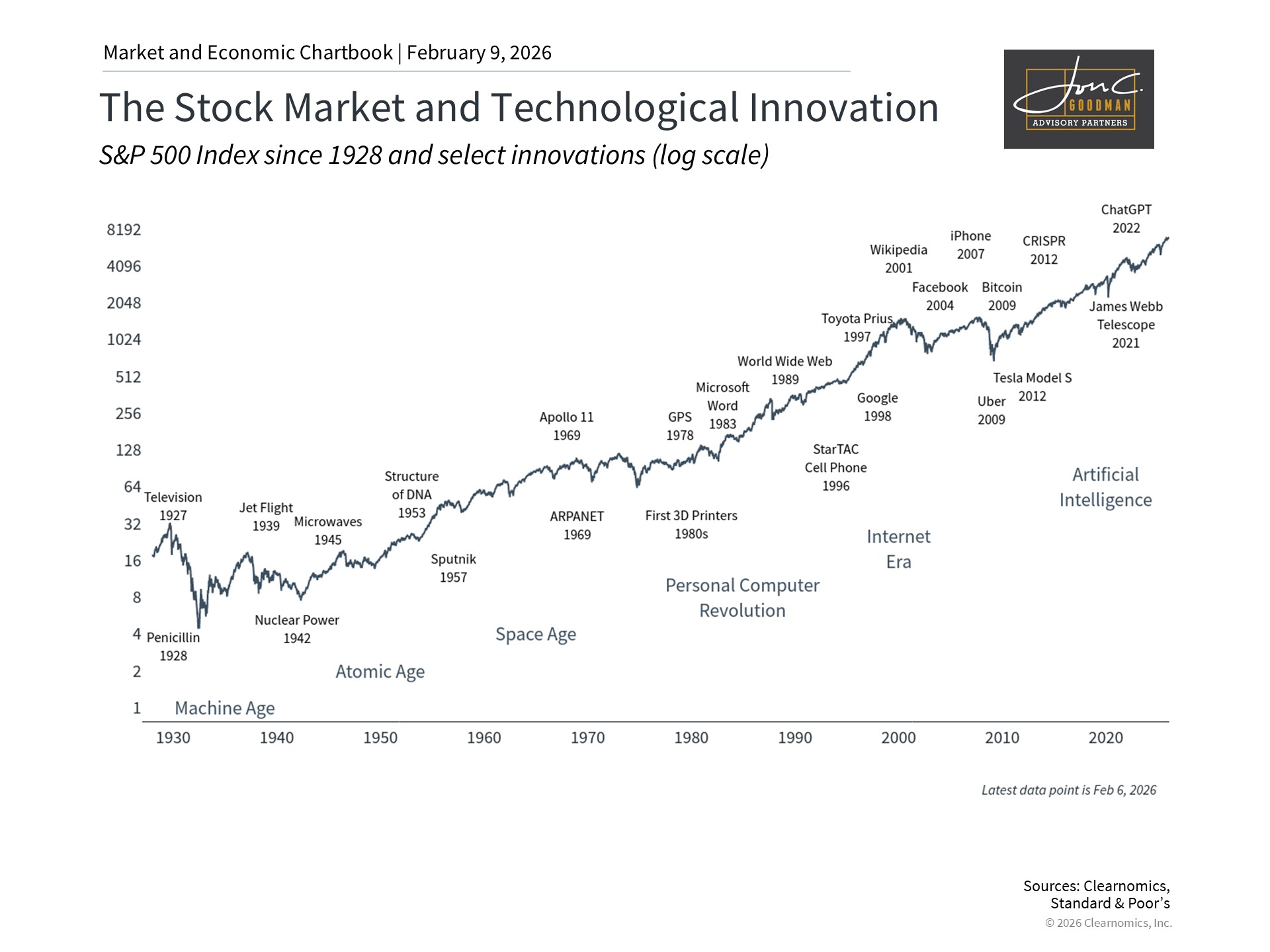
Artificial intelligence now represents the latest chapter in this ongoing transformation. As with previous technological revolutions, markets are grappling with its implications for individual sectors and the broader economy. For those investing with a long-term horizon, examining how similar cycles have evolved historically can offer valuable perspective.
Innovation inherently brings disruption, and recent swings in technology stocks illustrate the difficulty of forecasting these developments. When Anthropic, a prominent AI firm, unveiled new automation capabilities that could replace specialized software in fields like legal and financial analysis, investors reconsidered traditional software business models. Major technology companies also faced pressure after disclosing over a hundred billion dollars in quarterly AI infrastructure spending, prompting doubts about potential returns.
Notably, this happened almost precisely one year following the “DeepSeek moment” of January 2025, when a Chinese AI developer suggested that advanced AI models could be developed far more economically. In both instances, markets reassessed which companies would benefit or suffer from technological change, yet recovered relatively quickly. These episodes remind investors that maintaining long-term focus matters as markets oscillate between recognizing innovation’s promise and disruption’s risks.
Historical patterns emerge in technological shifts
Today’s AI-driven uncertainty may seem unique, but historical evidence reveals that technological upheavals follow recognizable trajectories. Reflect on software’s evolution over recent decades: from boxed products installed on individual machines, to internet-connected mobile platforms, to the underlying infrastructure of modern work, communication, commerce, banking, and entertainment. Each innovation wave creates distinctions between “old economy” and “new economy” players, challenging markets to identify the winners.
Artificial intelligence could transform the creation of services themselves, extending software’s displacement of traditional processes. Yet even the most revolutionary technologies rarely eliminate the need for specialized knowledge and services. Regardless of their sophistication, AI systems will still depend on high-quality data, dependable platforms, and distinct domain expertise. Consumers will likewise continue prioritizing trust, personalization, and quality results.
The competitive landscape for delivering these services may evolve, but core needs will probably persist. Just as individuals don’t manufacture their own vehicles or reassemble them for each trip, AI applications will continue relying on established infrastructure and specialized offerings. This dynamic typically benefits consumers through enhanced products, reduced costs, and broader access to services.
Maintaining realistic expectations about transformation timelines is equally important. Although AI companies have forecasted the emergence of “artificial general intelligence” or “artificial super intelligence” for several years, recent indicators suggest that advances in AI training have moderated somewhat. Nevertheless, current AI capabilities are already impressive and clearly sufficient to reshape investor sentiment.
Employment trends contribute to economic concerns
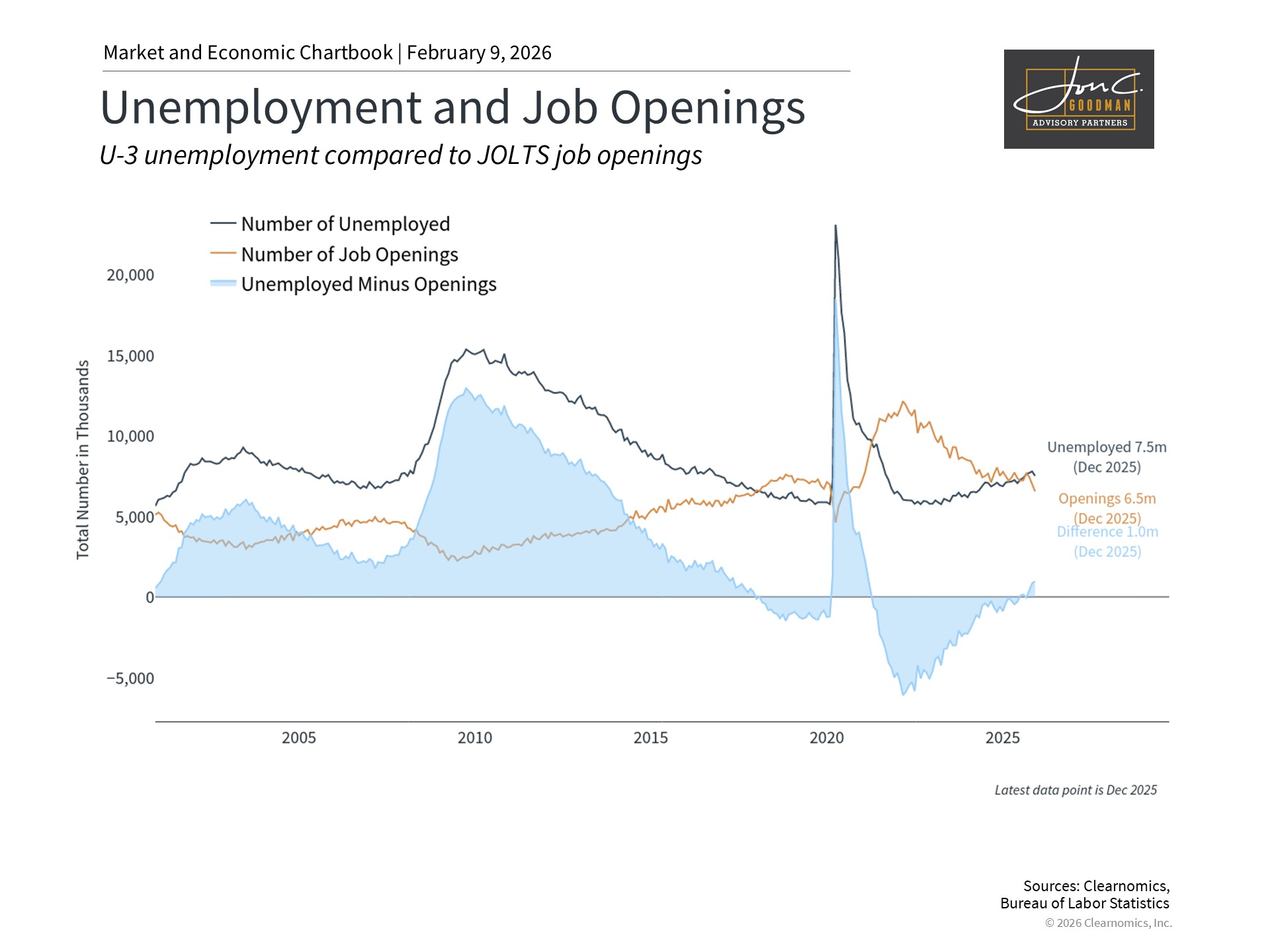
Compounding investor anxiety is a labor market that has softened since mid-2025. Recent Bureau of Labor Statistics data revealed that job openings dropped to their lowest point since 2020 in December. The ratio has shifted from more than two openings per job seeker at its peak to less than one currently, with approximately 6.5 million openings for 7.5 million unemployed workers. Additionally, Challenger, Gray & Christmas reported that January job cuts surged to 108,435, representing a 118% year-over-year increase and the highest January figure since 2009.
While no clear evidence links these job reductions directly to AI, such trends influence the overall economic picture. Historically, major technological waves—from the Industrial Revolution through the Information Technology Revolution—have ultimately generated more employment opportunities than they eliminated, though transition periods requiring worker retraining can prove challenging for both individuals and society.
Meanwhile, weakening employment conditions have concerned some investors following years of stronger-than-anticipated economic expansion. This situation also affects the broader outlook and Federal Reserve policy trajectory. Other economic indicators remain solid, however, including sustained consumer spending supported by near-record household wealth and inflation holding steady below 3%. Despite certain headwinds, there are grounds for optimism about continued healthy economic growth.
Portfolio implications of current developments
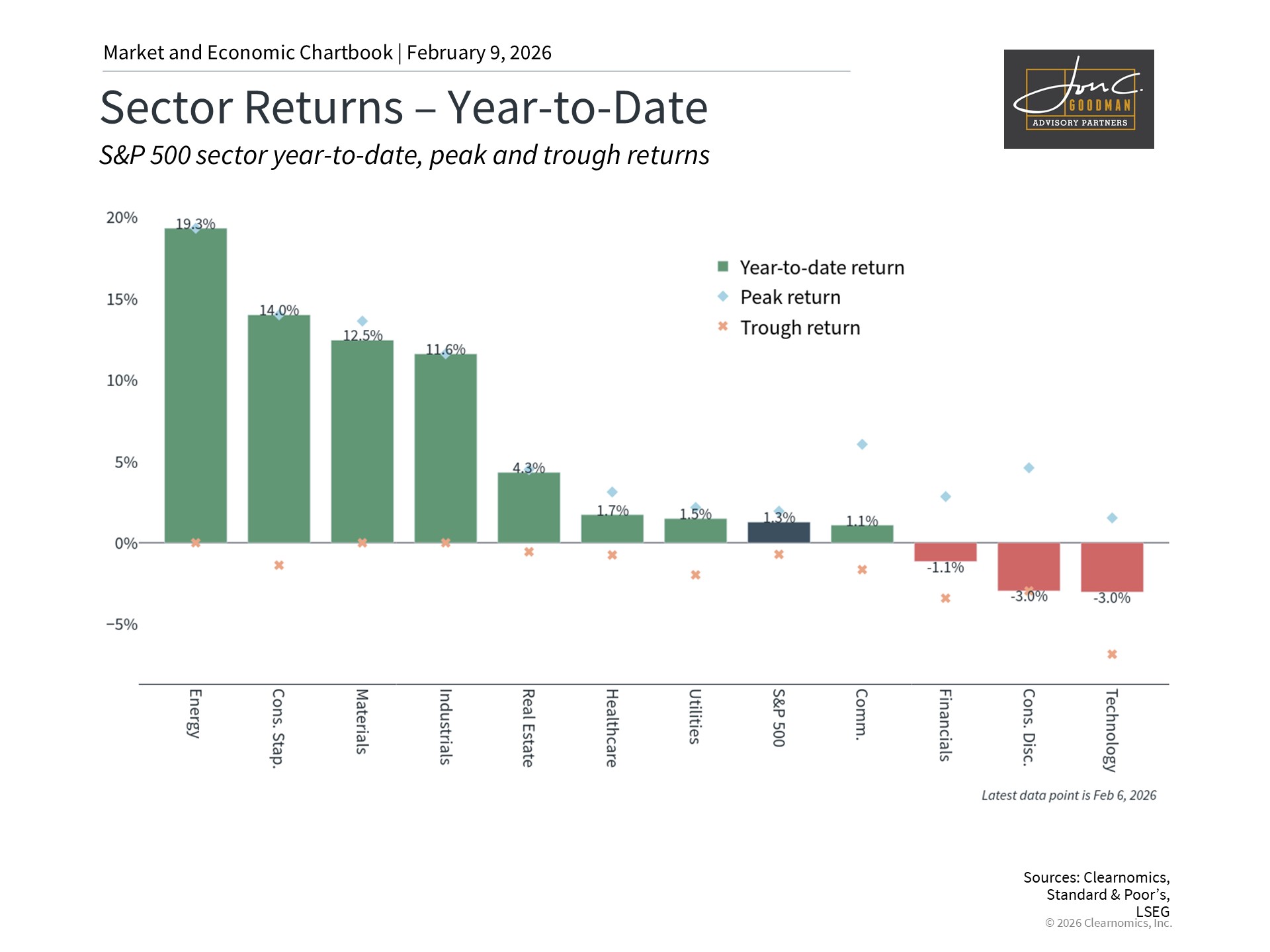
Recent volatility reinforces that asset allocation outweighs any individual trend or news item for investors. Information Technology and Communication Services sectors have delivered strong performance in recent years but are also prone to fluctuations as expectations change. These sectors are sensitive to long-term factors including interest rates, making them vulnerable to Federal Reserve uncertainty. While groups like the Magnificent 7 have excelled over recent years, they can underperform during periods like 2022 or the past two months.
Stock market valuations present perhaps the most significant question. With the S&P 500’s price-to-earnings ratio approaching historically elevated territory, investors have been shifting into sectors such as Consumer Staples, Energy, Materials, and Industrials. This may signal increased market selectivity and interest in opportunities beyond AI. After all, AI’s prominence in investor consciousness doesn’t preclude attractive prospects elsewhere in the market.
Cryptocurrencies have also experienced substantial declines recently, with Bitcoin dropping 50% to slightly above $60,000 before partially recovering. From a portfolio standpoint, this illustrates that cryptocurrencies remain highly volatile assets susceptible to sentiment shifts that often lack clear explanations. For those considering these assets, determining their role within a balanced portfolio far exceeds the importance of market timing attempts.
Current AI developments should be evaluated within the broader context of market and economic evolution. If historical patterns hold, markets will likely overreact and underreact to these trends in the near term. Experience demonstrates that patient, properly positioned investors are best situated to reach their financial objectives.
The bottom line? Although AI is prompting reassessment of particular stocks and sectors, fundamental investment principles endure. Maintaining portfolio alignment with your financial objectives remains the optimal approach for navigating periods of rapid transformation.

Wellness Navigator and Holistic Brain Health Coach, Christine Despres, RN,NBC-HWC,CDP
I removed alcohol for 30 days. What my brain did next surprised me.
I did Dry January. And what I learned about my brain’s reward system was fascinating.
I had this whole list in my head: drop a few pounds, sleep better, look refreshed and glow. The standard stuff.
That’s not exactly what happened.
Alcoholism and Alzheimer’s run in my family. I carry the APOE gene, which means higher risk for cognitive decline. When diseases run in your family, it doesn’t doom you – but it does make you more susceptible. So why not build a lifestyle that supports your best health?
But there are plenty of reasons to try this – liver health, blood sugar, blood pressure, sleep quality, autoimmune flares, skin issues, brain fog, perimenopause symptoms. Alcohol quietly affects all of them.
I’ve done Dry and Damp January before, so I knew I could get through it. But what hit me this time – all-or-nothing is way easier than trying to moderate. No mental gymnastics about “should I have one tonight?” Just no. Done.
The research backs this up. A Brown University review of over 150,000 people found complete abstinence showed way more dramatic results than just cutting back – sleep quality up 18%, liver fat down 15%, blood glucose down 23%. For my brain? I wanted to feel the full reset.
Your brain’s reward system doesn’t mess around
Take away one source of dopamine, and your brain immediately hunts for a replacement.
For me, it was surprisingly sugar. I’m normally a salty, cheese-and-bread person, not sweets. But this month I was craving desserts when I hit the couch on Friday night. My brain was screaming “give me dopamine ANY way you can get it.” “Where’s my treat?”
Alcohol triggers dopamine release – that’s why it feels relaxing. When you remove it, your brain starts scanning for alternatives. Sugar? Dopamine. Shopping? Dopamine. Scrolling? Dopamine.
What actually changed
The inflammation changes were dramatic. Less stiff, way less swollen – my rings were literally falling off. That morning stiffness I thought was just part of being 50-something? Gone.
We’re finding links between chronic inflammation and over 130 different diseases, from heart disease to Alzheimer’s. Alcohol is one of those sneaky triggers we don’t always connect. A glass or two feels relaxing in the moment, but your body’s working overtime to process it. The inflammation shows up as joint pain, brain fog, disrupted sleep and weight gain around the middle.
My sleep got insanely better. Those 3am spirals where you replay every conversation and worry about everything? Stopped. Hot flashes and night sweats dramatically reduced. Sheet karate minimized!
The best part? Mondays stopped being a reset. I was building on the week before instead of constantly starting over. I could feel it most at yoga – better balance, stronger, actually making progress and building on it. That felt really good.
My big pro tip, having my significant other do it with me.This made all the difference. If there’d been alcohol consumption at home? Way harder. We did mocktails together.
Whether it’s alcohol, sugar, scrolling, shopping – we all have patterns our brains rely on for dopamine hits. The question isn’t whether you have them. It’s whether you’re aware of them.
When you remove one reward, watch what your brain does. Where does it go looking? That’s information. Your micro habits are either helping you or harming you. That’s what we need to think about.
I’m having that glass of wine again (probably a good Burgundy). But now I understand how my reward system works. What inflammation was doing that I’d accepted as normal. What my body was trying to tell me.
Did you try Dry January? Maybe February is a better month? What did you notice about your reward patterns or how your body responded? Send me a message – I want to hear about it.
To your health,
Christine
Registered Nurse | Board-Certified Health & Wellness Coach | Holistic Brain Health Coach
https://www.thewellnessnavigator.com/
P.S. If you’re curious about inflammation, understanding your own reward patterns, or how your habits might be affecting your brain health – let’s talk. Book a free 30 minute Brain Strategy Session.

⏱️ millionaireME Minute | The Paramount Importance of Getting on the Right Bus 🚌
One of the simplest pieces of advice I’ve ever received is also the most enduring.
For me, it came from the winningest college basketball coaches in history, Mike Krzyzewski, and it’s something he shares often, for good reason.
It’s something his mother told him early in life back when he was a total unknown, just a Polish kid growing up in Chicago:
“Get on the right bus. It’ll take you to all the places you want to go.”
As he tells the story, it’s why he reluctantly climbed aboard the United States Military Academy, West Point, after high school.
Not the fastest bus.
Not the flashiest bus.
The right bus.
Sunday night’s Super Bowl, featuring Sam Darnold, quarterback for the Seattle Seahawks, was a reminder that being like Mike and subscribing to that truth still works.
No one would’ve asked a guy drafted by the 2018 New York Jets if he’d become a Super Bowl champion—let alone one of the winningest players in the NFL over the past two seasons, including his time last year with the Minnesota Vikings.
After stints with the Carolina Panthers and San Francisco 49ers (where he was a backup quarterback), Darnold finally became a free agent, and he chose well.
And not just once.
Twice.
First, with his one-year contract at Minnesota.
Then his $100.5M contact with Seattle.
Same Sam Darnold.
Different environments.
Different coaches.
Different teammates.
Different standards.
The only real change?
He consistently chose to run with winners.
Until he won. 🏆
This isn’t just a sports lesson. It’s a life one.
Your trajectory is shaped less by your raw talent and more by:
- who you learn from
- what you tolerate
- what “normal” looks like around you
Winning cultures don’t just raise performance—they rewrite belief.
If you want better outcomes, ask a better question:
👉 Am I on the right bus?
👉 And, is so, where is it headed?
Because, yes, of course, effort matters.
And so does talent.
But direction—and who you’re riding with—matters more than we like to admit.
Choose wisely.
That’s all for this week.
Until next time,
