| Greetings!
Welcome back to “Advice for the Good Life,” where each week we take a deep breath, look around, and get directionally correct in the areas that matter most—your wealth, your wellness, and your wider life. As we enter the final month of 2025, my hope is that this newsletter gives you both clarity and calm, along with a nudge toward living your best life with intention.
In today’s Wealth Advisory, we look at a November defined by volatility—AI stocks wobbling, shifting expectations around Federal Reserve policy, and the aftershocks of a prolonged government shutdown. Despite the noise, the enduring lesson remains the same: markets give and markets take, but long-term success belongs to those who stay disciplined, diversified, and level-headed. We’ll unpack what moved the markets and how to finish the year with confidence rather than concern.
Next, your Wellness Navigator, Christine Despres invites us to approach these last 30 days with purpose. Instead of rigid resolutions, she shows how to craft a personalized Wellness Vision for 2026—one grounded in who you want to become, not what you think you “should” fix. It’s practical, it’s hopeful, and it’s exactly the kind of work that helps you end the year energized rather than depleted.
And in Etcetera, we zoom out to the cultural moment with a look at what Black Friday, Small Business Saturday, and Cyber Monday really revealed about America this year. Record sales told one story; rising prices, shrinking baskets, and widening divides told another. It’s a reminder to stay thoughtful about how we spend, save, give, and support the communities we care about.
As always, I hope you’ll enjoy, share, and pass along anything here that helps you or someone you love take a step toward a happier, healthier, wealthier, and wiser life.
Here’s to finishing the year strong—and living the good life on purpose.
Wealth Advisory: Navigating Volatility in AI and Federal Reserve Policy
November brought a temporary surge in market volatility that impacted numerous asset classes. Despite robust year-to-date performance across equities, fixed income, and international markets, concerns persisted regarding artificial intelligence stocks and the Federal Reserve’s interest rate trajectory. Additionally, the government shutdown caused delays in releasing crucial economic data, complicating efforts to assess the economy’s health.
By month’s end, many asset classes had stabilized and recovered from earlier losses. This pattern reinforces a fundamental investing principle for those with long-term horizons: maintaining a well-structured portfolio capable of weathering market fluctuations. Achieving investment success means keeping sight of long-term objectives instead of pursuing fleeting gains or responding emotionally to news cycles.
What factors influenced November’s market movements, and how should investors maintain their composure as the year draws to a close?
November’s Primary Market and Economic Developments
- The S&P 500 edged up 0.1% in November, while the Dow Jones Industrial Average advanced 0.3%, and the Nasdaq fell 1.5%. For the year through November, the S&P 500 has climbed 16.4%, the Dow has risen 12.2%, and the Nasdaq has surged 21.0%.
- The VIX, which measures equity market volatility, concluded the month at 16.35 after reaching an intra-month peak of 26.42.
- The Bloomberg U.S. Aggregate Bond Index increased 0.6% in November and has advanced 7.5% year-to-date. The 10-year Treasury yield closed November at 4.02%, after momentarily dipping below the 4% threshold.
- International developed markets, measured by the MSCI EAFE Index, rose 0.5% in U.S. dollar terms, whereas emerging markets declined 2.5% according to the MSCI EM Index. Year-to-date returns stand at 24.3% for the MSCI EAFE Index and 27.1% for the MSCI EM Index.
- The U.S. dollar index finished at 99.46, temporarily surpassing the 100 mark during the month.
- Bitcoin suffered a substantial decline of approximately 17% in November, closing at $91,176.
- Gold prices concluded November higher at $4,218, though remaining below October’s record high of $4,336.
- The delayed September employment report, published after the government shutdown concluded, revealed 119,000 new jobs were added while the unemployment rate increased to 4.4%. An October employment report will not be issued.
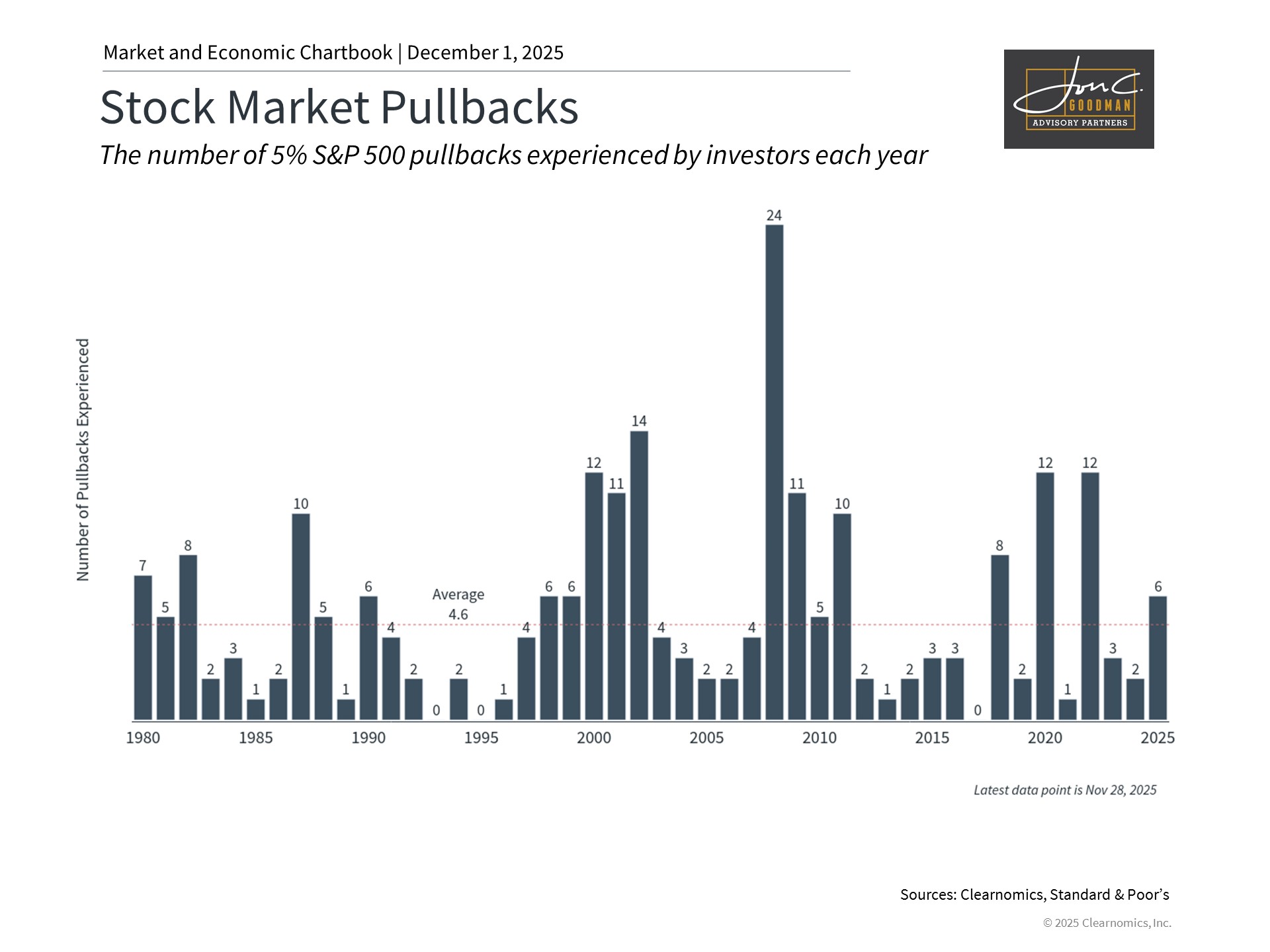
A temporary “risk off” environment emerged in markets.
Throughout November, investors temporarily retreated from risk assets including technology equities, high-yield corporate bonds, digital currencies, and similar investments. The shift stemmed primarily from doubts about the viability of AI-related investments and recalibrated expectations regarding future Federal Reserve rate reductions. The S&P 500 has now experienced six pullbacks of 5% or greater this year, the highest count since 2022 though consistent with historical norms. Several major asset classes rallied in the closing days of November, allowing the S&P 500 to finish marginally positive.
AI-focused technology stocks endured their most challenging week since April during the month. Volatility stemmed from concerns about corporate spending patterns, leverage levels, profitability, and speculation about potential overvaluation. However, underlying business fundamentals remained solid, with companies like Nvidia posting robust third-quarter revenue and earnings growth. Certain equities, including members of the Magnificent 7, recovered following these quarterly announcements.
Digital currencies underwent a pronounced correction amid this risk-averse environment. Bitcoin tumbled more than 30% from its early October peak above $125,000, briefly falling below $85,000 and erasing its year-to-date appreciation. Though cryptocurrency adoption among investors has expanded, such episodes illustrate that these and comparable assets can exhibit highly speculative characteristics and experience dramatic cycles. Consequently, disciplined risk management and appropriate asset allocation remain essential.
Fixed income markets advanced in November, supported partly by declining long-term interest rates, with the 10-year Treasury yield momentarily dropping below 4% again. This movement reflected evolving expectations regarding government policy that could lead to lower rates over time. Through November, the Bloomberg U.S. Aggregate Bond Index has returned 7.5%, marking its strongest performance since 2020. This has contributed valuable balance to diversified investment portfolios.
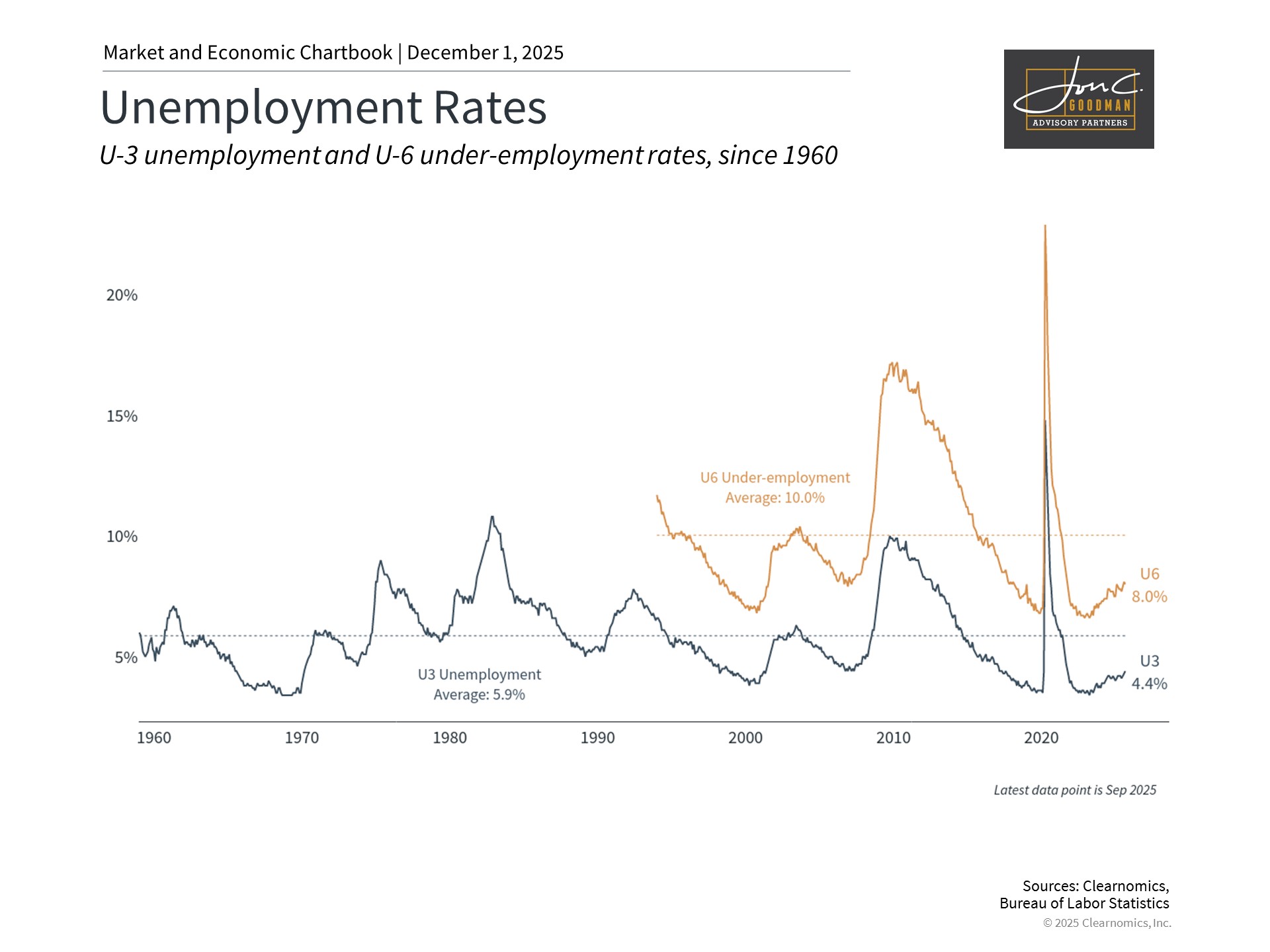
Government shutdown concluded but economic uncertainty persists.
The historically lengthy 43-day government shutdown concluded, though federal funding extends only through January 2026. This timeline ensures political uncertainty will resurface in just a few months. Nevertheless, markets largely overlooked the shutdown, despite increased difficulty stemming from absent economic data.
The Bureau of Labor Statistics finally released the September employment report, initially scheduled for October publication. The data showed job creation surpassed expectations for September, recovering from summer weakness. However, revised statistics indicate 4,000 jobs were eliminated in August, marking the second month of negative employment growth this year. September’s unemployment rate climbed to 4.4%, its highest point since October 2021, though this level remains historically modest.
A complete October employment report will not be released since household and business surveys were not administered that month, although selected data will appear with November’s report on a delayed schedule.
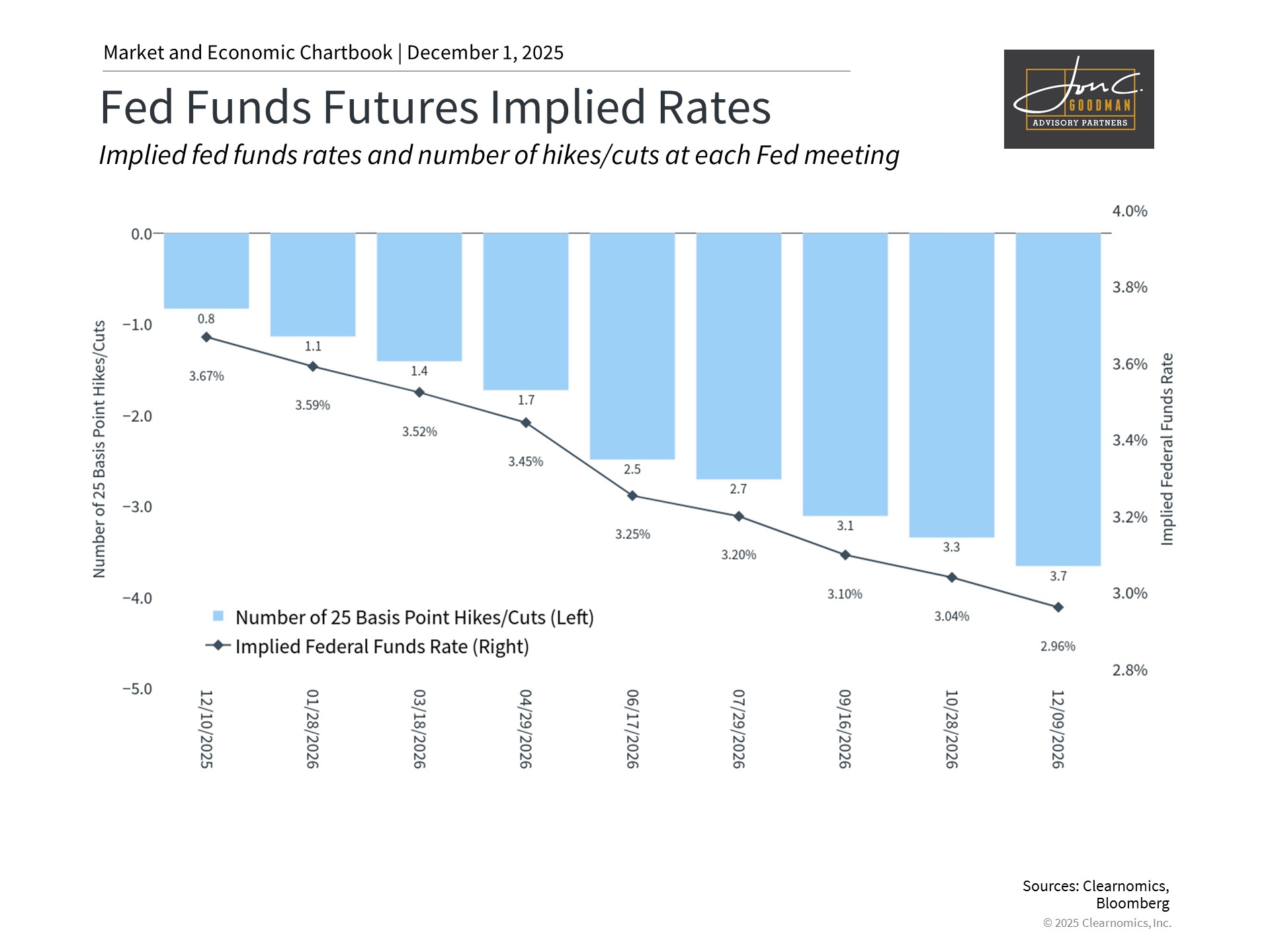
Federal Reserve rate cut expectations have evolved.
These data interruptions mean the Federal Reserve will approach its mid-December meeting with an incomplete economic assessment. The likelihood of a rate reduction at the upcoming Fed meeting has fluctuated significantly, with probabilities declining sharply in mid-November before recovering. Currently, market-implied expectations indicate the Fed will reduce rates in December, followed by additional cuts in April or June 2026.
Additional economic indicators, including consumer confidence measures, have also deteriorated. The University of Michigan’s Index of Consumer Sentiment preliminary reading dropped from 53.6 to 50.3 in November. This decline captures ongoing American concerns about employment stability, elevated prices, and general financial well-being. Despite households experiencing financial pressure, weak sentiment in recent years has not resulted in curtailed spending or diminished corporate revenues.
The bottom line? November’s market turbulence and continuing economic uncertainty serve as reminders that equity market fluctuations are a normal occurrence. Investors should sustain a long-term perspective as the year concludes.

Wellness Navigator and Holistic Health Coach, Christine Despres, RN, NBC-HWC, CDP
✨ 30 Days Left in 2025: Let’s End the Year on a High Note
We’re in the home stretch—just a month until we close out 2025. And while the holidays can feel like a whirlwind of obligations, gatherings, and to-do lists, I want to invite you to approach these final weeks differently.
The holidays are exhausting—let’s be honest. But with the right mindset and a few intentional practices, you can end this year feeling more grateful, grounded, and genuinely happy—not just relieved that it’s over.
Creating Your Wellness Vision for 2026
It’s time to look ahead and design the life you actually want. And no, I’m not talking about New Year’s resolutions.You know the ones: “I’m going to lose 20 pounds,” “I’ll go to the gym 5 days a week,” “I’ll eat perfectly clean.” They’re rigid, punishment-based, and by February? Forgotten and totally unrealistic. Why set yourself up for failure?
A Wellness Vision is different.
Instead of focusing on what you lack or what you “should” do, a Wellness Vision connects you to who you want to become and how you want to feel. It’s aspirational, personal, and rooted in your honest values—not someone else’s idea of what your health should be.
Here’s why it works:
- Writing it down makes it real.
Research shows that people who write down their goals are significantly more likely to achieve them. The act of putting pen to paper (or fingers to keyboard) signals to your brain that this goal is a priority. Your brain then starts filtering information differently, helping you spot what’s relevant and take action.
- Vision + SMART goals = sustainable change.
Here’s how they work together: your vision paints the picture of who you want to become and why it matters. Your SMART goals break it down into doable steps. Your brain loves this combination—the compelling vision activates your emotional centers and keeps you engaged, while the concrete steps satisfy your brain’s need for clarity and progress. You’re not just wishing and hoping—you’ve got a real plan that doesn’t depend on perfect scenarios every single day.
- Your WHY is everything.
Not all motivation is created equal. Extrinsic motivation (I want to look good for my vacation, my doctor said I have to) fades fast. Intrinsic motivation (I want to feel energized to play with my grandkids, I want to protect my brain for the long haul) keeps you going when things get hard. When your why is more personal, your habits stick.
Join Me Live on December 3rd and Get It Done
I know you’re busy. I know your to-do list is long. But here’s the thing: creating your Wellness Vision doesn’t have to be a solo, overwhelming project you never do.
What if you could knock it out in 30 minutes—together—and feel that dopamine hit of checking something meaningful off your list?
That’s exactly what we’re doing in this month’s Brain Boost Session on Wednesday, December 3rd at 10:00 AM ET.
We’ll walk through the Wellness Vision worksheet step-by-step. You’ll leave with:
- A clear, compelling vision for 2026
- ONE brain-healthy priority habit (not 10—just one that creates the biggest ripple effect)
- A SMART goal you can actually stick to
- Your personal WHY that will keep you motivated all year long
And if you can’t make it live? No problem. The session is recorded, and you’ll get the worksheet to work through on your own time.
👉 Save your spot here: Brain Boost Sessions
Let’s end 2025 with intention and a clear plan for the year ahead. You’ve got this—and I’ve got you!
With appreciation and excitement for what’s ahead,
Christine
Your Nurse. Your Guide. Your Wellness Navigator.

What Black Friday, Small Business Saturday & Cyber Monday Reveal About America in 2025
Every year, the post-Thanksgiving shopping trifecta—Black Friday, Small Business Saturday, and Cyber Monday—gives us a snapshot of American consumer life. This year’s picture is unusually sharp. On the surface, the numbers look spectacular: record online sales, higher average purchase prices, and projections that holiday spending may exceed $1 trillion for the first time. But beneath those headline numbers is a more complicated—and more revealing—story about the economic divide in America.
Record Sales… But Not for the Reasons You’d Expect
Black Friday online sales broke records again, with U.S. shoppers spending about $11.8 billion online in a single day. Cyber Monday is expected to climb even higher. Yet when analysts dig deeper, they’re finding something interesting: consumers bought fewer items per order than last year. Total spending is up—but only because prices are higher. Units are down; dollars are up.
In other words, Americans aren’t necessarily splurging. They’re paying more to get the same—or less. That’s not abundance so much as inflation showing its teeth.
Financing the Holidays
Another sign of strain: the heavy use of “buy now, pay later.” BNPL transactions grew sharply this year, especially for people buying basic goods, children’s items, and home essentials. Credit card usage also jumped.
This doesn’t automatically mean people are reckless; many are simply stretched. For some households, holiday shopping has quietly shifted from a joyful splurge to a financial juggling act.
A Tale of Three Americas
A Deloitte survey captured the divide clearly:
- Lower-income households (<$50K) plan to spend 12% less this season.
- Upper-income households (>$200K) plan to spend 18% less, signaling caution rather than scarcity.
- Middle-income households ($100–199K) expect to spend slightly more, suggesting relative stability.
The wealthy pulling back by nearly 20% may be the most surprising part. It’s psychological, not financial—a shift from conspicuous consumption toward caution, savings, or reallocating dollars toward experiences rather than things.
Meanwhile, for lower-income households, cutting back isn’t optional. It’s survival.
Small Businesses: Caught in the Crosscurrents
Small Business Saturday was created to level the playing field, but the gravitational pull of online shopping is stronger than ever. Mobile-based purchases dominated the weekend, meaning foot traffic declined. That’s great for big e-commerce platforms but tough on local shops that depend on in-person visits and lack the online infrastructure to compete with nationwide sales.
The digital divide is no longer just about access to internet—it’s a divide in opportunity.
What This All Means
BFCM 2025 tells a story bigger than holiday shopping:
- Households are unevenly resilient.
- Inflation continues to reshape spending behavior.
- Credit usage may foreshadow future financial fragility.
- And America’s consumer economy—our default barometer of national health—feels increasingly bifurcated.
The numbers are big. The story behind them is bigger. And in a season defined by gratitude and generosity, it’s worth remembering that not every household is experiencing the same version of “holiday cheer.”
That’s all for today.
Thanks for reading,

|