

Greetings!
As summer begins its slow surrender to fall, this week’s Advice for the Good Life is about something deceptively simple: keeping things in perspective.
In this week’s Wealth Advisory, we tackle some decidedly big numbers—tariff refunds, a widening federal deficit, and a national debt that has now crossed $40 trillion. Those headlines deserve our attention, but perhaps not our anxiety. Markets have continued reaching new highs despite the uncertainty, offering another reminder that successful investing often has less to do with predicting the next headline and more to do with maintaining perspective, discipline, and a plan.
Then, our Wellness Navigator, Christine Despres, brings that same wisdom down to a very personal level. As summer winds down and routines begin returning, resist the temptation to fix everything at once. Go to bed 15 minutes earlier. Take a walk. Cook a couple of meals at home. Small wins, repeated consistently, have a remarkable way of becoming big ones.
Maybe that’s the thread running through this week’s edition: whether we’re talking about our money or our health, progress rarely requires perfection. More often, it requires patience, perspective, and simply taking the next right step.
As always, thanks for reading. If something here helps you, please share it with someone you care about—and invite them to subscribe.
Enjoy the waning days of summer!

Wealth Advisory: What Tariff Refunds and the National Debt Mean for Your Portfolio
Global trade has been a persistent source of financial market uncertainty since new tariffs were introduced last year. A significant legal development occurred in February, when the Supreme Court ruled that the original “Liberation Day” tariffs were unlawfully imposed, triggering a wave of refunds to affected businesses that is now well underway.1 In the meantime, new tariffs have been put in place under separate legal authority, including those recently applied to close trading partners such as Canada.
The fiscal consequences have been notable as well. Tariff refunds have contributed to a wider federal budget deficit, and the national debt has surpassed $40 trillion for the first time, prompting questions about the government’s long-term borrowing costs.2
Despite these concerns, the effect on investment portfolios has been limited. Broad market indices have continued to reach new all-time highs during this period, underscoring the importance of maintaining perspective. Markets have historically performed well across a wide range of trade and fiscal environments, and the current situation is no exception. So what should investors keep in mind about these latest developments?
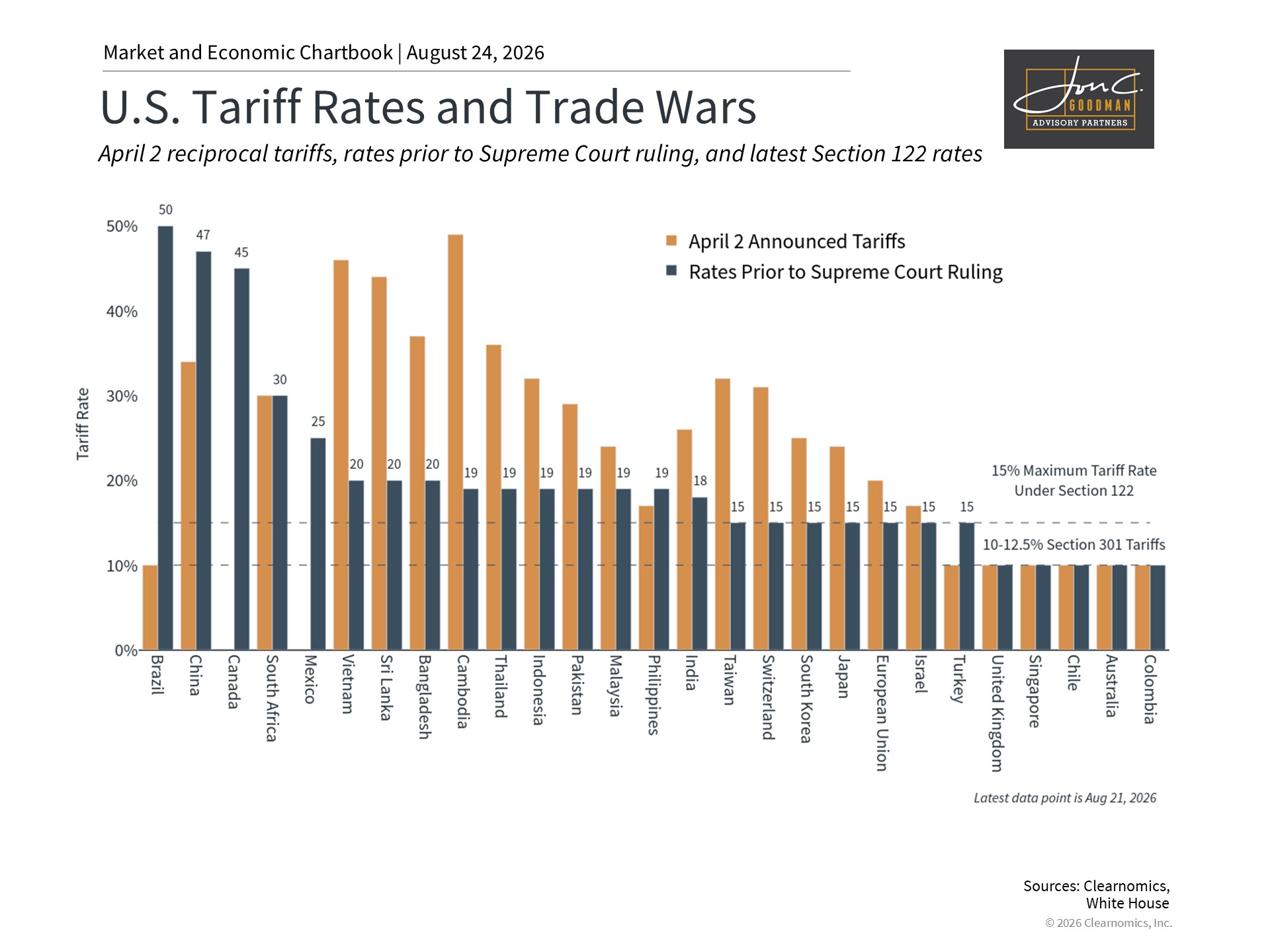
Tariff refunds are returning funds to businesses
Markets responded positively in February when the Supreme Court ruled that tariffs collected under the International Emergency Economic Powers Act (IEEPA) had been unlawfully imposed. Because tariffs are generally viewed as a cost burden on consumers, the ruling was seen as supportive of the broader economy.
Following the ruling, businesses that had paid those tariffs became eligible for refunds, and the payout process is actively underway. According to U.S. Customs and Border Protection, $129 billion in refund claims had been accepted for processing, representing a significant share of the total amount owed.3 Treasury data shows that tariff refunds have exceeded new tariff collections since May, resulting in net outflows from the government for three consecutive months.4
June stood out as the single largest month of refunded tariffs on record, with $49.2 billion returned to businesses compared to just $23.6 billion collected. With roughly 40% of total refunds still to be processed, net tariff receipts for the government are likely to remain negative in the coming months.
On the surface, these refunds may act as a form of stimulus by strengthening company balance sheets and supporting investment. However, it is worth noting that this cash was originally paid by businesses in the first place. While markets may view the refunds favorably, they are largely a one-time event that reverses last year’s tariff payments rather than representing a lasting improvement in fundamentals. It is also important to note that many companies continue to pay tariffs under different legal frameworks.
One concern for consumers was that tariffs would prove inflationary, but this outcome has been less severe than many anticipated. Many retailers absorbed tariff-related costs or passed them on indirectly, which helped limit the drag on consumer spending. This also makes it difficult to trace precisely how refunds will flow back to households. Some shipping companies, for instance, have begun returning refunds to customers who paid tariff surcharges directly, while some larger retailers have pledged to pass on savings through lower prices rather than direct payments.

Tariff refunds have contributed to a wider deficit and growing debt
Tariff refunds have also reversed the revenue boost the government had seen over the past year. The current annual deficit already stands at approximately $1.8 trillion, even though the fiscal year does not end until September, surpassing the full-year 2025 deficit.5 The Congressional Budget Office recently projected the full-year deficit will reach $2.1 trillion, roughly $200 billion more than was estimated earlier in the year.6
As a result, the national debt has now exceeded $40 trillion for the first time in history. This figure has grown steadily over decades as annual deficits have compounded year after year. The accompanying chart illustrates this long-run trajectory, with each year’s deficit adding to the total. While tariff refunds are contributing to the deficit in the near term, tariffs alone are not sufficient to close the budget gap. Larger structural drivers, including entitlement programs such as Social Security and Medicare, represent far more significant challenges.
Many investors are understandably concerned about the trajectory of the national debt, but history suggests it is important to separate these concerns from day-to-day investment decisions. Since 1970, the federal government has run a deficit in all but five years, with the only four surpluses occurring in the past thirty years. Despite this, balanced portfolios have performed well over this period. Furthermore, deficits tend to be highest during periods of economic difficulty, which can coincide with market bottoms. While the past is no guarantee of future results and the scale of the national debt does present real challenges, using the deficit alone as a basis for investment decisions has historically been counterproductive.

Efforts to manage government borrowing costs are underway
Rising debt levels have also had an effect on interest rates and the government’s borrowing costs. Long-term interest rates have climbed to multi-decade highs in recent periods, which is one of the primary channels through which fiscal policy affects the broader economy. When yields on 10-year and 30-year Treasuries rise, borrowing becomes more expensive for both businesses and households.
In response, the Treasury Department has expanded its buybacks of U.S. Treasury securities, a tool that helps to keep interest rates within a manageable range.7 Other Treasury activities, such as efforts to support the Japanese Yen, may appear unrelated at first glance, but these too are aimed at discouraging governments like Japan from selling large quantities of Treasury securities. Even so, these measures remain modest relative to the overall size of the Treasury market.
The accompanying chart places today’s interest rates in a longer historical context. Rates are elevated compared to the past two decades, particularly relative to the era when the Federal Reserve held rates near zero for many years. However, a longer view makes clear that current rates are not historically extreme. Higher rates also create opportunities for investors seeking income, as bonds now offer more attractive yields for portfolios.
Concerns about tariffs, the national debt, and interest rates may intensify as the midterm elections approach in November. Investors should be cautious about allowing headlines to drive portfolio decisions. History consistently demonstrates that markets have navigated many periods of trade and fiscal uncertainty, and that investors who maintained a longer-term perspective were better positioned to achieve their financial goals.
The bottom line? Tariff refunds and rising deficits are creating near-term fiscal challenges, but it’s important to keep these developments in perspective. Maintaining a balanced portfolio aligned with long-term financial goals remains the best way to navigate periods of fiscal uncertainty.
References
- https://www.cbp.gov/trade/programs-administration/trade-remedies/ieepa-duty-refunds
- https://fiscaldata.treasury.gov/datasets/debt-to-the-penny/debt-to-the-penny
- https://storage.courtlistener.com/recap/gov.uscourts.cit.17270/gov.uscourts.cit.17270.25.1.pdf#page=3
- https://fiscaldata.treasury.gov/datasets/monthly-treasury-statement/receipts-of-the-u-s-government
- https://fiscaldata.treasury.gov/americas-finance-guide/national-deficit
- https://www.cbo.gov/system/files/2026-08/61983-2026-07-MBR.pdf
- https://home.treasury.gov/news/press-releases/sb0607

Wellness Navigator and Holistic Brain Health Coach, Christine Despres, RN, NBC-HWC, CDP
Ease Back In, One Step at a Time: Slowly Saying Goodbye to Summer’s Freedom
August is National Wellness Month and there’s a natural nudge to get back on track. Not sure I’m ready. Summer has a way of loosening everything. Bedtimes are later, workouts get skipped for one more pool day and dinner turns into whatever’s available. But eventually it has to end.
Normally the change of seasons helps shift your body into gear on its own, but it’s still blazing hot and the sun is still out late, so your circadian rhythm is going to take its time catching up to a new schedule. And honestly, no way I’m Irish goodbying summer yet. Give yourself some grace and ease your way back into a steady routine.
But the calendar is turning, and if you’re anything like the women I coach, you’re feeling that pull to snap everything into place at once. Early bedtimes. Every workout back on the schedule. A meal plan that would make a nutritionist weep with joy. And by Thursday, you’re exhausted and right back where you started.
Here’s what I’ve learned after 30 years of watching people try to change everything overnight, in nursing and in coaching. It doesn’t work. Not because you lack discipline, but because your brain doesn’t build lasting habits through sudden overhauls. It builds them through small, repeatable wins.
So this week, don’t try to fix everything. Pick one area to focus on.
Start with sleep. Set your bedtime alarm for 15 minutes earlier than where you’ve landed this summer. Not your ideal bedtime yet, just 15 minutes closer. Hold that for a week before you touch anything else. Small, consistent shifts in sleep timing are one of the most powerful things you can do for memory consolidation and next day focus. Plus when you start to feel more rested, everything gets easier.
Get moving. If the gym or the class you used to love feels like a mountain, don’t commit to five days a week again. Start with one class and get back on your walking schedule with just 10 to 20 minutes after dinner. The point isn’t just the workout itself, it’s reminding your body and your brain that showing up is still something you know how to do. It creates momentum to build on.
Sit down to dinner. Plan your menu for the week, get back to food prepping but keep it realistic. Two home cooked meals on your quieter nights is a full win. You don’t need every dinner from scratch to feel like you’re back in your rhythm, you just need a couple of nights where you’re actually sitting at the table instead of ordering in on or eating chips and salsa standing at the kitchen counter. ( My personal favorite.;)
Start small. Piece it together. Then add the next. Each small win gives your brain a hit of dopamine, the motivation chemical that makes you want to repeat the behavior, which is exactly why small consistent wins build momentum better than one big overhaul.
Pumpkin lattes and cozy sweaters will be here before you know it!
If you’re not sure where to start, or you’ve tried this before and it hasn’t stuck, I’d love to help. I’m offering a free 30 minute strategy session to map out a plan that actually fits your life.
Grab a time here: Strategy Session
To small starts and steady progress,
Christine
The Wellness Navigator | Brain & Metabolic Health Coach | RN, NBC-HWC, CDP
thewellnessnavigator.com