

Greetings!
There’s plenty competing for our attention this week. Election forecasts. Federal deficits. Headlines that can make us wonder what we should be doing differently with our money. Meanwhile, some of the most consequential decisions we make barely make a sound: taking a walk, checking our blood pressure, or following through on a good habit.
In this week’s Advice for the Good Life, Wealth Advisory puts the midterm election and national debt in perspective, with a focus on what matters for your long-term portfolio. In Wellness Navigator, Christine Despres connects heart and brain health, sharing practical steps in recognition of World Stroke Day. And our Parting Thought offers a fitting reminder: “The cheat code is discipline and consistency.”
We can’t control every outcome. But we can keep making choices that give the future something good to work with.
Enjoy this week’s edition, share it with someone you care about, and encourage them to subscribe. The good life is better when shared.


What the Midterm Election, Federal Deficit, and National Debt Mean for Your Portfolio
With midterm election season underway, investors are watching developments closely given the implications for control of Congress. Current forecasts point to divided government as the most probable outcome, as Republicans hold narrow majorities in both chambers.1 Although a shift in party control would mark a departure from the past two years, such outcomes are not unusual and have historically been common during midterm cycles.
Regardless of how the election unfolds, one clear development is that the federal budget deficit climbed to just under $2 trillion over the past year, its highest level in absolute terms since 2021.2 This reflects government spending that significantly exceeded revenues. The situation is unlikely to improve materially regardless of which party controls Congress next year, given that pressures such as rising interest costs and entitlement spending have accumulated over many decades. These annual shortfalls continue to add to the national debt, which has now surpassed $40 trillion, representing more than 120% of the size of the overall economy.3
For investors who follow these developments, concern is understandable regardless of political affiliation. That is precisely why maintaining a long-term perspective, one that separates political issues from investment and financial planning decisions, is so valuable. So, what should investors keep in mind about the deficit and the election this political season?
The federal budget deficit has grown
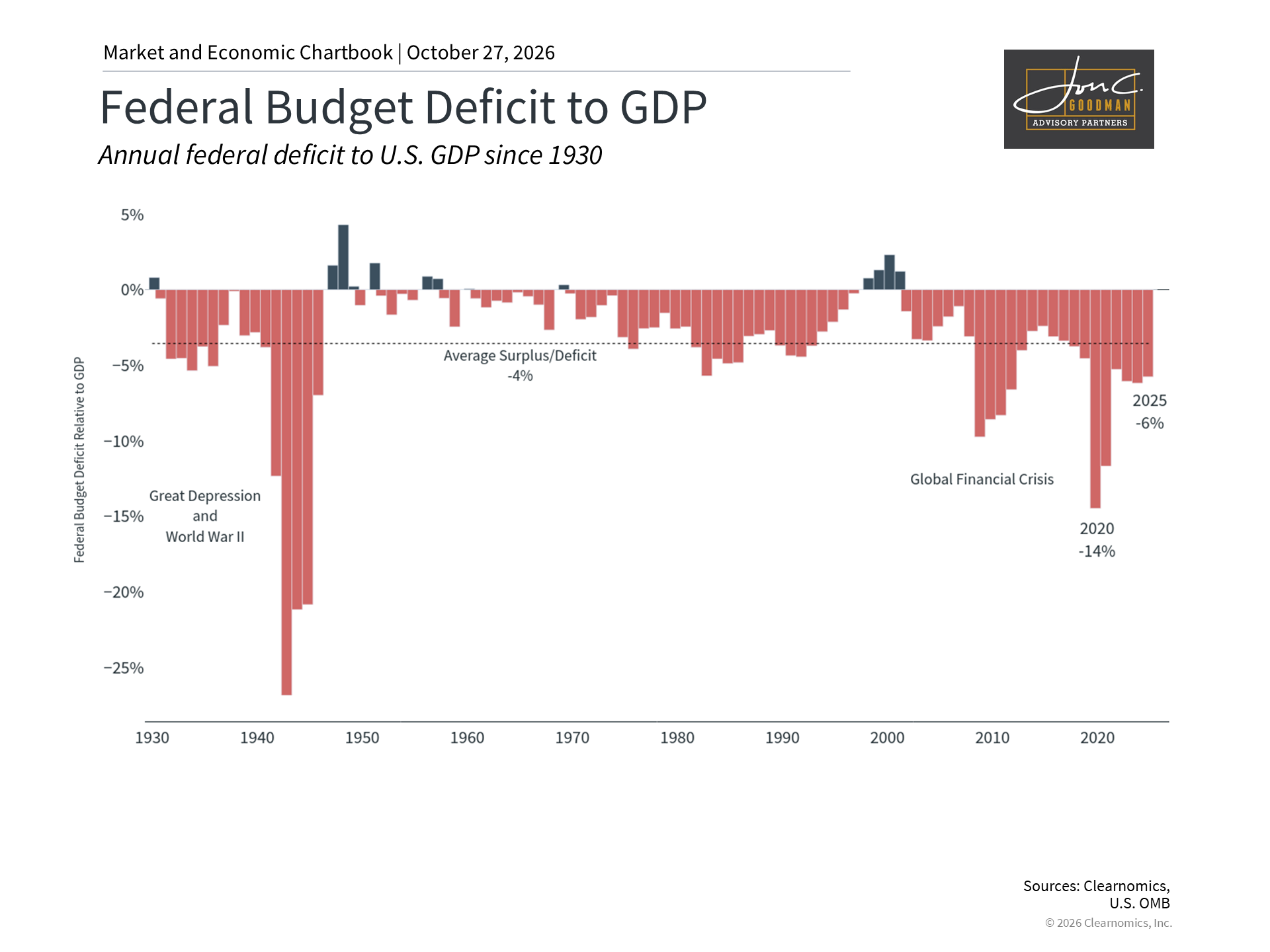
To put the impact of government spending on financial markets in context, it helps to start with the numbers. The federal government recorded a $1.99 trillion deficit for the fiscal year ending September 30, 2026, a 12% increase from $1.78 trillion the prior year.4 Total government spending reached $7.4 trillion, while revenues from taxes, tariffs, and other sources amounted to only $5.4 trillion.5
The gap is financed through borrowing, primarily via the issuance of Treasury securities that are purchased by investors and institutions around the world. Based on current Gross Domestic Product (GDP) figures, the latest deficit is expected to represent approximately 6% of GDP, a ratio comparable to that seen in 2025.6
As the chart above illustrates, recent deficits have been elevated relative to historical norms. The budget deficit has averaged 4% of GDP over nearly a century, with periods of financial and global disruption, such as World War II and the 2008 global financial crisis, producing even wider gaps.
Deficits have generally narrowed following such disruptions, yet truly balanced budgets have been rare. The most recent surplus occurred during the Clinton administration, supported by a decade of strong economic growth. Before that, balanced budgets were achieved during the Johnson and Eisenhower administrations in the late 1960s and mid-1950s, respectively.
Over time, cumulative annual deficits have pushed total national debt past $40 trillion for the first time in August. According to the Congressional Joint Economic Committee, this amounts to approximately $117,707 per American, or $298,606 per household.7
While these figures are substantial and reflect genuine fiscal challenges, interpreting their investment implications is not straightforward. Historically, adjusting portfolios in response to deficit concerns would have worked against financial goals. This is because deficits tend to be largest during periods of economic and financial distress, which are also often the times when markets are near their lows. Counterintuitively, those periods would have been among the best times to invest.
Budget deadlines, the debt ceiling, and rising interest rates could be in the news
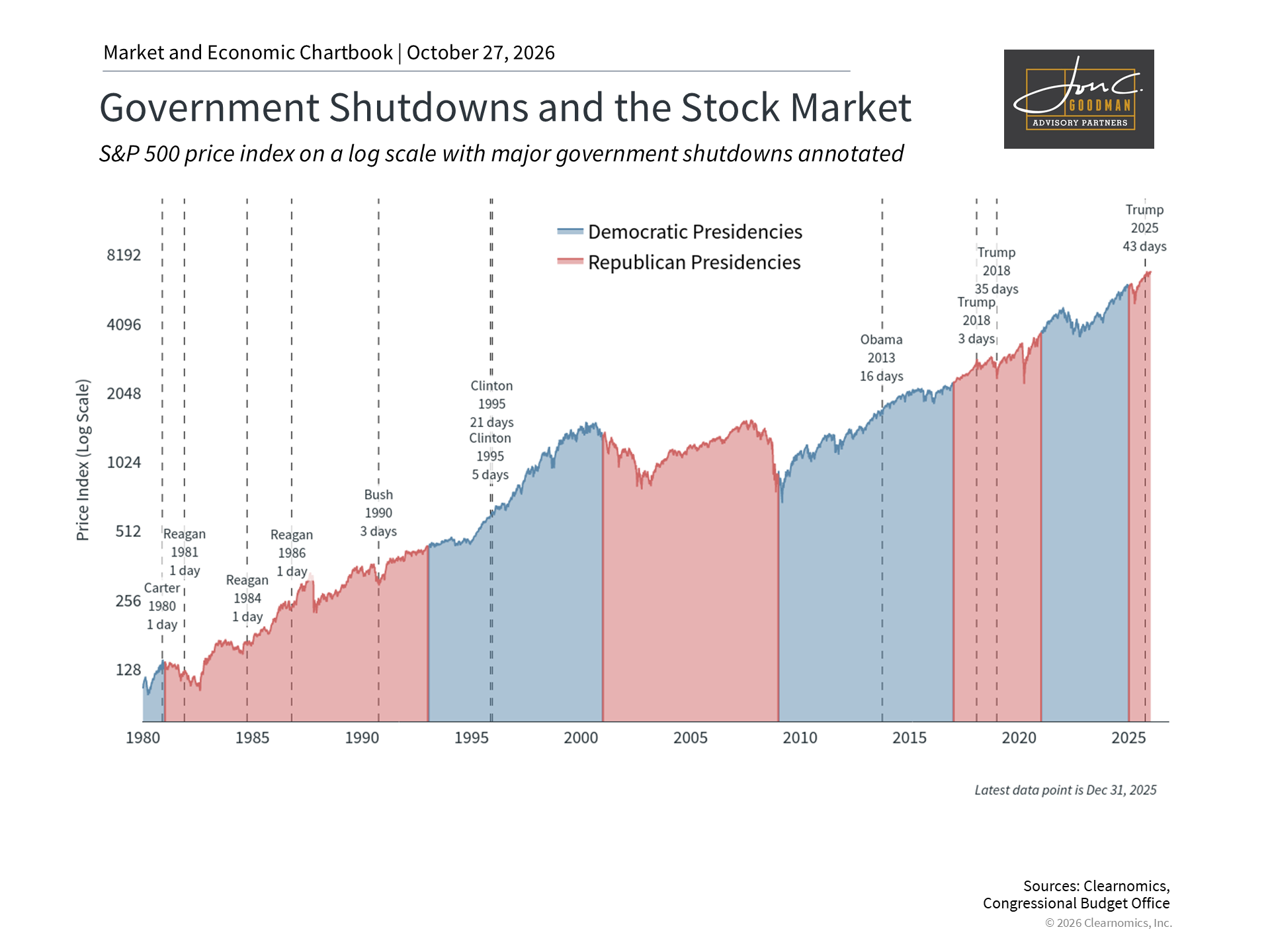
There are two key implications that long-term investors should keep in mind. First, the national debt is approaching the statutory debt ceiling of $41.1 trillion established by the One Big Beautiful Bill Act last year, a threshold that could be reached by mid-2027.8 The federal government’s deadline for a new budget falls on December 11, shortly after the midterm election. Raising the debt ceiling is expected to be a central debate for the incoming Congress, and if an agreement is not reached in time, a government shutdown could follow.
Although shutdowns can create hardships for federal workers and trigger brief market swings, major indices have historically stabilized and moved past these events relatively quickly. This was true even during notably prolonged shutdowns, such as those in 2018 and more recently in 2025. The chart above traces historical government shutdowns against the broad upward trajectory of the stock market over this period. While past performance does not guarantee future results, it does underscore the importance of avoiding overreactions to political headlines when making investment decisions.
Second, rising interest rates are adding pressure to the government’s fiscal position. The 30-year Treasury yield has held above 5% since June, while the 10-year yield continues to hover near that level. As existing government debt matures and must be refinanced at higher rates, interest payments increase and the budget imbalance worsens. This is one reason the Treasury Department has stepped in to purchase more Treasury securities to help stabilize U.S. interest rates.9 Additional measures, including operations to support the Japanese yen, have been undertaken to indirectly stabilize rates as well.
Policy uncertainty can lead to short-term volatility
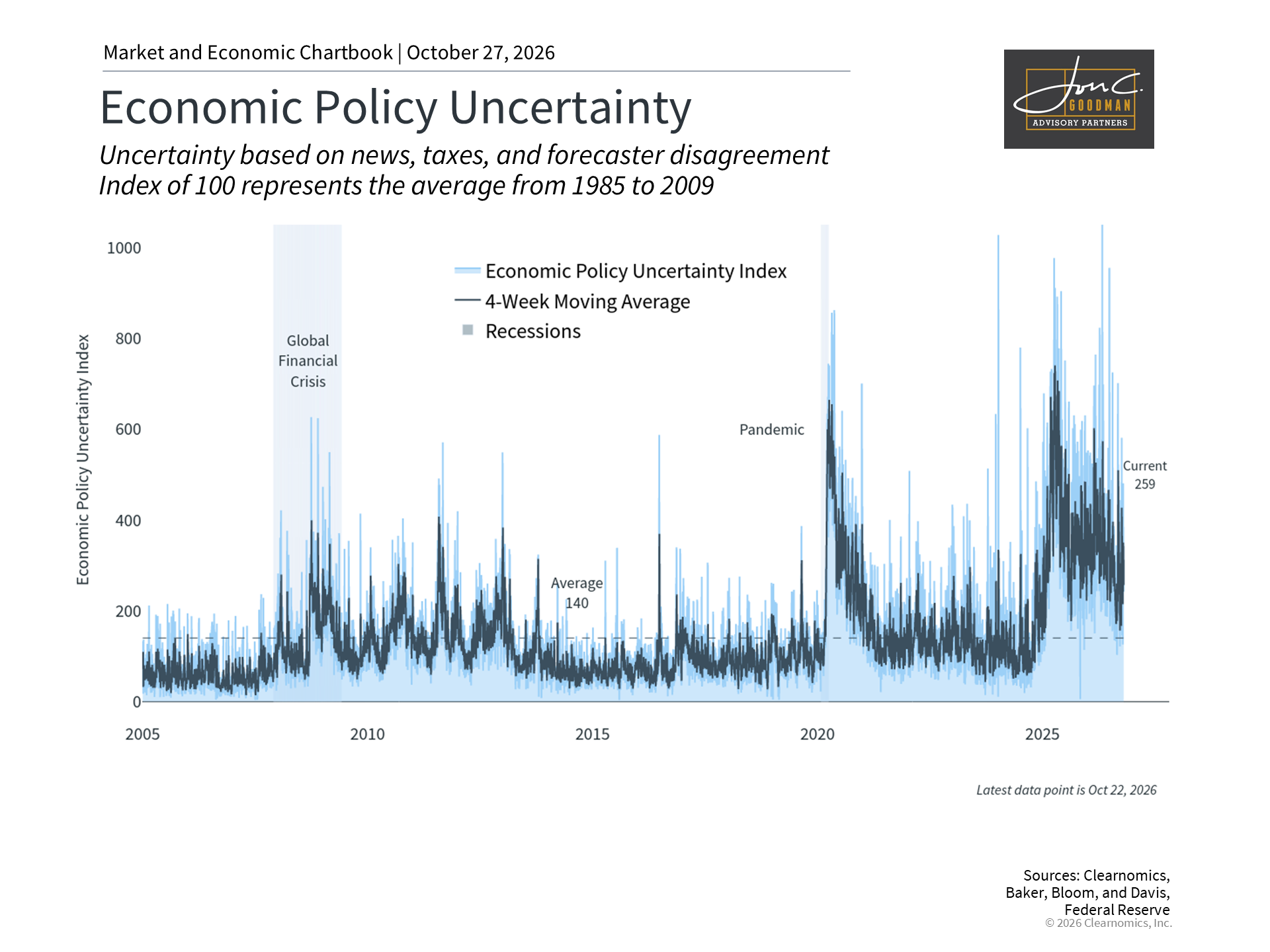
The national debt presents a long-term fiscal challenge with no easy solutions, as addressing it requires difficult decisions around taxes, entitlement programs, and spending priorities. At the same time, policy predictions have frequently proven inaccurate, particularly during periods of strong economic growth. For example, the market decline that followed last year’s tariff announcements proved shorter-lived than many anticipated, giving way to a rebound that carried major indices to new all-time highs.
This is why it remains important for investors to stay grounded when navigating political topics. As the chart above shows, economic policy uncertainty has contributed to short-term market swings in recent years, but these episodes have generally been brief. Earlier instances, including this year’s geopolitical conflict in the Middle East, created volatility as investors worked to assess the potential impact on the economy and corporate earnings. Although oil prices remain elevated, markets have fared well thanks to underlying economic resilience.
None of this is to suggest that every year produces positive returns, that the national debt is not a genuine concern, or that policy has no bearing on markets. Rather, the key point is that foundational factors, including corporate earnings, interest rates, and longer-term economic trends, tend to be the primary drivers of market performance over time. For investors, making sound decisions grounded in these longer-term fundamentals is more productive than reacting to political headlines or focusing on which party holds Congressional control.
The bottom line? The midterm election and the growing federal deficit are important topics, but history shows that long-term portfolio outcomes are driven by fundamentals rather than by political outcomes.
References
- https://www.realclearpolling.com/latest-polls
- https://fiscaldata.treasury.gov/americas-finance-guide/national-deficit/
- https://fiscaldata.treasury.gov/americas-finance-guide/national-debt/
- https://fiscaldata.treasury.gov/americas-finance-guide/national-debt/
- https://www.realclearpolling.com/latest-polls
- Clearnomics research using U.S. Treasury and Bureau of Economic Analysis data, as of October 23, 2026
- https://www.jec.senate.gov/public/index.cfm/republicans/debt-dashboard
- Clearnomics research and U.S. Treasury data, as of October 23, 2026
- https://home.treasury.gov/news/press-releases/sb0607
Index Descriptions
S&P 500
The Standard & Poor’s 500 Index is a capitalization-weighted index of 500 stocks designed to measure performance of the broad domestic economy through changes in the aggregate market value of 500 stocks representing all major industries.

World Stroke Day
October 29 is World Stroke Day and this month ends with the Walk to End Alzheimer’s in Atlanta. To me the two belong together, because the same circulation feeds your heart and your brain.
Your brain is about two percent of your body weight, yet it takes about twenty percent of your blood flow, through vessels mostly thinner than a hair.
Anything that harms those vessels harms your brain, usually before you feel a thing.
The Loud Version and the Quiet One
A stroke is the loud version. A vessel blocks or bursts and the damage is sudden. According to the CDC, stroke takes an American life every three minutes and fourteen seconds.
The quiet version plays out over twenty or thirty years. Small arteries in the brain narrow and stiffen until fog, slower thinking and trouble finding words set in.
Its name is vascular cognitive impairment, the second most common cause of dementia after Alzheimer’s.
Since 2004, stroke deaths have dropped 24 percent while dementia deaths have climbed 47 percent. We got better at surviving the emergency, so more of us live long enough for the slow decline to show.
Know the Signs: BE FAST
Balance lost, Eyes blurred, Face drooping, Arm weak, Speech slurred, Time to call 911.
If any of these come on suddenly, don’t wait to see if it passes. Note when it started, because treatment works best in the first hours and the hospital will ask.
Three Ways Forward
The American Heart Association estimates about 80 percent of strokes are preventable.
Your heart and brain share the same allies, so these three changes help both. Choose one and work on it through December.
- Know your numbers. Blood pressure is the biggest lever, behind roughly half of all strokes. Check it at the pharmacy, at home or with your doctor. If your last labs were a year ago, ask for a fasting glucose or A1c and a lipid panel too.
- Get your heart rate up three times this week. Aim for half an hour at a pace where you can talk but not sing, like hiking, cycling or a dance class. Each session sends fresh oxygen to your brain.
- Follow the MIND diet, an anti-inflammatory, Mediterranean-style way of eating. Start with dark leafy greens every day, two tablespoons of extra virgin olive oil a day and wild salmon one to two servings a week. Limit red meat, pastries and sweets, plus fried or fast food.
Stroke survivors were once my patients and I stayed beside them through a very challenging recovery.
Today I coach women in midlife and beyond while there’s time to change the story, which is why 80 percent preventable matters so much to me.
If heart disease runs in your family or you’re wondering whether your lifestyle is truly supporting your brain and heart, book your free 30-minute Brain Health Strategy Session here and together we’ll find the habits that move the needle for you.
Aging well isn’t luck, it’s a strategy. What’s yours?
Be well,
Christine Despres, RN, NBC-HWC, CDP, Brain & Metabolic Health Coach
P.S. It’s not too late to give. My team, Walk On with the Wellness Navigator, steps off on Saturday, October 31. Last-minute donations still count and every gift funds care, resources and research for families facing this disease. act.alz.org/goto/WalkOn