

Greetings!
Summer has a way of reminding us that some of the best things in life—and investing—come from knowing when to act and when to simply stay the course.
In this week’s Wealth Advisory, we begin with markets, where stocks are once again setting records even as interest rates remain near multi-decade highs. Rather than being contradictory, the combination of strong corporate earnings, economic resilience, and attractive bond yields may be creating something investors haven’t enjoyed in quite some time: compelling opportunities on both sides of a balanced portfolio. We also look at why waiting for the inevitable market pullback can sometimes cost more than the correction itself.
Then Wellness Navigator and Holistic Brain Health Coach, Christine Despres, takes us somewhere considerably more relaxing: the beach. Her wonderfully titled “Ditching the Baby Oil, Keeping the Beach” is a reminder that wellness doesn’t require perfection—or abandoning the things we love. From blue space and brain health to the simple dopamine hit of finding a sand dollar, she makes a compelling case that aging well is less about flawless execution and more about consistency, presence, and continuing to do what lights us up.
Perhaps that’s the common thread this week: Don’t wait for perfect.
Not for the perfect market entry point. Not for the perfect workout, diet, or wellness routine. And certainly not for the perfect day to enjoy what remains of summer.
Take the win. Keep going. And enjoy the journey.
As always, thank you for reading Advice for the Good Life. If something here encourages, educates, or inspires you, please share it with someone who might enjoy it too—and invite them to subscribe.
All for One, One for All,

Wealth Advisory: What is Powering Stocks, Bonds and Record Market Highs?
Following several periods of uncertainty this year, the stock market has climbed to new all-time highs. This is encouraging news for investors, particularly because the rally has been broad-based, with sectors such as Energy, Information Technology, and Industrials all contributing. Meanwhile, interest rates remain near multi-decade highs, pushing bond yields to their most attractive levels in years. Investors should nonetheless remain prepared for periods of volatility, which recent years have demonstrated can arise at any moment.
For long-term investors, rising stock prices alongside higher yields create an environment that calls for thoughtful portfolio balance. At first glance, it may seem contradictory for stocks to reach record levels while interest rates stay elevated, given that rising rates can slow economic activity. However, when both stocks and bonds are supported by positive trends, long-term portfolios can be well positioned to support financial goals. How should investors approach this environment as markets hover near record levels?

Stocks and bonds each support portfolio balance in distinct ways
The S&P 500, Nasdaq, and the Dow Jones Industrial Average have all generated double-digit total returns this year.1 Several important themes have shaped which parts of the market have driven these results. Among the most prominent are the continued influence of artificial intelligence on technology stocks and the support that higher oil prices have provided to the energy sector. These are the factors most frequently highlighted in headlines, and they help explain why major indices have reached new highs.
Another significant contributor has been the historic pace of corporate earnings growth, which has provided a fundamental foundation for the rally. Over the long run, economic expansion tends to drive corporate profits, which in turn pushes stock prices higher. Notably, corporate profits have increased significantly in recent years despite only modest economic growth. Current forecasts suggest that the S&P 500 could reach an earnings-per-share figure of $347 this year, representing an annual growth rate of over 30%. If achieved, this growth rate would far exceed the historical average of around 8%.2
Fed policy and interest rates have also played an important role in the recent S&P 500 rally. In the short run, markets can be highly sensitive to expectations around Fed decisions. This is because interest rates factor heavily into how stock prices are calculated today based on future cash flows. As oil prices rose earlier this year, markets anticipated Fed rate hikes to address inflation. With recent cooling in the labor market and steady inflation readings, however, those expectations have moderated, with only one quarter-point hike priced in by next January.
Understanding the impact on stocks and bonds depends on recognizing that interest rates can rise for different reasons. Rates that climb due to inflation concerns can weigh on both asset classes, as occurred in 2022 when the Fed tightened policy aggressively. On the other hand, rates can also rise because economic growth expectations are improving, which pushes up what are known as “real rates,” or the interest rate after accounting for inflation.3 Stronger real rates can support market valuations through improved earnings while simultaneously offering bond investors more attractive yields.
This dynamic helps explain why stocks have continued to advance even as rates remain elevated. The chart above illustrates the relationship between stock and bond returns over the past several decades, including the extended periods in which both asset classes perform well during economic expansions. The key lesson for investors is not to try to predict market returns or interest rates, but rather to hold a portfolio that can benefit from the strengths of each.
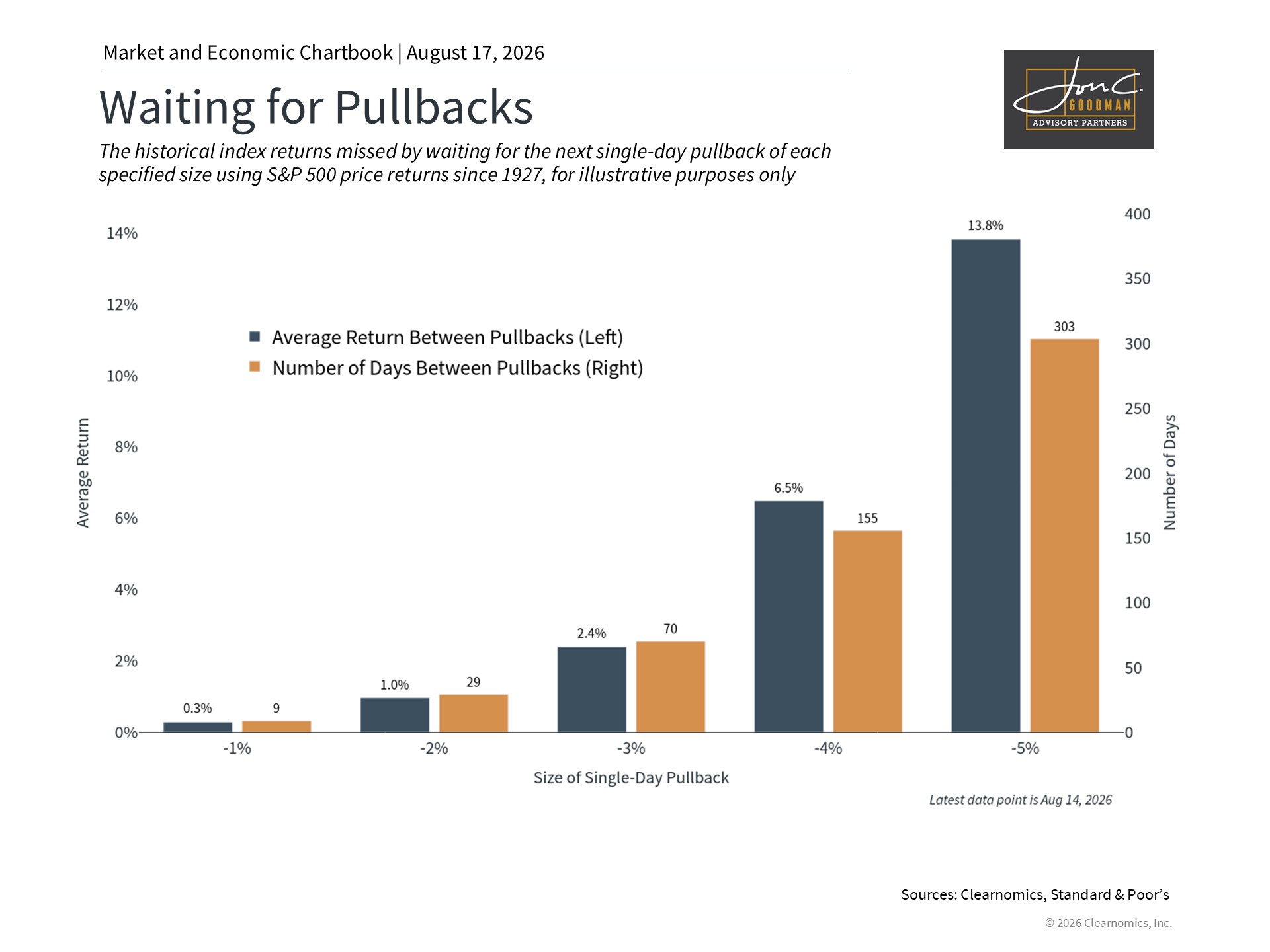
Waiting for market pullbacks is often counterproductive
With markets near all-time highs, many investors naturally wonder whether they should adjust their portfolios or wait before committing capital. History shows that because the economy and markets tend to grow over time, attempting to time these movements can be counterproductive. The opportunity cost of waiting is often greater than simply staying invested.
The chart above illustrates why waiting for the ideal entry point frequently does not work as intended. An investor waiting for a 5% pullback before investing would have waited an average of 291 days. During that period, the market would have already gained nearly 14%. So, even though pullbacks of 5% or worse do occur periodically, and each situation is different, the market’s tendency to rise over time means the next dip is often higher than the last. In many cases, investors who waited would have been better served by simply remaining invested from the start.
This is not to suggest that markets move in straight lines or that pullbacks do not happen. Rather, it reinforces that new all-time highs are a normal feature of bull markets, and that the most effective path toward long-term goals is often to maintain a well-constructed portfolio.
There are also other strategies available for investors looking to improve their asset allocations. For those who need to invest a lump sum at current valuations, approaches such as dollar-cost averaging can be useful. Likewise, diversifying a portfolio across different sectors, styles, factors, and geographies can help reduce exposure to areas of the market with elevated valuations while still allowing investors to participate in potential growth.

Bond yields are a key driver of long-term fixed income returns
While equities have performed well this year, bonds have been relatively flat due to rising interest rates. Because bond prices move in the opposite direction of yields, higher rates reduce the value of existing bonds. At the same time, investors can benefit by reinvesting in bonds at higher yields or by adjusting their portfolios to take advantage of them, where appropriate for their financial plans.
The chart above highlights that a bond’s starting yield is an important determinant of long-run returns. At present, bond yields are among the most attractive seen over the past two decades. Investment grade corporate bonds and Treasury securities are now offering income levels that were difficult to find in the years following the global financial crisis, when interest rates were held near zero.4 For investors who depend on their portfolios for income, or who are seeking to balance equity risk, this represents greater fixed income opportunity than has existed in many years.
While higher rates can pressure bond prices, they also position bonds to play a meaningful role in portfolios. Combined with the stock market trends that have benefited investors this year, these two asset classes together can support the long-term financial goals of investors.
The bottom line? Stocks have benefited from growth trends while bond yields are historically attractive, creating opportunities across both asset classes. For long-term investors, maintaining a balanced portfolio is the best way to benefit from this environment while staying focused on financial goals.
References
- Standard & Poor’s and Nasdaq as of August 14, 2026
- Clearnomics research using Standard & Poor’s and LSEG data, as of August 14, 2026
- https://home.treasury.gov/resource-center/data-chart-center/interest-rates
- Clearnomics research and Bloomberg data, as of August 14, 2026

Wellness Navigator and Holistic Brain Health Coach, Christine Despres, RN, NBC-HWC, CDP
Ditching the Baby Oil, Keeping the Beach
I’m not buying into pumpkin season quite yet, although back to school does start to change the pace of things. I’m grateful to be writing this from the beach, my happy place, and I want to show you why a beach day, or any day outside doing what you love, is a brain health activity.
Some of you are thinking the beach isn’t exactly the healthiest choice. Fair, if I’m doing it the way I did in the 80s, baby oil and a silver reflector mat, which I am absolutely paying for now, btw. But you can make almost anything you love a little healthier and keep it in the mix. These days I wear quality sunscreen and a hat, and I sit in the shade more than I chase the deepest tan. What I’m not willing to do is stop doing something I truly love.
The beach takes my mind to a place nothing else can. The crashing waves, the floating in refreshing blue water, the combination of sun, salt, and sand. It puts my mind at ease and I just soak it all up. It’s not just a feeling, there’s real science behind it. Time near water, sometimes called blue space, is linked to lower cortisol and a quieter mind. Your happy place isn’t a luxury, it’s doing something measurable for your brain, building resilience you carry with you long after you leave the sand.
August is National Wellness Month, and it’s easy to think wellness means another routine, a new supplement, a perfect diet or a restrictive program. That’s not what your brain actually needs, it’s more about showing up regularly than showing up perfectly. Sometimes it just means doing the things you love as healthily as possible, being fully present in the season you’re in.
I love a beach walk looking for shells, it’s one of my favorite hunts. Others are after heart shaped rocks, or waiting on the next wave to surf. Growing up, it was sea glass and sand dollars for me. Finding a rare color, or an intact sand dollar, felt like hitting the jackpot. It got me thinking, is that luck? A keen eye? Some kind of sixth sense? Or just being intentional, paying attention while everyone else walks past.
Find the places and experiences that light you up, fire your neurotransmitters and bring you into the present. That’s the goal, a lifestyle that supports your brain so you never lose those memories or the ability to keep making more. That’s cognitive healthspan.
Aging Well Isn’t Luck, But It Isn’t Perfection Either
This week I found a couple of sand dollars that were slightly chipped, not the flawless kind. In my family, finding a perfect one is like winning the lottery. I took the win on the chipped ones anyway. That dopamine hit doesn’t care about imperfections. It just cares that I paid attention and found something.
Same principle behind aging well. It isn’t luck, but it isn’t perfection either. Your brain thrives on consistency, not flawless execution. A 10 minute walk is better than no workout at all. One home cooked meal is better than none. You take the win, keep going and build momentum.
Your Invitation This Week
I hope you got your favorite summer activities in already. If not, get out there. Walk the shoreline, take the boat out, get in a few more laps, cast a line or just get outside and notice what’s there. You don’t need the perfect day to make it count, the effort itself is what actually sticks.
I’d love to hear what you find out there, hit reply and tell me.
Ready to move out of summer mode and build a sustainable lifestyle that protects your brain, so you can beat the fog, feel like yourself again and stay sharp for every season ahead?
Let’s talk. Book a brain strategy session and let’s map out your plan together. Strategy Call
Feeling grateful,
Christine
Brain & Metabolic Health Coach | RN, NBC-HWC, CDP