

Greetings!
November is upon us, and with it comes a timely reminder that some of our most important investments have little to do with Wall Street.
In this week’s Advice for the Good Life, we’re looking at two assets worth protecting: your wealth and your well-being.
In Wealth Advisory, we revisit a volatile October, when questions about artificial intelligence, stubborn inflation, and the Federal Reserve’s next moves kept investors on their toes. Despite the uncertainty, economic growth and corporate earnings remain encouraging. The takeaway? Markets will always give us something to worry about, but a disciplined, diversified approach remains our best defense against the temptation to react to every headline.
In Wellness Navigator, Christine Despres shares a particularly meaningful reflection as we begin Alzheimer’s Awareness Month. Fresh off a successful Walk to End Alzheimer’s that raised nearly $15,000, she reminds us that our brains, much like our portfolios, benefit from investments made long before we need to draw upon them. Her message about generosity, connection, and the power of small daily habits is both personal and hopeful.
And finally, our Parting Thought offers a little perspective on why we pursue financial security and good health in the first place: The goal is to die with memories, not dreams.
After all, the purpose of building wealth and preserving health isn’t simply to accumulate more of either. It’s to make the most of the life we’ve been given.
As always, I hope you’ll enjoy this week’s edition, share it with someone who might benefit, and encourage them to subscribe.
Here’s to living the good life—happy, healthy, wealthy, and wise.
Warmly,


Wealth Advisory: Navigating AI Uncertainty, A Hawkish Fed, and Robust GDP
October proved to be a volatile month for financial markets, even as year-to-date performance remained strong overall. Major indices posted mixed results, with technology stocks weighing on broader performance. Meanwhile, the bond market recorded gains in several areas as long-term interest rates retreated from recent highs. These movements reflected investors reassessing key themes, including artificial intelligence, Federal Reserve policy, and the trajectory of interest rates.
Markets were particularly focused on questions surrounding whether AI investments will translate into meaningful financial returns, how energy-driven inflation is influencing Fed decision-making, and whether the pace of consumer and business spending can be sustained. These are not entirely new concerns. Many of these themes have both underpinned market gains and introduced bouts of turbulence throughout the year. As a result, maintaining a long-term perspective and avoiding overreactions to short-term market movements remains as critical as ever.
What were the primary drivers of market activity in October, and what key considerations should investors keep in mind going forward?
Key Market and Economic Drivers in October
- The S&P 500 and Nasdaq fell -0.9% and -5.3%, respectively, while the Dow Jones Industrial Average rose 1.7% in October. Year-to-date, they have gained 10.7%, 9.4%, and 7.7%, respectively.
- Volatility, as measured by the CBOE VIX index, ended the month at 19.4, after falling as low as 14.2 in September.
- International developed markets returned -0.8% based on the MSCI EAFE Index in U.S. dollar terms, while emerging markets returned -8.1% based on the MSCI EM Index.
- The 30-year Treasury yield fell from its recent highs, closing the month at 5.31%. The 10-year Treasury yield ended the month at 4.93%, falling below 5%. The Bloomberg U.S. Aggregate Bond Index returned 2.4% for the month.
- Oil prices rose significantly in October, driven by renewed geopolitical tensions in the Middle East. Brent crude closed the month at $118 per barrel and WTI just below $103.
- The U.S. Dollar Index fell to 101.9 at the end of October. Gold ended the month at $3,873 per ounce, a recent low.
- The Fed held rates within the range of 3.75% to 4.00% at its October meeting, with two officials favoring a 25-basis point increase.
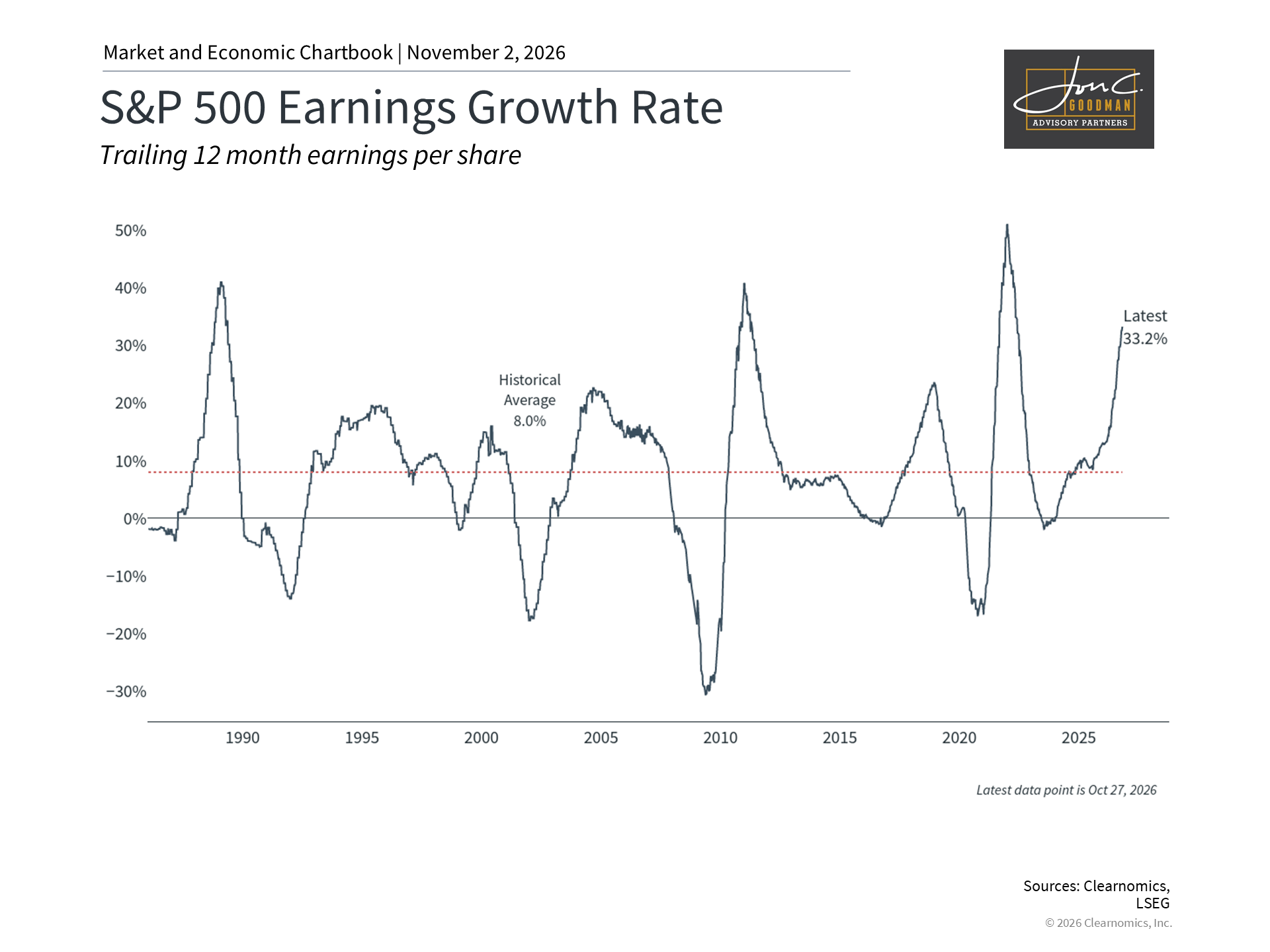
AI spending remains in focus even as corporate earnings continue to grow
Artificial intelligence has been a defining theme for financial markets in recent years, and that continued in October. Today, AI is supporting both business investment and market performance, though the primary driver is the buildout of AI infrastructure rather than productivity gains or token usage within companies. This infrastructure expansion requires substantial expenditure on data centers, semiconductors, and the energy systems needed to power them. While this spending has contributed to broader economic growth, it has also weighed on the free cash flow of companies making these investments.
This dynamic contributed to market swings throughout October, as several large technology companies reported negative free cash flow tied to infrastructure spending. This renewed investor questions about whether investments of this scale will ultimately generate a sufficient return on investment.
At the same time, this level of capital expenditure supports a wide range of industries, including construction firms, electricity providers, equipment suppliers, and semiconductor hardware manufacturers. This broader support is one reason corporate earnings growth has accelerated in recent quarters, as illustrated in the chart above. Strong earnings have not only underpinned market returns and GDP growth, but have also helped moderate stock market valuations. The forward price-to-earnings ratio for the S&P 500, for instance, has improved from a high of 23.3 a year ago to 18.9 today.1
It is worth noting that AI is just one of many forces influencing markets. Technology stocks also tend to be sensitive to interest rate movements, given that their cash flows are projected far into the future. Trends in long-term rates, Fed policy decisions, and other macroeconomic factors can therefore affect these sectors and the broader market alike. As investors continue to evaluate the long-term economic impact of AI, maintaining balance across sectors, investment styles, and geographies remains an important principle for achieving financial goals.
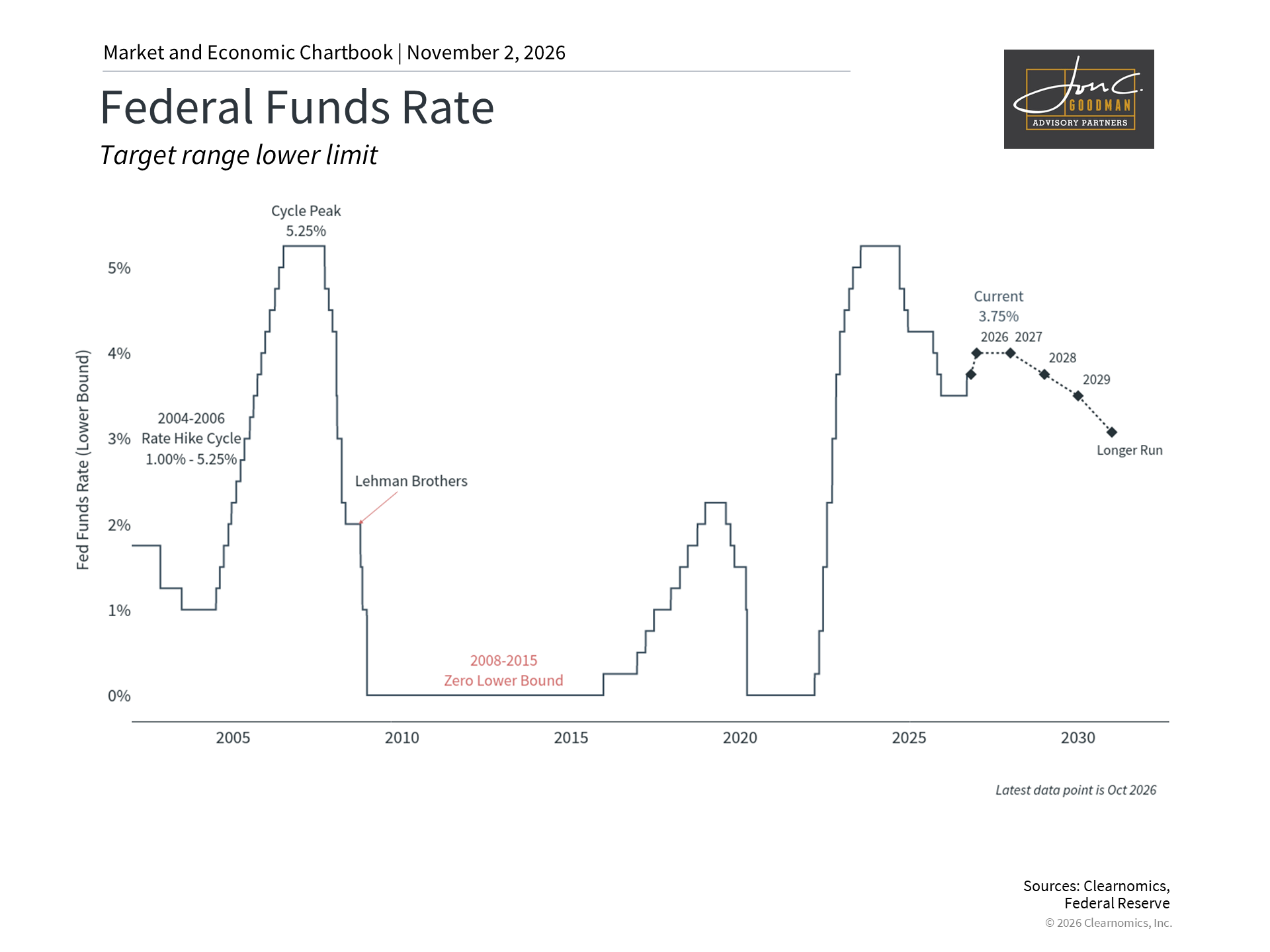
Energy prices and inflation are shaping the Fed’s cautious stance
Higher energy prices remained a persistent challenge in October as geopolitical tensions in the Middle East intensified. According to the International Maritime Organization, October marked the highest number of commercial shipping attacks on record in the Strait of Hormuz and surrounding waterways, even as more shipments continued to flow through the region.2 Ongoing attacks on Saudi Arabian energy infrastructure added further pressure on supply. In response, Brent crude, the global benchmark, rose to a six-month high near $118 per barrel, while WTI reached approximately $103.
Against this backdrop, inflation has remained higher than both economists and policymakers would prefer. The Personal Consumption Expenditures (PCE) price index rose 0.5% in September and 3.6% from a year earlier. Core PCE, which excludes volatile food and energy prices, increased 0.3% for the month and 3.1% from a year earlier.3 Inflation has now remained above the Fed’s 2% target for 67 months and is near a three-year high.
This context helps explain why the Fed’s October decision to hold its policy rate unchanged at 3.75% to 4.00% has been characterized as a “hawkish hold.” While the federal funds rate was left unchanged, the Fed is expected to raise rates at its final FOMC meeting of the year and possibly once more in 2027.4 The decision to hold was made on a 10 to 2 vote, with two officials preferring an immediate quarter-point increase.5 The official statement described economic activity as expanding at a strong pace, while indicating that additional information would help determine the appropriate policy stance going forward.
Fed Chair Kevin Warsh also announced a change to the Fed’s meeting schedule. The Fed will continue to meet eight times in 2027, but one of those meetings will be dedicated exclusively to broader monetary policy strategy, without a rate vote or official statement. While this change has no immediate impact on investors, it does mean there will be fewer policy announcements for the market to react to in the coming year.
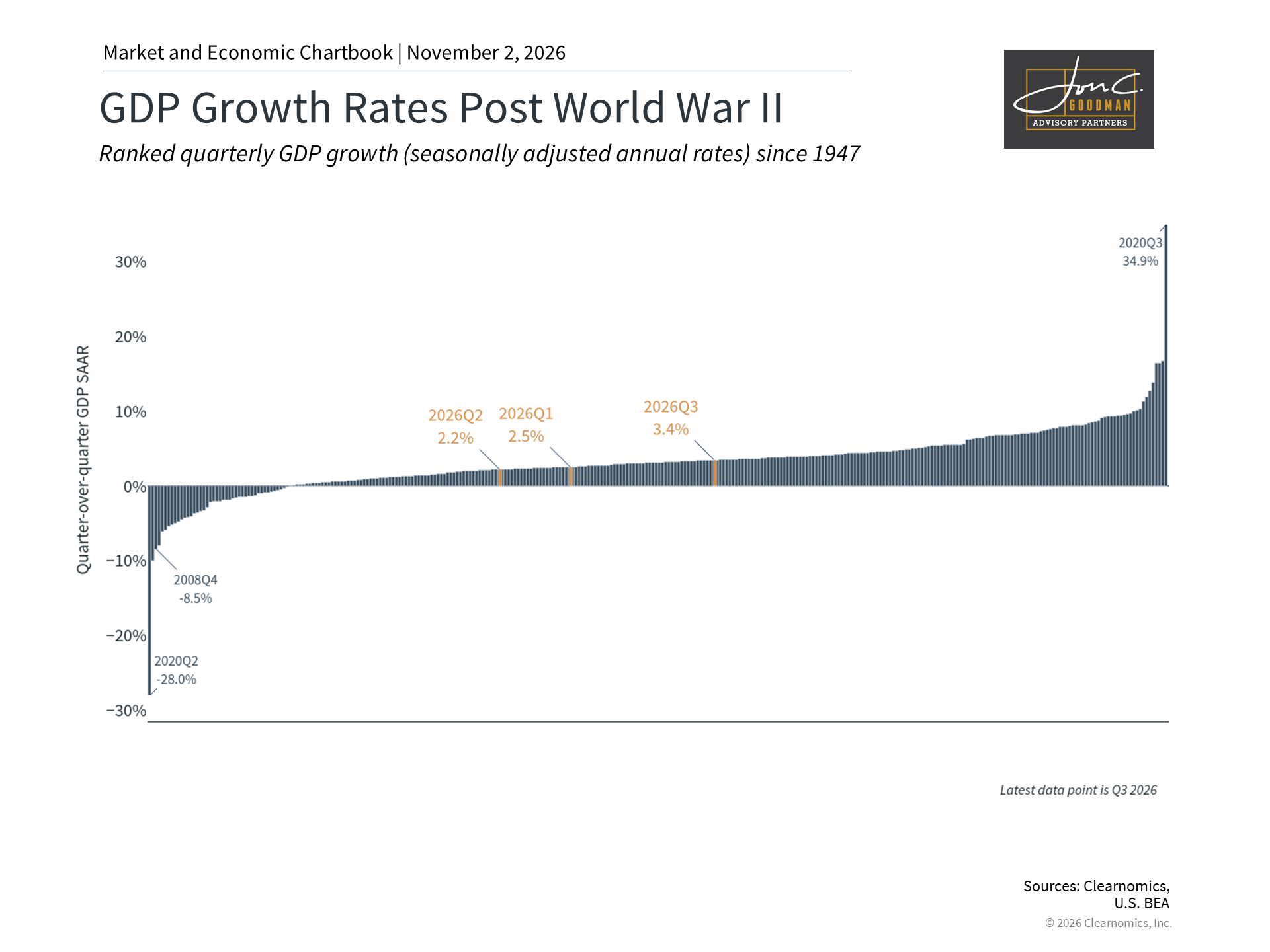
Economic growth accelerated even as consumer sentiment stayed subdued
A notable economic report released in October revealed that the economy expanded more rapidly in the third quarter than analysts had anticipated. According to the Bureau of Economic Analysis, real GDP grew at a 3.4% annualized rate in the third quarter.6 This represented the strongest quarterly growth since the third quarter of the prior year and, as the chart above illustrates, compares favorably to historical growth rates.
Growth was driven primarily by strong consumer spending, which rose 2.5%, and business investment, which increased 3.3%. Government spending contributed a more modest 0.9% gain, while net exports fell -3.3%, reflecting a period in which imports exceeded exports and thereby detracted from overall GDP.7
Consumer spending has held up well in recent quarters despite persistently weak sentiment. Households continue to express concern about inflation and the job market, with confidence in the economy near historic lows. Yet spending remains resilient, likely supported by positive trends in financial markets and low unemployment rates.
Business investment received a notable boost from AI data center construction. This also helps explain the decline in net exports, as data centers and other AI infrastructure rely heavily on semiconductor hardware imported from abroad. Together, these dynamics produced a meaningful positive contribution to economic growth.
Collectively, these factors point to a healthy economy with low unemployment, even as elevated energy prices keep inflation somewhat sticky. No economic environment is without its challenges, and investors must always navigate new uncertainties. Today’s conditions are supporting strong earnings growth, which is constructive for financial markets and portfolios over the long run. For this reason, maintaining a longer-term perspective and resisting the urge to overreact to news headlines or individual earnings reports remains sound practice.
The bottom line? October brought volatility due to questions around AI spending, energy-driven inflation, and Fed policy. Staying balanced and focused on long-term goals, rather than reacting to monthly headlines, remains the most important principle for investors navigating today’s environment.
References
- Clearnomics research using S&P 500 data, as of October 30, 2026
- https://www.imo.org/en/mediacentre/hottopics/pages/middle-east-highlighted-incidents.aspx
- https://www.bea.gov/news/2026/personal-income-and-outlays-september-2026
- https://www.cmegroup.com/markets/interest-rates/cme-fedwatch-tool
- https://www.federalreserve.gov/monetarypolicy/files/monetary20261028a1.pdf
- https://www.bea.gov/news/2026/gdp-advance-estimate-3rd-quarter-2026
- https://www.bea.gov/news/2026/gdp-advance-estimate-3rd-quarter-2026

What your Generosity has to do with your Brain
This past Saturday, our team Walk On with the Wellness Navigator joined Atlanta’s Walk to End Alzheimer’s, and together we raised almost $15,000. Thank you to everyone who walked, donated and cheered us on. The outpouring of support and generosity was felt and appreciated.
What a way to kick off November, Alzheimer’s Awareness Month. This cause is a big part of why I focus my work on women in midlife and beyond.
Why I Walk
Alzheimer’s runs in my family, and it touches my friends and neighbors too. I have one copy of the APOE4 gene, and like so many women, I’ve wondered, “Is this going to be me?” If it ever is, I want there to be a cure.
I spent 30 years as a nurse, many of them in dementia and hospice care. I loved my elders dearly. Again and again, I saw how much this disease takes. It reaches every part of a person’s life and everyone who loves them.
Why Women?
Almost two-thirds of Americans living with Alzheimer’s are women, and about 1 in 5 of us will develop it in our lifetime. We live longer, giving risk more years to build. Our hormones shift, and as estrogen declines in menopause, the brain’s fuel supply can dip. And we carry a heavy load.
Most dementia caregivers are women, and caregiving often brings chronic stress and poor sleep, both linked to dementia.
Your Retirement Brain
The disease begins in the brain 20 years or more before the first symptom, and up to half of dementia cases may be prevented or delayed. That makes midlife the window of opportunity. You wouldn’t wait until 75 to start saving for retirement.
Your brain is no different. What you do now builds the one you’ll have at 75.
And that’s the hope. Thanks to neuroplasticity, your brain can keep learning and adapting, and the habits that move the needle start supporting it right away. Just like every dollar we raised, every habit adds up.
Saturday’s event was also brain health in action. Being part of something bigger, giving back and connecting with the community give our lives meaning, which matters even more as we age. Research links that sense of purpose to a lower risk of cognitive decline.
So start this month by giving back to yourself and your brain, your greatest asset. The return on that investment is priceless, and it takes just half an hour.
Join me this Wednesday, November 4 at 10 a.m. for Brain Boost, my free monthly Zoom session, where we’ll get ready to thrive through the holidays. New to Brain Boost?
We calm the nervous system with breathwork and gratitude, dig into the science, and you leave with one habit to practice. Can’t make it live? Sign up anyway and I’ll send you the recording. Save your spot here.
Be well,

Christine Despres, RN, NBC-HWC, CDP | Brain & Metabolic Health Coach