

Greetings!
Some things in life are stubbornly beyond our control. Mortgage rates, for example. Others—thankfully—are much closer to home.
This week’s Advice for the Good Life is really about knowing the difference.
In Wealth Advisory, we take a look at what happens when mortgage rates climb back above 7%. The effects reach well beyond the monthly payment: homeowners with historically low mortgages are reluctant to move, buyers are squeezed by affordability, refinancing has slowed to a trickle, and yet home prices remain stubbornly close to record highs. Housing is both where we live and, for many Americans, the largest asset on the family balance sheet—which means what happens there rarely stays there.
Then Christine takes us upstairs—to the most valuable piece of real estate we’ll ever own: the space between our ears.
In Wellness Navigator, she answers a question she hears surprisingly often: “What the heck is a brain health coach?” Her answer is worth reading, because brain health isn’t simply about avoiding cognitive decline someday. It’s about the habits we practice today—nutrition, movement, sleep, stress management, cognitive engagement and reducing harmful exposures—that can help us remain sharper, stronger and more independent for the long haul.
And finally, we’re introducing something new: Parting Thought.
Think of it as a few words for the road—ideas drawn from the four aspirations at the heart of the Good Life: Happy. Healthy. Wealthy. Wise. We’ll rotate among them, occasionally overlap them, and hopefully leave you with something worth carrying into the week.
Today’s thought is categorically Wise: a reminder that wisdom isn’t knowing what will happen next. It’s learning to distinguish between what we can control and what we can’t—and then faithfully tending to what’s been entrusted to us.
Maybe that’s the common thread this week.
We can’t set mortgage rates. We can’t dictate markets. And we certainly can’t control every card that aging eventually deals us.
But we can tend to the things entrusted to us: our balance sheets, our bodies, our brains, our habits—and the people with whom we hope to enjoy all of them.
That’s the long game. And around here, that’s what we mean by the Good Life.
As always, enjoy, share, and subscribe if something here helps you—or someone you care about—live it a little better.
Alongside,

Guide for the Good Life | Certified Private Wealth Advisor® Professional

Wealth Advisory: How 7% Mortgage Rates Are Shaping Housing and the Broader Economy
The housing market holds significant importance both at the personal level and for the broader economy and financial system. For most households, purchasing a home is a major milestone that takes years of careful planning and saving. It typically represents their largest asset, their most substantial monthly expense, and their primary source of debt. Beyond individual households, the housing market also plays a considerable role in overall economic activity, accounting for between 15% and 18% of the country’s gross domestic product.1 When combined with the overall wealth effect that the housing market generates, these factors can meaningfully influence consumer sentiment, household balance sheets, and the pace of broader economic growth.
Interest rates are one of the most direct influences on the housing market. When rates rise, mortgage costs for new applicants increase as well, affecting everything from loan qualification standards to the total volume of home sales. The average 30-year fixed mortgage rate has moved back above 7% after declining toward 6% at the beginning of the year. Although mortgage rates have been notably volatile in recent years, they have not remained at these levels on a sustained basis in nearly 25 years. Understanding what these housing market pressures could mean for households and the broader economy is an important question for investors and homeowners alike.
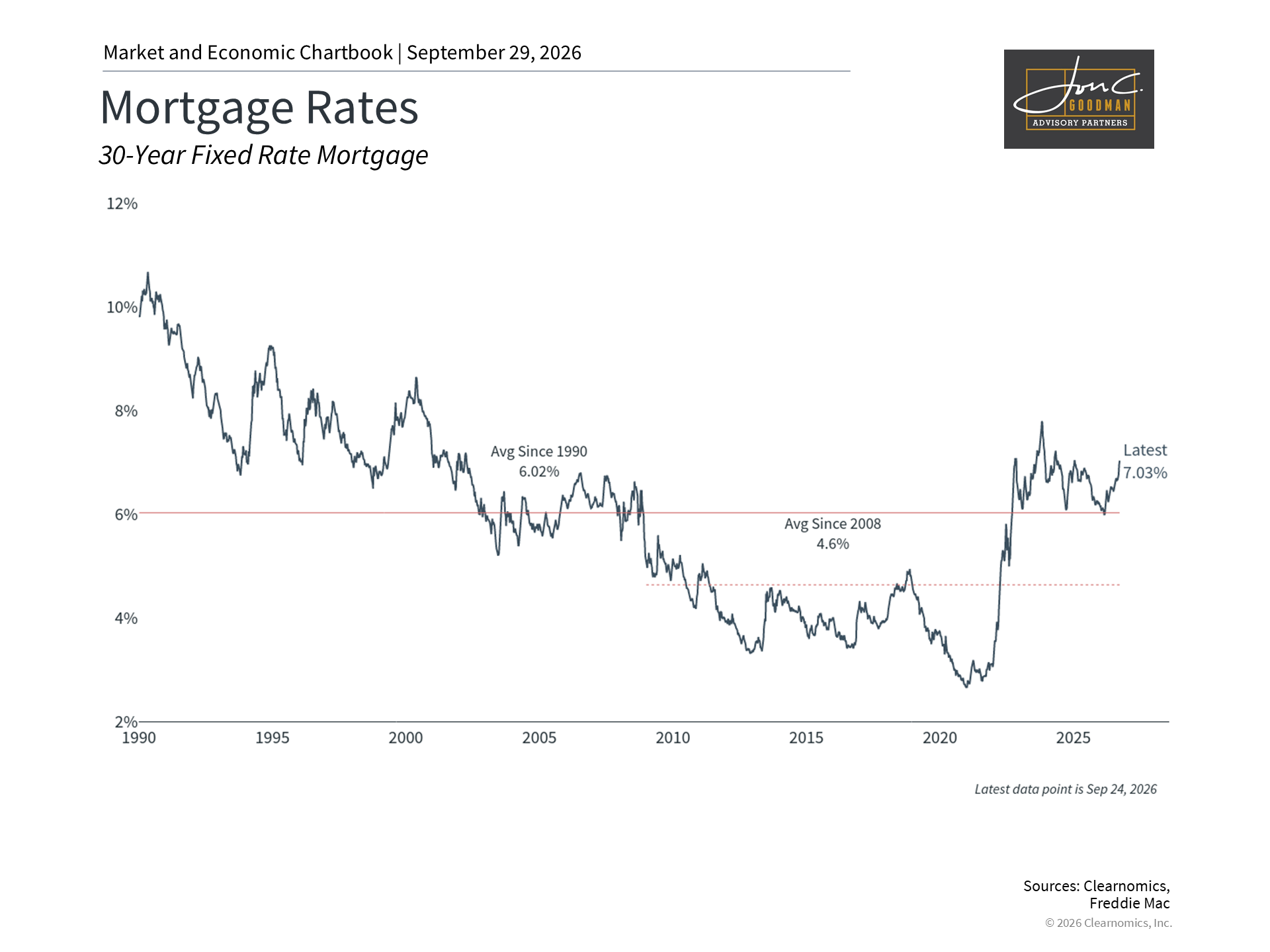
Mortgage rates have climbed back above 7%
Mortgage rates had been declining alongside long-term Treasury yields from the early 1980s through 2020, when they reached their lowest point during the pandemic. From 1990 to the 2008 financial crisis, the long-run average for 30-year fixed rates was 6%. By comparison, the average since then has been only 4.6%. During much of the past decade, and particularly during the pandemic years when rates fell to 3% or below, many buyers and homeowners grew accustomed to financing costs that were well below those historical norms.
The return to 7% naturally raises questions about the economics of homeownership. One of the most significant consequences is what economists call the “lock-in” effect. Homeowners who secured low fixed rates in previous years face a strong disincentive to sell, since doing so would require taking on a new mortgage at today’s considerably higher rate. This dynamic reduces the supply of existing homes coming to market and can keep overall transaction volumes low. Washington policymakers have been considering potential solutions such as “portable mortgages,” which would allow homeowners to transfer their lower rates to a new property.
According to the National Association of Realtors, existing home sales fell 2.0% month-over-month and 1.2% year-over-year in August, reflecting continued softness in market activity.2 The inventory of existing homes now stands at 4.9 months of supply, while new homes now stand at 8.5 months, the highest levels in over a decade.3 While higher inventories are a positive development, these figures are calculated based on the current rate of sales activity, so they may also reflect homes sitting on the market for longer periods.
For buyers who do enter the market, higher rates have a clear and direct effect on affordability, as a larger portion of monthly income must be directed toward mortgage debt service. This creates an incentive for prospective buyers to wait for rates to improve, which further delays housing activity. Those who do proceed face difficult tradeoffs in terms of location, property size, or the size of their down payment.
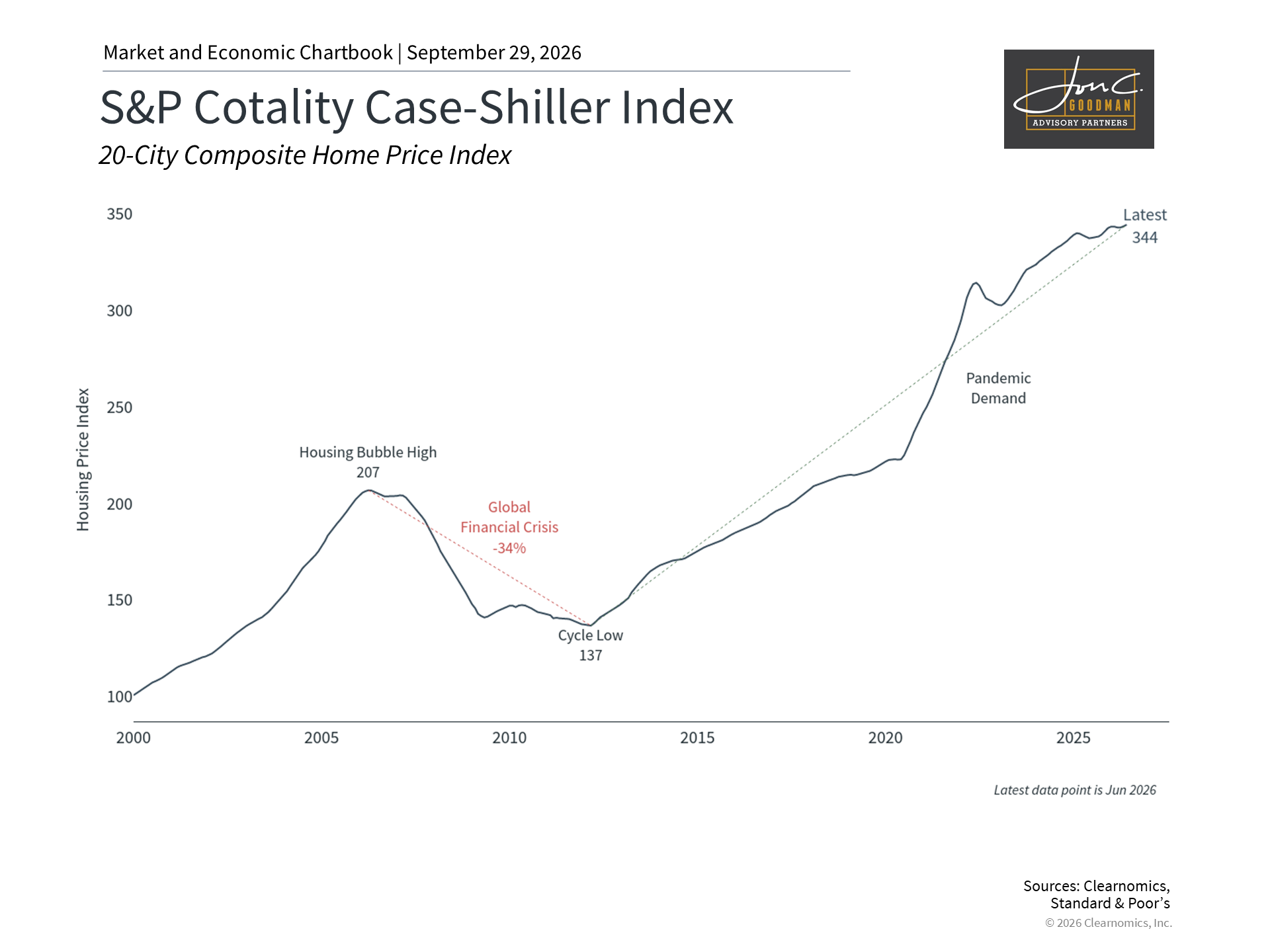
Home prices remain near record highs despite sluggish activity
Even though transaction volumes remain low, home prices nationally continue to hover near record highs according to the S&P Cotality Case-Shiller Index, as shown in the chart above. It is not uncommon for activity and prices to move in different directions within the housing market. The broader economy remains relatively healthy and unemployment is low, creating an environment in which existing homeowners are financially stable and capable of continuing to pay their mortgages, with little immediate pressure to sell.
Elevated home prices also contribute to what is commonly known as the “wealth effect.” When households perceive that their homes are maintaining or increasing in value, they tend to feel more financially secure. With the stock market also hovering near all-time highs, these trends together can support greater spending on goods and services.
This dynamic may partly explain why consumer spending has held up better than many economists anticipated, despite concerns such as tariffs and higher energy costs. This resilience in spending has persisted even as consumer sentiment has remained near historic lows. One notable puzzle in recent years has been the disconnect between how consumers describe their feelings about the economy and how much they actually spend.4
One explanation is that sentiment tends to be driven more by inflation, including factors such as higher gasoline prices this year, while spending is supported by the wealth effect. Although housing costs are an important component of household finances and account for more than one-third of the Consumer Price Index, these “shelter” costs have increased just 3% over the past year, while gasoline prices have climbed 27.4%.5
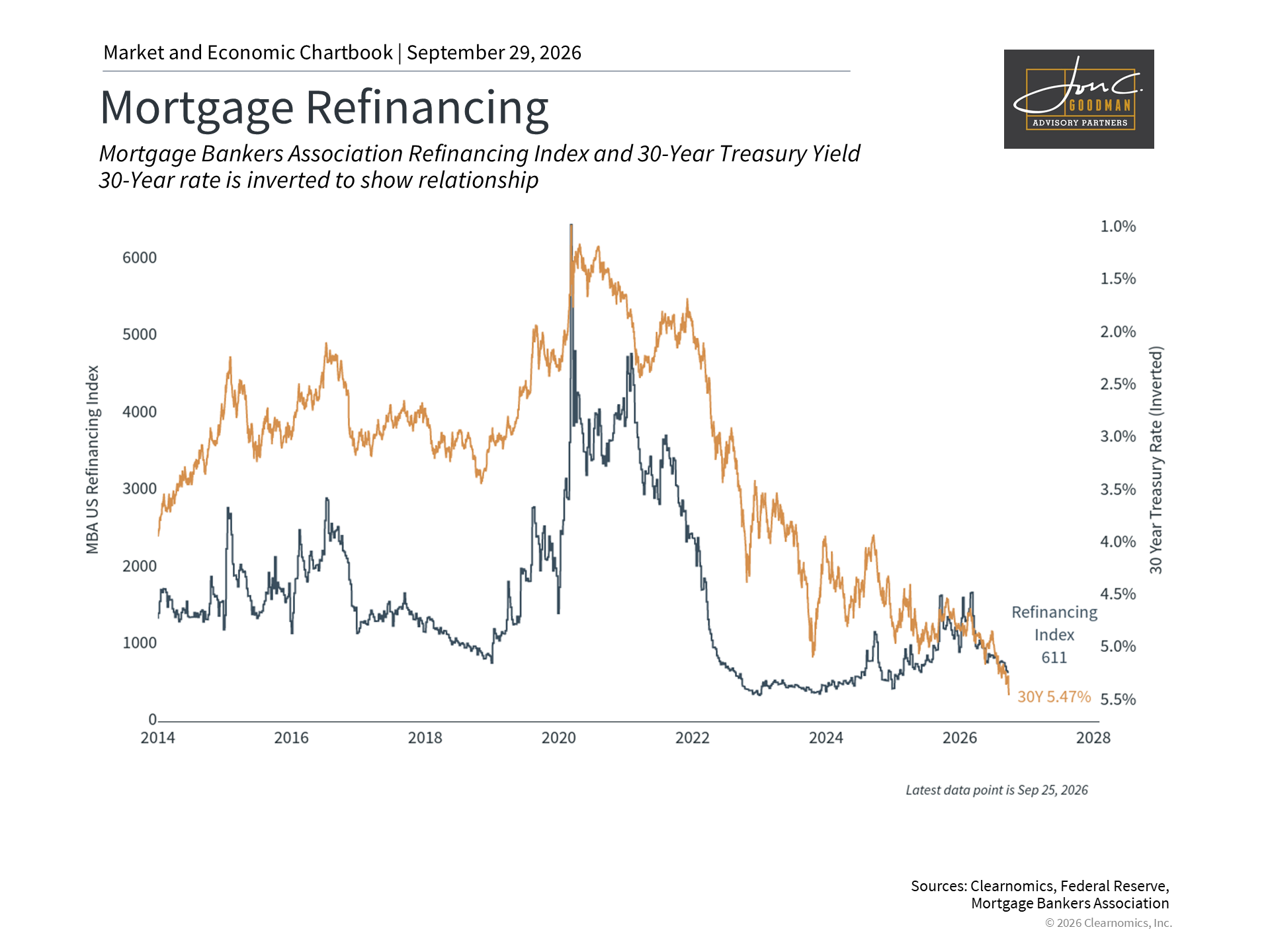
Refinancing activity has dropped sharply from its peak
As long-term interest rates have risen, it follows that refinancing activity has declined sharply as well. Data from the Mortgage Bankers Association shows that refinancing volumes have dropped to multi-year lows after peaking between 2020 and 2022, when many homeowners took advantage of historically low rates to reduce their monthly payments or tap into their home equity.6
In practical terms, homeowners who might otherwise have refinanced are no longer able to do so at favorable rates. Since refinancing is one of the key ways households convert rising home values into spendable cash, this trend could weigh on consumer spending going forward.
Mortgage debt remains by far the largest component of household borrowing, even as credit card and student loan balances have grown in recent years. Household debt service as a share of disposable income, which encompasses both mortgage and consumer debt, stood at approximately 11% in the second quarter of this year. This remains moderate relative to the pre-2008 peak of nearly 16%, suggesting that most households are managing their debt loads effectively, even if they are unable to access their home equity.7
The ultimate impact on spending, home prices, and transaction volumes will depend in large part on how long interest rates remain elevated. At present, many interest rates across maturities are near twenty-year highs, including 5-year, 10-year, and 30-year Treasury yields.8 With inflation remaining stubbornly above the Fed’s target, bond yields suggest that rates may stay higher for longer. The Fed’s own quarterly Summary of Economic Projections indicates that policy rates could remain elevated through at least 2027.9 Although interest rates are inherently difficult to predict, particularly if there are new developments related to inflation, oil prices, or the job market, investors and households are well served by maintaining discipline and staying focused on their long-term financial plans.
The bottom line? The housing market may continue to face headwinds as mortgage rates remain above 7%. For investors and households alike, this environment of elevated rates underscores the importance of staying vigilant and maintaining a focus on long-term financial planning.
References
- https://www.nahb.org/news-and-economics/housing-economics/housings-economic-impact/housings-contribution-to-gross-domestic-product
- https://www.nar.realtor/newsroom/nar-existing-home-sales-report-shows-2-0-decrease-in-august
- https://www.nar.realtor/research-and-statistics/housing-statistics/existing-home-sales
- https://www.sca.isr.umich.edu/
- https://www.bls.gov/news.release/cpi.nr0.htm
- Clearnomics research and the Mortgage Bankers Association, as of September 28, 2026
- Clearnomics research and the Federal Reserve Economic Data, as of September 28, 2026
- https://home.treasury.gov/policy-issues/financing-the-government/interest-rate-statistics
- https://www.federalreserve.gov/monetarypolicy/fomcprojtabl20260916.htm
Index Descriptions
S&P Cotality Case-Shiller Home Price Indices
The S&P Cotality Case-Shiller 20-City Index measures the value of residential real estate and tracks changes in the selling prices of single-family homes across 20 major U.S. metropolitan areas.

Wellness Navigator: My Brain is Fine, Thanks for Asking
What the heck is a brain health coach?
When I tell people I’m a brain health coach, I sometimes get a look like they are confused, as if maybe I work with head injuries or TBI’s but that’s not what it seems like I do. That work is deeply admirable, but it isn’t my specialty. So let’s clarify.
What I actually do is help people break the habits that damage the brain and build the ones that protect it. It’s all about holding on to what we have as we age instead of being a bystander in our own health.
“Not me, my brain is fine”
That’s usually the next reaction. But your brain is the command center for every system in your body, helping regulate your blood sugar, cortisol, inflammation, heart and digestion. Start with the brain and the benefits trickle down to your metabolic health, energy, mood and sleep.
You don’t have to do it alone
The US POINTER study followed more than 2,000 adults at risk for cognitive decline for two years. Both groups got better, but the group guided through a structured program with regular coaching improved the most, a benefit researchers compared to slowing cognitive aging by up to two years. Two better years, because they had structure and accountability.
And this isn’t only about prevention. The same habits sharpen your brain, whether you want to stay at the top of your field, start a business or feel sharp and confident for decades to come.
What a Coach Does
The problem isn’t a lack of information. It’s too much of it. Another supplement or TikTok trend might be fun, but does it fit your unique biology? I’m your accountability partner and your guide through the noise. Together we look at your body’s signals, your family history and how you live day to day. Then we map a clear path forward so you can stop guessing and start moving the needle. Over time, those steps become consistent habits and those habits become your lifestyle.
Reignite Your Mind and Metabolism
My four-month program is personalized, not restrictive or one-size-fits-all. We work through all six pillars of brain health, which are nutrition, movement, sleep, stress, cognitive engagement and detox. As we go, we look at what’s working and what isn’t and adjust along the way. You’ll have eight one-on-one sessions, custom guided meditations and breathwork, morning and evening routines and meal planning with recipes.
I’m not here to sell you a coaching program. I’m here to help you transform your life, so the years ahead are spent doing what you love with the people you love. There are no guarantees in life, but I’m going to give it an honest effort to age with clarity, strength, independence and vitality. I want the same for you.
If you’ve been waiting for the moment to invest in yourself, this is it. Book a free call at christinedespres.as.me and we’ll talk about where you are, where you want to be and whether the program is a good fit.
The power to age well is more in your control than you think.
To your brain health,
Christine
Brain & Metabolic Health Coach | RN, NBC-HWC, CDP
thewellnessnavigator.com
Parting Thought
“A Smart person knows what to say. A wise person knows whether to say it or not.”