
Greetings!
The headlines have been anything but dull lately, particularly when it comes to artificial intelligence, technology stocks, and the companies driving the AI revolution. But beneath the market’s daily ups and downs are some important questions about leadership, transparency, and the risks of putting too many eggs in one basket.
In this week’s Wealth Advisory, we look beyond the headlines to consider what these developments mean for long-term investors—and why a sound plan matters more than ever.
In Wellness Navigator, Christine continues our recognition of Alzheimer’s Awareness Month, exploring three more potentially modifiable risk factors for dementia: heart health, vision, and mood. Her message is encouraging: small, consistent actions today can make a meaningful difference tomorrow.
Finally, our Parting Thought comes from author Liane Cordes, whose words about continuous effort are frequently misattributed to Winston Churchill. Regardless of who gets the credit, the message is worth remembering: progress depends less on extraordinary ability than on the willingness to keep showing up.
Whether we’re talking about our money, our minds, or our lives, there’s a common thread this week: Lasting results are built through thoughtful decisions and consistent effort.
As always, I hope you’ll read, enjoy, and share this week’s Advice for the Good Life.
Here’s to living well!


Wealth Advisory: What NVIDIA’s Leadership Shift Reveals About AI Market Trends
Technology and AI-related stocks have gone through a period of volatility since the Nasdaq reached its all-time high in early October. The midterm election initially raised questions about the pace of data center construction across the country. Since then, investors have been processing developments related to Jensen Huang, the co-founder who has led Nvidia since 1993, including leadership changes, espionage as part of the AI race between the U.S. and China, and how Nvidia will navigate the period ahead. While the story continues to unfold, it comes as little surprise that these events have drawn significant investor attention, given Nvidia’s central role as a supplier of chips to the AI industry.
Stock-specific events can introduce uncertainty, but long-term investors benefit from understanding how these developments affect the broader risks and opportunities in the market. These events shine a light on topics that investors may not always prioritize, including corporate governance, succession planning, and transparency. These considerations are just as important to long-term investing as market performance, valuations, and the other factors that typically command investor attention.
Corporate governance, in particular, refers to the rules and oversight that determine how a company is directed and held accountable. These factors carry even greater weight when a single company plays an outsized role in the market and the economy. So how can investors make sense of these developments while staying focused on the long term?
Leadership transitions can introduce near-term market uncertainty
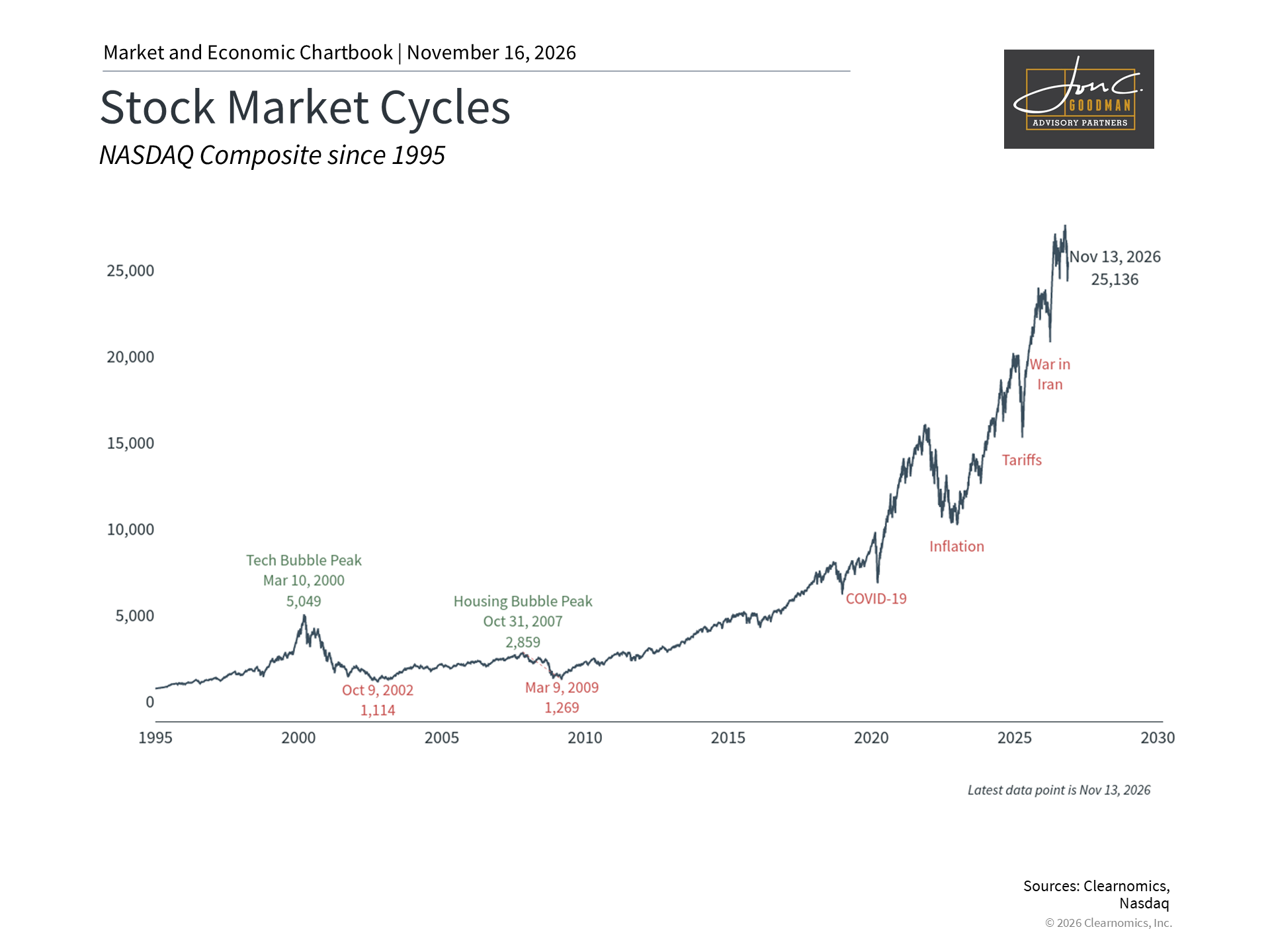
As the accompanying chart shows, tech stocks have pulled back since their October 6 peak.1 It is not unusual for technology stocks to experience declines of this magnitude, even during strong long-term cycles. Their valuations depend heavily on expectations for future growth, which can shift quickly in response to investor sentiment, interest rates, and other factors.
The idea that a stock’s price reflects all available information is a cornerstone of modern finance. However, when a long-serving leader departs unexpectedly, investors may need to reassess everything from strategy to execution. This process takes time and creates uncertainty, even when a company’s fundamentals remain sound.
Why does this matter beyond a single company? The larger a company’s role in an index and an industry, the more a company-specific development can influence the broader market. The Magnificent 7 accounts for over one-third of the S&P 500, so swings in a small group of stocks can affect the overall index.2 Nvidia also sits at the center of the AI supply chain, which means news about the company can ripple through chipmakers, cloud providers, and many other stocks.
This is far from the first time a company has faced questions about a founder or long-serving CEO, with Apple perhaps being the most well-known example. In 1985, Apple’s board had not set clear boundaries between co-founder Steve Jobs and CEO John Sculley, and the resulting conflict led to Jobs’ removal. Years later, after returning to the company, when Jobs faced health issues, Apple built a formal succession plan that moved Tim Cook into the CEO role in 2011. A more recent parallel comes from the AI industry itself. In 2023, the board of OpenAI removed CEO Sam Altman, who returned four days later.
Over the past century, corporate governance standards for public companies have evolved considerably. This evolution has been driven in part by periodic crises that have prompted greater board independence, stronger regulation, and improved risk management practices. Whether or not corporate governance has a direct measurable impact on investment performance, these rules exist to protect investors.
Circular deal structures have drawn scrutiny from investors
One concern among investors is the rise of so-called “circular deals,” arrangements that have become increasingly common in the AI industry. These include cases where Nvidia finances, invests in, or guarantees obligations for customers and partners, such as AI model developers and cloud providers, that in turn buy its chips. This can appear circular in that Nvidia is often providing the capital that enables the customer to purchase its products.
Whether this is truly circular, however, depends on whether the customer is economically viable. In these situations, a more traditional way to view such arrangements is known as “vendor financing,” where a supplier helps to provide financing for customers to pay for its products. Whether vendor financing works depends on whether demand for the customer’s own products continues to grow. These arrangements can help the industry scale to meet that demand more quickly. However, if demand slows or was not there in the first place, the risks can compound, since the same companies are both customers and investments.
The scale of these commitments has grown rapidly across the industry. For example, Nvidia’s most recent quarterly filing disclosed about $530 billion in off-balance sheet commitments and guarantees, which are future obligations that do not appear as liabilities on the balance sheet.3 This is up from $184 billion the prior quarter and far larger than the roughly $91 billion in debt and obligations on its balance sheet. Its investment portfolio has also grown to about $128 billion, much of it in private stakes in AI companies that cannot be quickly converted to cash.
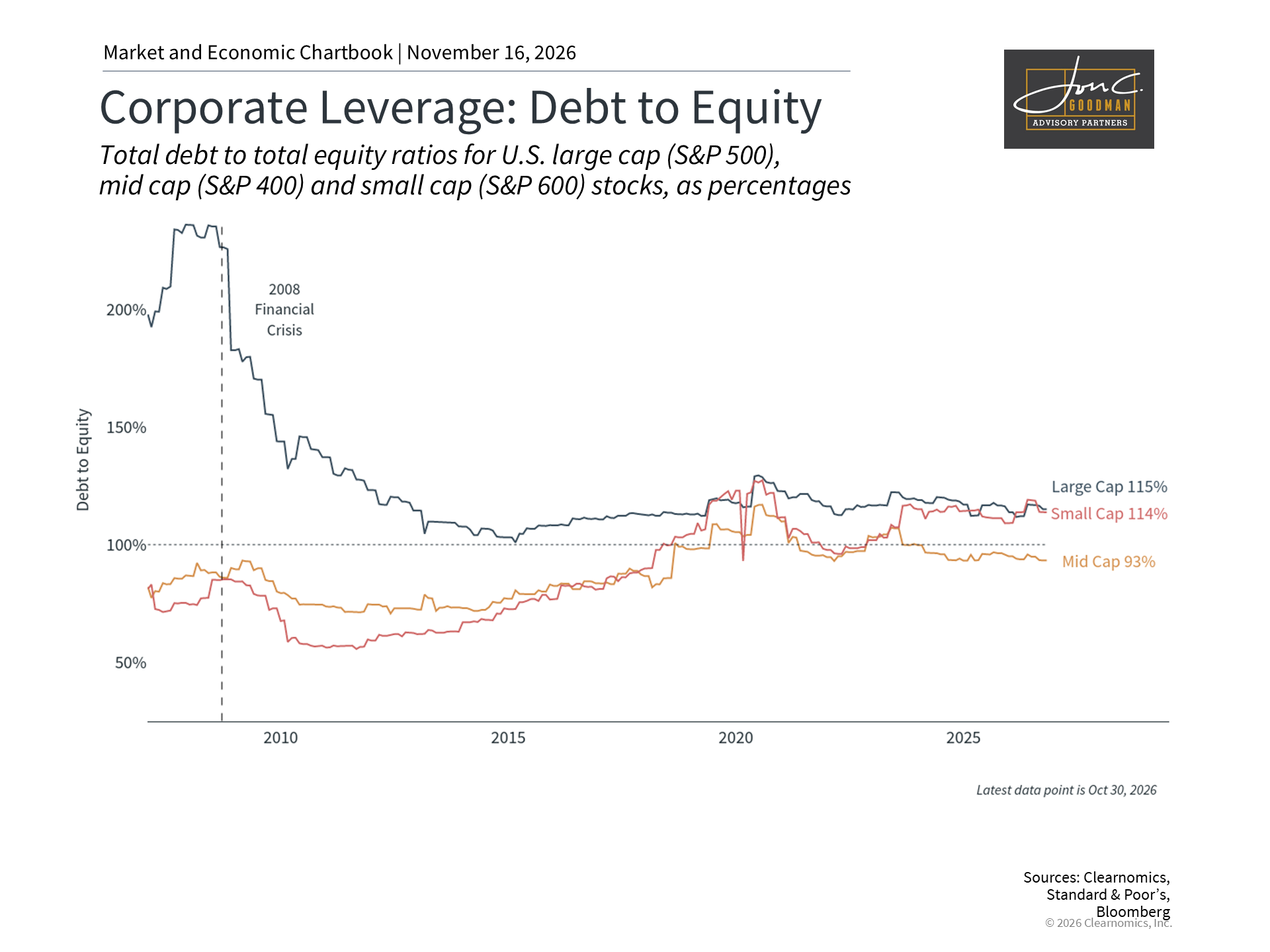
At the same time, the company generated about $127 billion in free cash flow over the past twelve months and holds about $22 billion in cash against $33 billion in total debt. Traditional leverage measures, such as the debt-to-equity ratio, often only capture what appears on the balance sheet. This is why it is important to consider both sides of the ledger when evaluating these commitments and identifying potential market risks. As the chart above shows, leverage ratios remain at reasonable levels compared to history.
Many of today’s corporate compliance rules exist because major companies once experienced serious breakdowns in oversight. Enron is the clearest example. Its executives used complex side companies, known as special purpose vehicles, to intentionally hide billions in debt and create the appearance of revenue. When this came to light in 2001, Enron went bankrupt, wiping out over $60 billion in shareholder value along with employee retirement savings.
Congress responded with the Sarbanes-Oxley Act of 2002, which requires strict internal controls and public disclosure.4 Lehman Brothers, which concealed billions in debt off its balance sheet ahead of its 2008 bankruptcy, is another reminder of why transparency matters. The key distinction today is disclosure. Unlike Enron’s hidden structures, Nvidia’s commitments are disclosed in public filings, allowing investors to evaluate the risks for themselves. This does not mean they carry no risk, but disclosed risk that investors can evaluate for themselves is very different from hidden risk.
Elevated valuations reflect high expectations for future growth
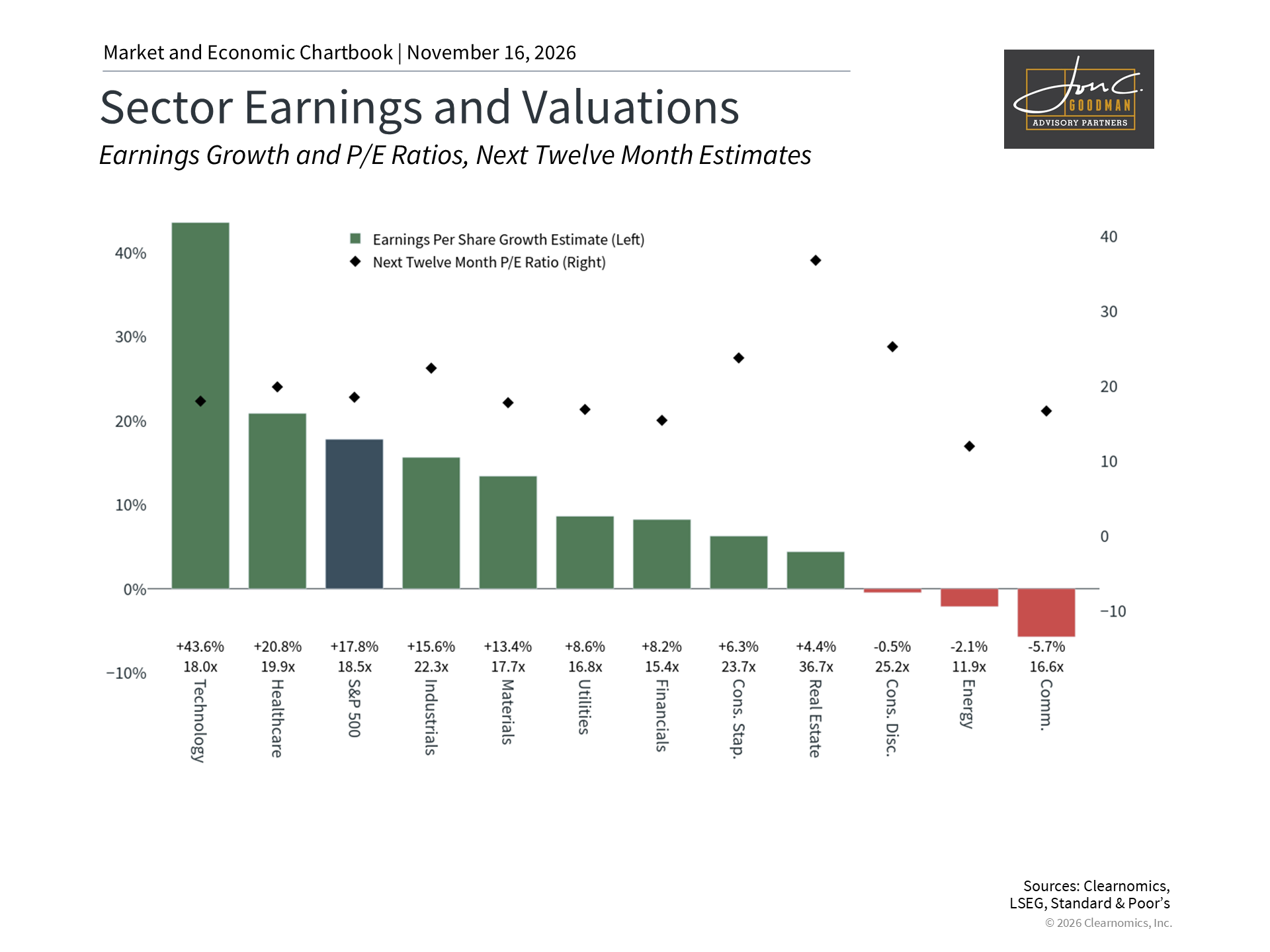
Rapid developments in technology and AI stocks, including the buildout of new data centers, have pushed earnings higher. While it is natural to draw comparisons to the dot-com bubble, the two eras differ in important ways. Unlike the dot-com bubble, which saw many loss-making companies reach euphoric valuations, the current market expansion is supported by earnings growth. This has helped valuations, which remain elevated but have improved on many measures, as the accompanying chart shows.5
Investor enthusiasm is also evident in new offerings. Anthropic’s initial public offering, or IPO, is expected to begin trading on November 19 and is reportedly about six times oversubscribed, meaning demand for shares far exceeds the amount being offered.6 This reflects both strong demand and high expectations across the industry.
It is worth remembering that valuations are not a market timing tool. Instead, they matter most when determining the right mix of assets in a portfolio. None of this is to say that AI is not transformational. Rather, it is a reminder that portfolios should not depend on any single company, theme, or individual leader, which is why balance across sectors, styles, and asset classes remains so important.
The bottom line? Leadership changes at Nvidia highlight the importance of corporate governance and transparency, especially when a few companies have an outsized impact on markets. Maintaining a diversified portfolio aligned with long-term goals remains the best way to navigate these periods of uncertainty.
References
- Clearnomics research using Nasdaq data, as of November 13, 2026
- Clearnomics research using Standard and Poor’s data, as of November 13, 2026
- https://investor.nvidia.com/financial-info/sec-filings/sec-filings-details/default.aspx?FilingId=19735893
- https://www.congress.gov/bill/107th-congress/house-bill/3763
- Clearnomics research using Standard and Poor’s data, as of November 13, 2026
- https://www.bloomberg.com/news/articles/2026-11-12/anthropic-s-ipo-is-said-to-be-about-six-times-oversubscribed

Alzheimer’s Awareness Month: Up to 45% is in your control
Last week we started with four of the 14 modifiable risk factors for dementia from the 2024 Lancet Commission: hearing, blood sugar, learning and connection. Addressing all 14 could prevent or delay up to 45% of cases.
Here are three more. If you already picked one, stick with it. If not, start with whichever feels easiest. The small wins you repeat become your lifestyle.
Your Heart
High LDL cholesterol ties with hearing loss at the top of the list, linked to 7% of dementia cases. High blood pressure in midlife adds another 2%. At your next physical, ask for your cholesterol and blood pressure results. If either is out of range, your doctor can guide treatment. The daily habits that bring those numbers down are where I come in.
Your Eyes
Untreated vision loss accounts for 2%. When eyes struggle, the brain gets less to work with. It’s easy to start skipping what you love, like reading, driving at night or a crowded dinner out. Cataracts are common and very treatable. If it’s been a couple of years since your last eye exam, book one this month.
Your Mood
Depression comes in at 3%. Improving your outlook can take less than a minute. My Gratitude Ritual, inspired by Dr. Amen, starts your day before you pick up your phone. It’s our Micro Habit Monday on November 23, but there’s no reason to wait. Here’s the full ritual.
I’ve Got Your Back
It’s January 2nd. The inbox is overflowing, the routine is nowhere to be found and your brain feels like it never left the party. The 5-Day Brain Fog Reset gives you five days to think clearly again, starting January 10. Join now to start receiving holiday support, with a plan to thrive in the new year. The Early Bird price of $67 ends November 30.
Get the 5-Day Reset details and sign up here.
Aging well isn’t luck, it’s a strategy. What’s yours?
Be well,

Christine Despres, RN, NBC-HWC, CDP | Brain & Metabolic Health Coach
https://www.thewellnessnavigator.com/