
As Thanksgiving approaches, there’s plenty to be grateful for—even if the stock market hasn’t made it particularly easy lately!
This week’s Advice for the Good Life explores three subjects that, while seemingly unrelated, share a common thread: the importance of perspective, intentionality, and making the most of what we’ve been given.
In Wealth Advisory, we examine the recent market correction, the extraordinary investments being made in artificial intelligence, and what history teaches us about innovation, uncertainty, and long-term opportunity. With year-end approaching, we also consider how market volatility can create opportunities for thoughtful investors.
In Wellness Navigator, Christine Despres shares some heartwarming Thanksgiving memories, the fascinating science behind gratitude and brain health, and a simple morning ritual that can help us cultivate more calm, connection, and joy—not just during the holidays, but throughout the year.
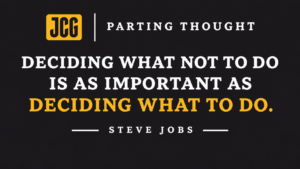
And in our Parting Thought, Steve Jobs reminds us that “Deciding what not to do is as important as deciding what to do.” It’s a particularly timely reminder that a good life isn’t simply about accumulating more, doing more, or achieving more. Sometimes, it’s about making room for what matters most.
I hope you’ll take a few minutes to read, enjoy, and share this week’s edition with family and friends. And if you’re not already a subscriber, I invite you to join us as we pursue a happier, healthier, wealthier, and wiser life together.
Most importantly, Ceci and I wish you and yours a wonderful Thanksgiving, filled with faith, family, friendship, and gratitude for the many blessings of this life.
Worry Less. Adventure More.


Navigating AI Uncertainty and Market Volatility
Market volatility rarely stems from a single cause, and recent swings across major indices are a clear illustration of this. A combination of factors, including leadership changes at Nvidia and Anthropic’s initial public offering (IPO), sent ripple effects well beyond AI-related stocks, pushing the S&P 500 and Dow Jones Industrial Average into correction territory while the Nasdaq briefly gave back all of its year-to-date gains.1
In the time since, a meaningful portion of those losses has been recovered across many parts of the market, helped in part by the reinstatement of Jensen Huang as Nvidia’s CEO, reportedly with involvement from the White House.2 This sequence of events underscores how rapidly markets respond to new information and why maintaining a long-term perspective remains essential. Amid these ongoing developments, a central question persists: will the hundreds of billions of dollars being directed toward AI infrastructure ultimately produce sufficient returns to justify the investment?
It is also worth noting that even as investors were processing these market movements, meaningful scientific progress was being made. A mathematician at Anthropic, working alongside AI, developed a proof of the Riemann Hypothesis, a problem that has remained unsolved for 167 years and sits at the foundation of many areas of mathematics.3 The immediate effects on everyday investors and individuals may be limited, but the significance of this achievement is difficult to overstate.
Even with these rapid advances, the tangible benefits of AI for companies and investors can still feel distant, while the costs associated with building AI infrastructure show up immediately in free cash flows. Many investors naturally look to historical parallels, such as the dot-com collapse of the early 2000s, to frame today’s environment. While certain surface-level similarities exist, perhaps the more instructive lesson from that period is that the infrastructure built during those years laid the groundwork for decades of subsequent innovation. The question for investors is how to maintain perspective and balance during a period of sustained market volatility.
Corrections are a normal part of investing
At their lowest point during the recent downturn, the S&P 500 and Dow entered correction territory, defined as a decline of between 10% and 20% from a recent peak, while the Nasdaq erased its year-to-date gains and approached bear market levels, defined as a fall of 20% or more.4 These broad declines were concentrated primarily in technology stocks, including semiconductor companies central to AI hardware development. Between October 6 and November 20, for example, Nvidia shares fell approximately 48%, contributing to pullbacks of roughly 18% for the Nasdaq and 12% for the S&P 500.5
Technology stocks are inherently volatile, and short-term swings of this magnitude are not unusual for the sector. Looking back over just the past year, the Nasdaq has experienced several such episodes. From early June through the end of July, for instance, the Nasdaq declined 9.8% from its peak, driven by many of the same AI-related concerns influencing markets today.6 A sharp rebound of 13.0% followed, with the index reaching a new all-time high in early October.7 From October 2025 to the beginning of the Iran war in March, the Nasdaq declined 12.6%, before it rebounded into the summer.8
Recent volatility has moved in both directions. While the full picture continues to develop, news of Jensen Huang’s reinstatement as CEO prompted sharp recoveries across the Nasdaq, S&P 500, and Dow. These types of rapid moves are characteristic of event-driven markets, where prices adjust quickly as new information becomes available. They are also precisely the kind of conditions that well-constructed, balanced portfolios are designed to help investors navigate.
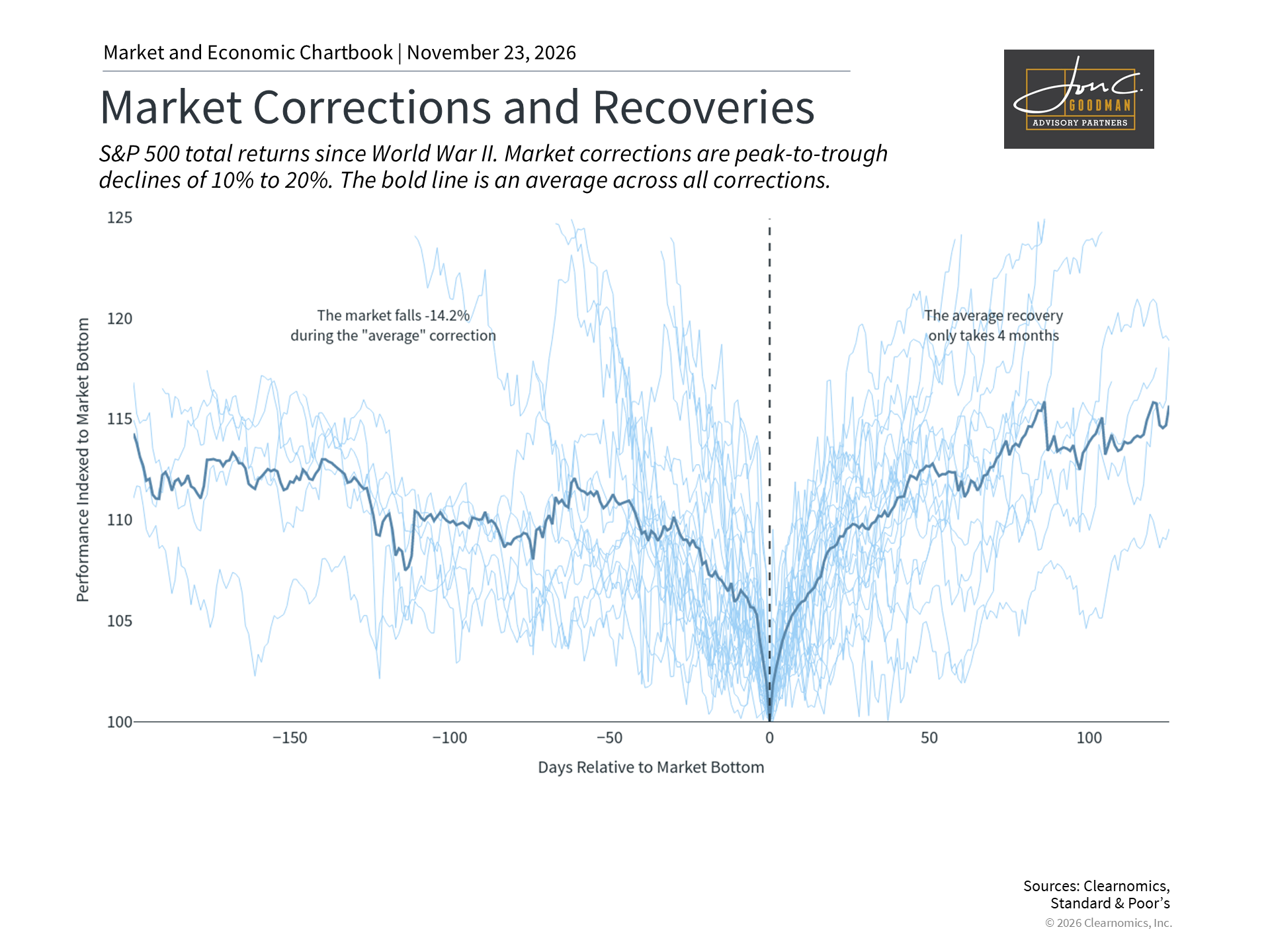
The accompanying chart offers a broader historical view of market corrections. Since World War II, the S&P 500 has declined an average of approximately 14% during corrections and has typically recovered within roughly four months.9 No two corrections are identical, and history shows that both the severity and the duration of a decline depend heavily on its root cause. More modest pullbacks, including several that occurred beginning in 2025 such as the market’s reaction to the “Liberation Day” tariffs, rebounded relatively quickly, supported by solid corporate earnings and economic growth.
Strong fundamentals do not make corrections impossible, and the history of market recoveries offers no guarantee that rebounds will always be swift or that further declines cannot occur. That said, these examples illustrate that a solid economic foundation can support portfolio resilience over the long run.
Innovation drives markets over long periods10
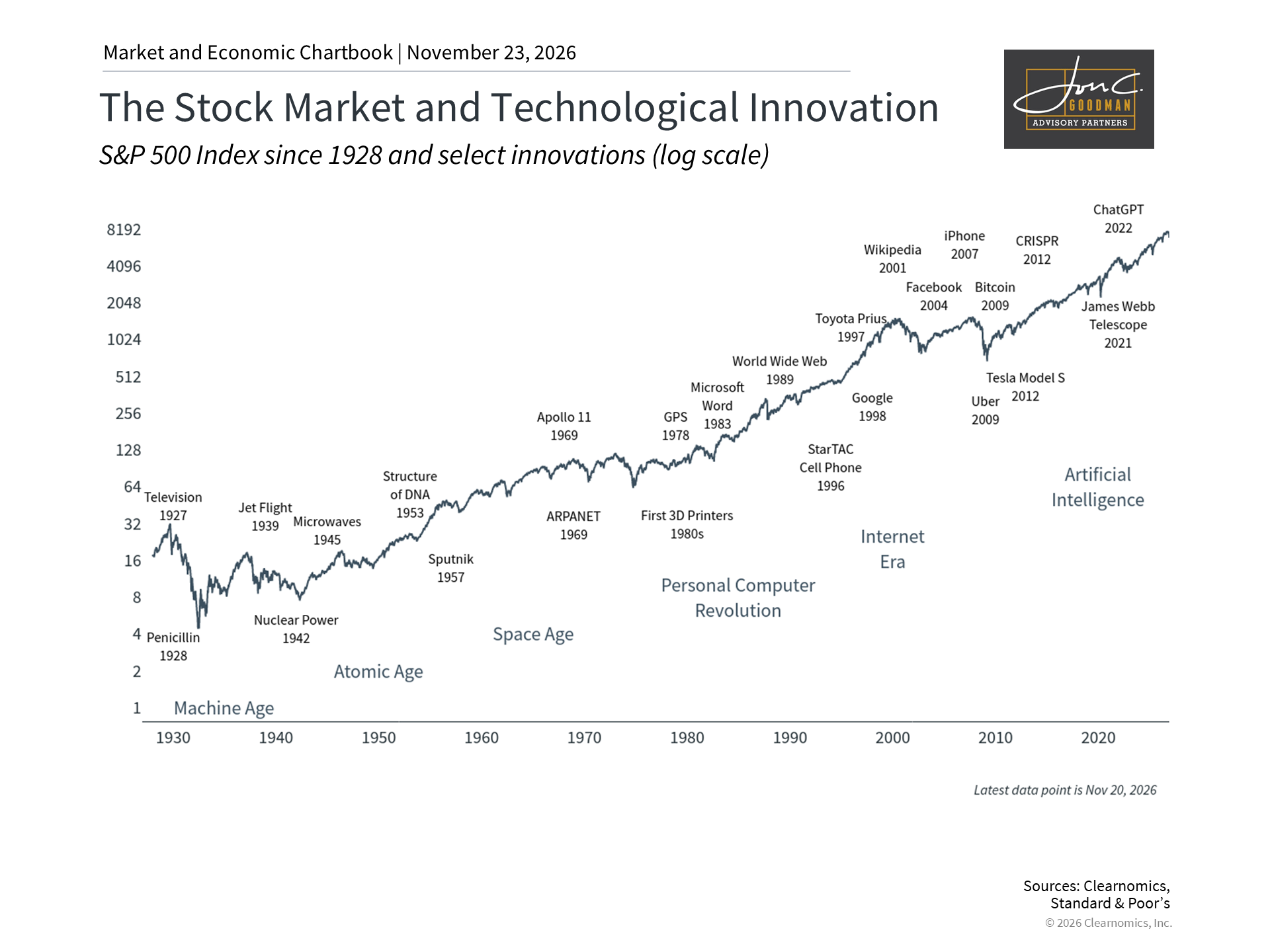
The chart above illustrates that each major wave of innovation over the past century was accompanied by both enthusiasm and uncertainty, yet equity markets have risen steadily as new technologies were absorbed into the broader economy. What ultimately mattered was not which companies captured the most attention in the early stages, but whether new technologies fundamentally changed how businesses operated and how people lived their daily lives.
The dot-com era offers a valuable point of comparison. While that period is often associated with the many unprofitable companies that failed, it also produced substantial infrastructure investment. Beginning in the late 1990s, telecommunications companies laid millions of miles of fiber optic cable in anticipation of rapidly growing internet traffic. Much of that capacity went unused at first, and some of the companies that overexpanded ultimately failed, in part because they never achieved profitability. However, the network they built became the foundation for technologies that are now woven into everyday life, including streaming video, cloud computing, smartphones, new digital services, and the always-connected economy that underpins many industries today.
Whether today’s AI investments will follow a similar trajectory remains the open question at the center of current market uncertainty. While data center construction and chip development have contributed meaningfully to economic growth and corporate profits, it may take time before the full benefits and costs to businesses and consumers become clear, beyond relatively straightforward applications such as chatbots and web search. Likewise, the longer-term effects on employment, productivity, inflation, and other factors that shape the lives of everyday individuals are still unfolding.
For long-term investors, Anthropic’s recent IPO is also a signal that the AI market is reaching a new level of maturity. One notable benefit of companies going public is that it expands access to a wider group of investors over time. Companies listed on the Nasdaq exchange, for example, are added to the Nasdaq Composite Index and may eventually be included in broad market indices such as the S&P 500, based on established eligibility criteria. This means that diversified investors can naturally gain exposure to these companies as they grow, without the need to make individual stock selections.
Volatility can create long-term opportunities
During bull market cycles, investors often wish they could access lower prices and more attractive valuations. Yet when those opportunities do arise, they typically come during periods of heightened uncertainty that make it difficult for investors to act. This is why it is important to think about market swings not through the lens of market timing, but rather through the lens of portfolio balance, grounded in financial planning and long-term investment objectives.
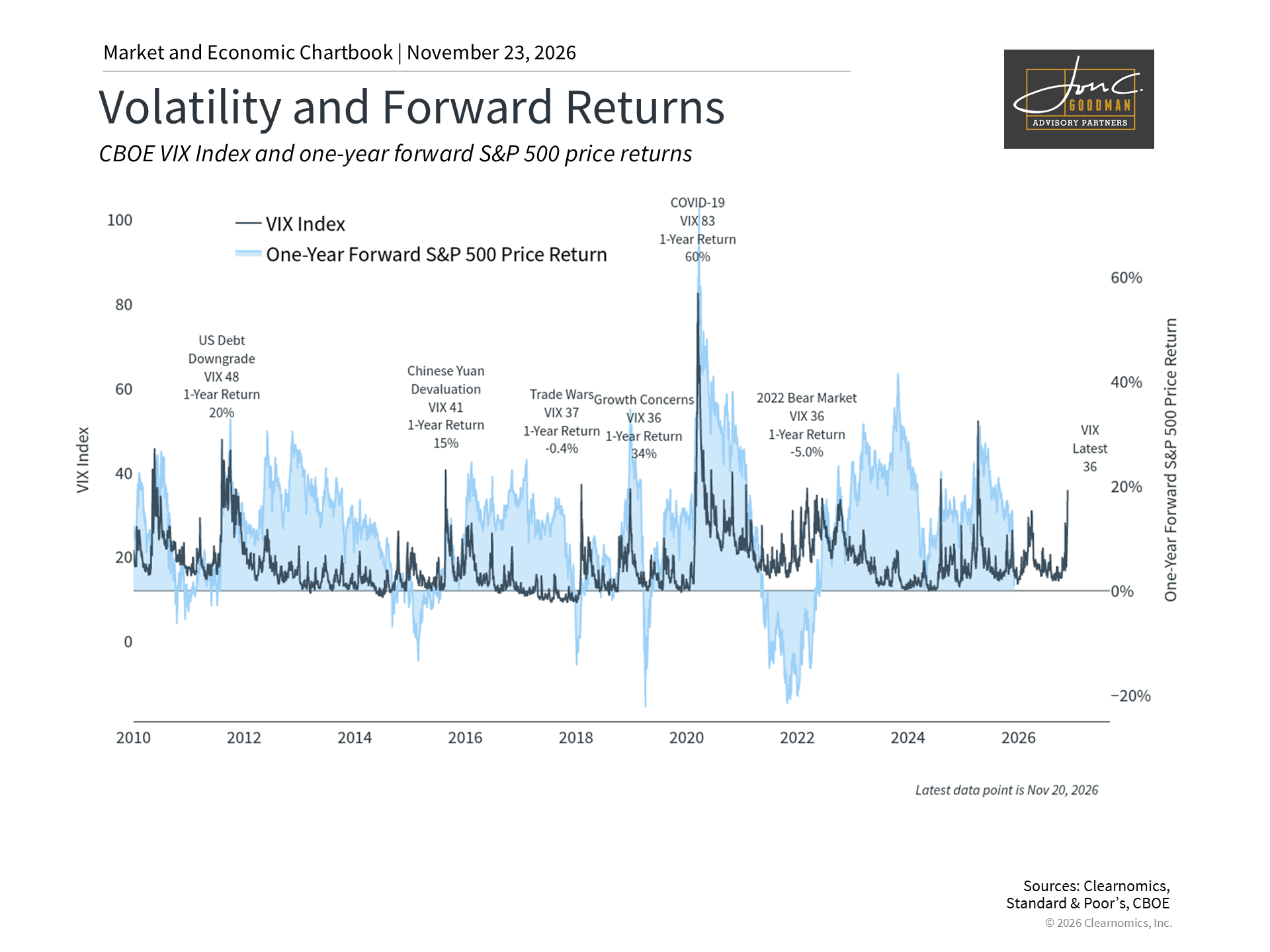
As the accompanying chart illustrates, periods when the CBOE Volatility Index (VIX), a measure of stock market volatility, has historically been elevated have tended to correspond with healthy returns over the following year.11 This pattern holds even though these are precisely the moments when some investors grow concerned and may seek the relative safety of cash. The evidence for this relationship spans dozens of examples from just the past few years alone.
Periods of volatility can also open up financial planning opportunities. With year-end approaching, for instance, tax-loss harvesting allows investors with taxable accounts to realize losses that can be used to offset gains elsewhere, subject to applicable rules such as the wash-sale rule, which prevents investors from acquiring the same or a “substantially identical” security within 30 days before or after the sale.12 Strategies like these can add value regardless of near-term market direction. Viewing market movements through this planning-oriented lens can be far more impactful than focusing on what any individual stock might do next.
The bottom line? AI-related volatility has introduced near-term uncertainty, but corrections and recoveries are a normal feature of investing. The long-term potential of AI, already evident in recent mathematical breakthroughs, reinforces the value of maintaining a patient and balanced portfolio aligned with long-term financial goals.
References
- Clearnomics research using Standard and Poor’s, Dow Jones, and Nasdaq data, as of November 20, 2026
- https://nvidianews.nvidia.com/news/nvidia-board-reinstates-jensen-huang-as-president-ceo-and-board-director
- https://www.claymath.org/millennium/riemann-hypothesis/
- Clearnomics research using Standard and Poor’s, Dow Jones, and Nasdaq data, from the market peak on October 6 to November 20, 2026
- Clearnomics research using Nvidia stock price and Standard and Poor’s and Nasdaq data, as of November 20, 2026
- Clearnomics research using Nasdaq data, from June 2, 2026 to July 29, 2026
- Clearnomics research using Nasdaq data, from July 29, 2026 to October 6, 2026
- Clearnomics research using Nasdaq data, from October 29, 2025 to March 27, 2026
- Clearnomics research using Standard and Poor’s data, as of November 20, 2026
- The modern design of the S&P 500 stock index was first launched in 1957. Performance prior to 1957 incorporates the performance of the predecessor index, the S&P 90.
- Clearnomics research using Standard and Poor’s and CBOE data, as of November 20, 2026
- https://www.irs.gov/pub/irs-pdf/i1040sd.pdf

Wellness Navigator
Thanksgiving is my favorite holiday. There’s less pressure than the others. During my years out West, far from my family in Maine, friends became family and it was always an open-door occasion. Food is my love language. Cooking, sharing and gathering around the table mean the world to me.
In My Kitchen
Some of my best memories are of cooking Thanksgiving dinner with my daughter, Sage. Together we’ve created traditions of our own. We prep the day ahead, and that evening becomes the fun part, with our playlist on. My kitchen is my happy place, and it turns out it’s good for brain health too. Music, laughter and time with the people closest to us all nourish the brain. So much so that we are going to do a cookbook together!
The Science of Gratitude
So does gratitude. The thoughts you repeat become the pathways you strengthen. When researchers scan the brain of someone feeling thankful, the areas tied to reward and connection light up. In one study, people who wrote gratitude letters for a few weeks were still getting that boost three months later. Over time, the habit is linked to lower stress, better sleep and a steadier mood, even when the holidays get busy.
Try This Thanksgiving Week
Before you pick up your phone in the morning, take a few minutes for yourself. When you start with email, news or social media, your brain begins in reaction mode, answering everyone else’s demands. Gratitude first lets you set the tone instead. Say this out loud or to yourself: “Today is going to be a great day. I’ve handled hard things before, and I can handle what today brings.”
Then name three gratitudes. One thing you’re looking forward to. Someone you’re grateful for and why. Something you appreciate about yourself.
Pair it with something you already do, like starting the coffee. You’ll find the whole practice in my Gratitude Ritual, inspired by Dr. Amen.
It doesn’t have to be November to give thanks. Build it into your routine all year round and watch your brain rewire itself to look for the good, bringing more calm, connection and joy.
However you gather this year, I hope your home is full of good food and the people who matter most to you. I’m grateful for you. What are you most grateful for this year? Hit reply and tell me.
Be well,

Christine Despres, RN, NBC-HWC, CDP
Brain & Metabolic Health Coach
P.S. Get back on your game after the holidays. The 5-Day Brain Fog Reset opens January 9. The Early Bird price of $67 ends November 30. Get the details here.